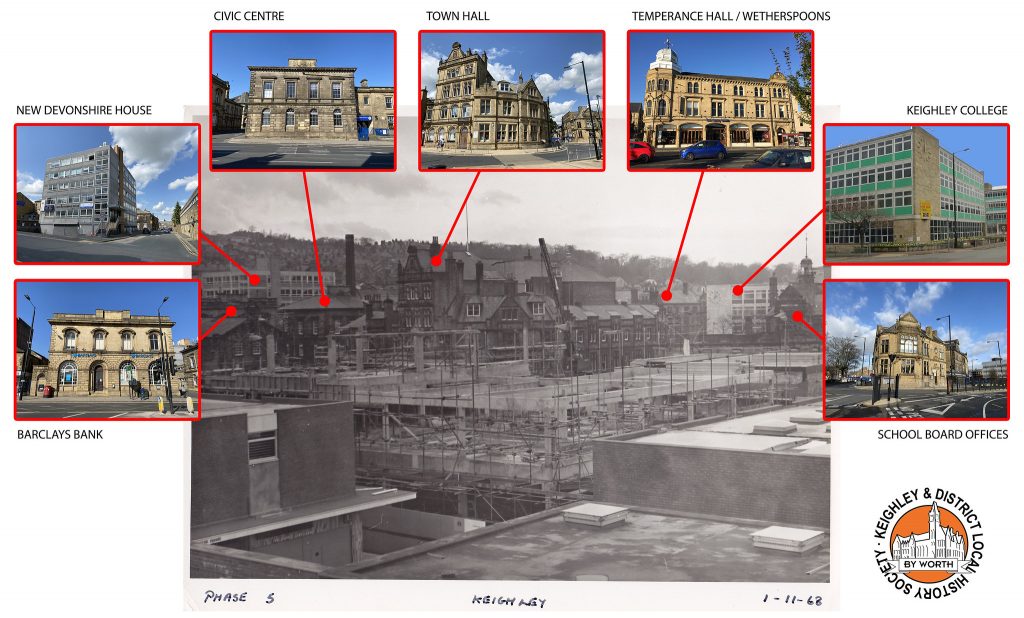
The main black and white photograph was taken near the end of the 1960s transformation of Keighley town centre on 1st November 1969. It was taken by Robert Long as part of a project to record progress on the restructuring.
Bob Long, writing on Facebook in 2021: “I took this photo of the town centre re-development. There should be about 200 photos in all, but I haven’t got a clue where they would be now [the History Society has over 50 of them]. They were taken for Seymour & Harris architects in London. This was a three year contract I had with them, from foundations to finished shop fronts. I was just starting my photographic business. A friend of mine, a Mr Bill Cusker, was the site supervisor for Token Construction Company and got me the job of photographing the redevelopment site. I had to climb up scaffolding onto top of the rooves to get the best shot required. The contract was to take photographs once a month to show the progress of the construction for the architects. I did this for about two years until the shops were ready for occupancy.”
The development saw the flattening of buildings on Cooke Lane, College Street, Adelaide Street, Queen Street and Brunswick Street. In their place was built the new shopping precinct. Work started around 1965 and took almost five years to complete. The photograph was taken near the end of the work and is looking out over what was Cook Lane towards North Street. You can see many of Keighley’s prominent buildings in the background and most of these are still standing today over fifty years later.
Barclays Bank (photographed by Tim Neal in 2021) at 77 North Street. It was built around 1900 to serve as Cravens Bank and became Martins Bank from the 1920s until the end of the 1960s. It was designated as a Grade II listed building in 1986.
New Devonshire House (photographed by Tim Neal in 2021) at the junction of Scott Street with Devonshire Street. This was built on the site of the Devonshire Street Congregational Church which had had to be demolished due to infrastructure faults in 1964.
Civic Centre (photographed by Tim Neal in 2021) at 81 North Street. Built in the late 19th century, The building previously housed the town’s police station. It was designated as a Grade II listed building in 1986.
Town Hall (photographed by Tim Neal in 2021) on Bow Street. Built as the Town Hall and Post Office in 1900 and officially opened in 1902. It was designated as a Grade II listed building in 1986.
Wetherspoons (photographed by Tim Neal in 2019) at 89-97 North Street. The building was originally built as the Temperance Hall for Keighley Temperance Society, founded in 1825, dedicated to abstinence from alcohol. It was built in the 1890s. The building was sold in 1970 and a charitable trust was established, which distributed funds from the sale up until 2018. It opened as a Wetherspoon’s pub in 2004, ironically named The Livery Rooms (the livery stables were actually the building next door, now the pub’s ‘garden’). It was also designated as a Grade II listed building in 1986.
Keighley College (photographed by David Seeley in 2014) at the junction of North Street and Cavendish Street. When the black and white photograph was taken this was a very new building, having been built on the site of the Mechanics’ Institute which had been badly damaged by a fire in 1962 and was demolished in 1967. By 2010 the college building was out of use and was itself demolished by 2018, leaving the grassed area currently running alongside North Street.
The School Board Offices (photographed by Tim Neal in 2022) at 1 Lawkholme Crescent were built in the 1890s. They were designed by designed by James Lechingham of Bradford after a competition to win the commission. Since August 2009 the building has been the Buddha Land Kadampa Buddhist Centre. It was designated as a Grade II listed building in 1991.