The History Society wishes everyone a Merry Christmas. We have made available our latest newsletter for everyone. Usually this is one of the perks of being a paid-up member, but hey, it’s Christmas!
The newsletter comes out four times a year and is between 12 and 20 pages of articles and news about the society. This edition has articles on a stage production of Jane Eyre, the Big Freeze of winter 1963, a KAODS production of the musical Sybil, news about the anniversary of St. John’s Church in Ingrow, an interview with society member and former town mayor Graham Mitchell, and a list of guest speakers and events for 2023.
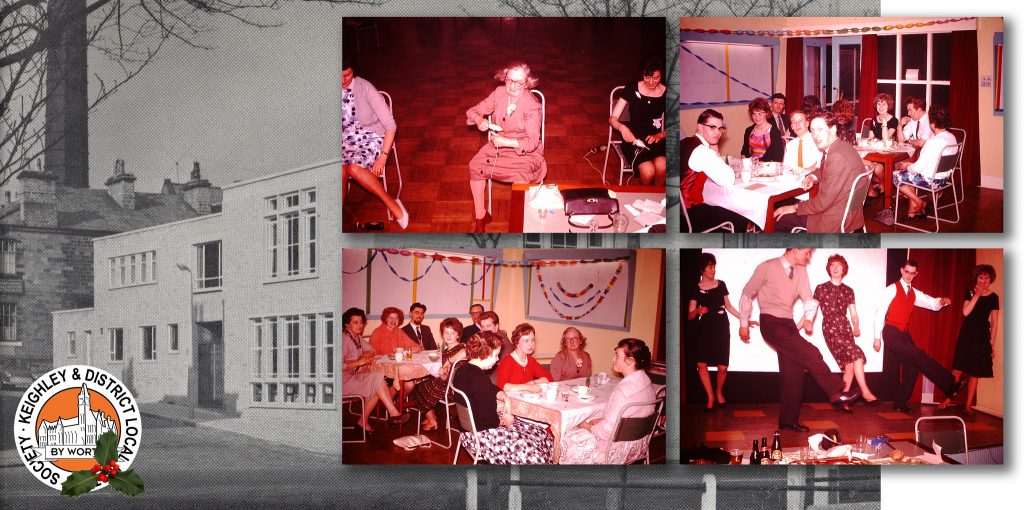
Members of Keighley Library staff enjoy themselves at their work Christmas party in December 1962. The party was held in the lecture hall, part of the new extension to the library. Those attending included Chief Librarian Fred Taylor and Mrs Taylor, Margaret Allsopp, Dorothy Beckwith, Betty Cardwell, Stewart Cardwell, John Cox, Nancy Crick, Michael Davison, Ian Dewhirst, Sally Hudson, Janet Kennedy, Dorothy Major, Doreen Nolan, and Barbara Watson.
All of the images are part of the John Normington Collection, donated to Keighley and District Local History Society by John’s daughter Liz Hornby in 2021.
John Normington was born in Keighley on 26th May 1929 and grew up in the Exley Head area of the town. He was joined by younger brother William five years later. John attended Ingrow Primary School and later won a scholarship for Keighley Boys’ Grammar School. His interest in music started with playing the drums at the age of six, then swapping to take up the piano.
His first job was at Keighley Library, where he remained (except for a break for National Service in 1947-49) until taking early retirement in March 1984. He was made Chief Assistant (Deputy) in 1953 having studied at the Leeds School of Librarianship. He ultimately became a lecturer himself in Cataloguing and Classification. He worked alongside local historian Ian Dewhirst for many years. Six months after he retired from Keighley Library in 1984, he took up the part-time role of Library Assistant at South Craven School.
One of his passions beyond the library was his music, and in performing. In the 1940s and 1950s he both acted with and played the drums for the Ingrow St. John’s Parish Church Players. Later he played the piano (and occasionally the drums) for Keighley Amateurs (of which he was a member for 72 years). Utilising his musical skills, he joined the Good Time Jazz Band in 1978. Another passion was potholing, having been introduced to it in the late 1940s, and he joined the Craven Pothole Club in 1952. He served as President of the Club in 1982 and as treasurer from 1984 to 1992. He was also a member of the 40 Club, the Grafton Club and Haworth Round Table. John died on 11th January 2020 at the age of 90.
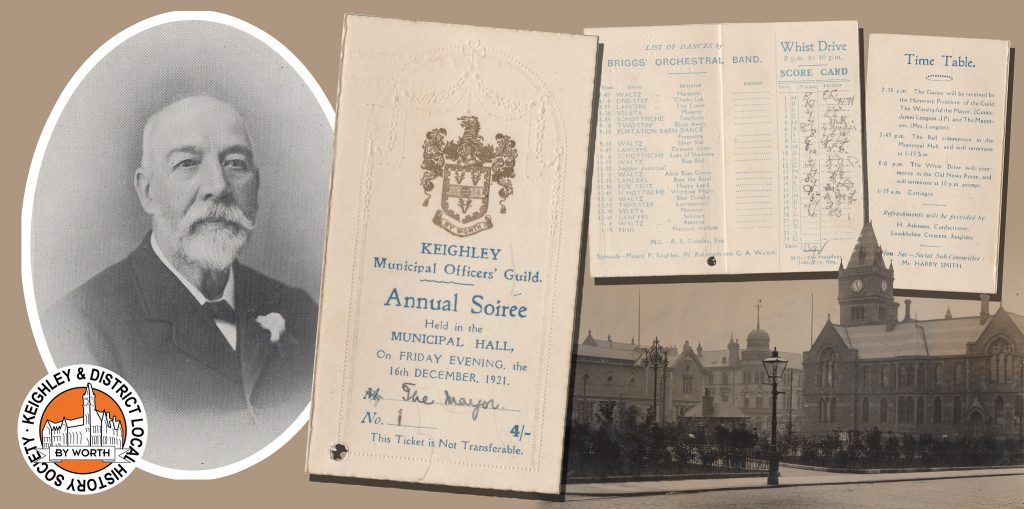
The Keighley Municipal Officers’ Guild held their Annual Soiree in the Municipal Hall on the evening of Friday 16th December 1921. The guest with ticket number one was the Mayor of Keighley, Mr James Longton, who served as Honorary President of the Guild.
Longton had been a member of Keighley Town Council since 1911. He was born in Withnell, near Chorley, in 1854. He served as Headmaster at Eastwood School in Keighley from 1881 to 1911 when he retired. He was Chairman of the Keighley Education Committee at the time he was made Mayor. He died on 4th July 1925.
The soiree commenced at 7.30pm with guests arriving to be greeted by the Mayor and Mayoress, Mrs Longton. The Ball began at 7.45pm with music provided by the Briggs’ Orchestral Band playing a selection of waltzes, lancers, two-steps and others (including a Flirtation Barn Dance!). A whist drive took place in the Old News Room from 8pm, and it appears from his dance card that the Mayor spent most of the evening playing whist. Refreshments for the evening were provided by H. Atkinson, a confectioner based on Lawkholme Crescent.
The portrait of the Mayor was taken by W. Bruce Johnston. The ticket is part of an archive relating to the mayoral year of James Longton, purchased by the History Society in 2022. The picture of Town Hall Square circa 1920 is from a postcard donated by Liz Hornby. Researched and collated by Tim Neal.
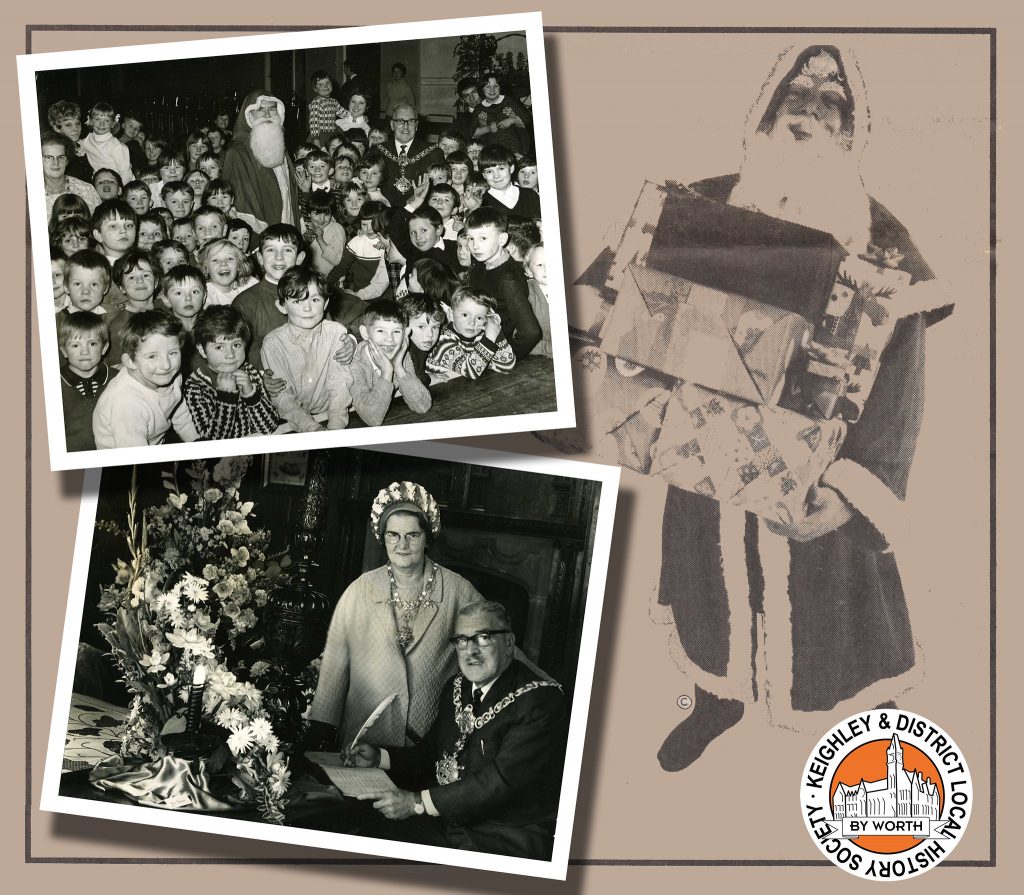
Father Christmas visits lots of Keighley children courtesy of the Mayor of Keighley, Alderman James Henry (‘Harry’) Waterworth, at a Christmas party held in Victoria Hall on Saturday 14th December 1968. The Mayor can be seen in his mayoral chain in the right half of the top picture. The Mayoress, Harry’s wife Harriet, is on the left edge of the picture, in the glasses. The top photograph was featured in the Keighley News of Saturday 21st December 1968.
Harry Waterworth was installed as Mayor on Tuesday 21st May 1968, with his wife Harriet Anne Waterworth made Mayoress. His Deputy Mayor and Mayoress were Councillor G. W. Lilley and his wife. Harry stayed in post for a year, which was the normal term of duty for the mayor.
Digital copies of the press photographs were donated to Keighley and District Local History Society by Daniel Waterworth (grandson of Harry Waterworth) in 2020.
Final reminder that it is our last meeting of 2022 this Wednesday (14th December). The meetings are held upstairs in Keighley Library, doors open at 7pm and the meeting starts at 7.30pm. The meeting is open to members of the public as well as History Society members. Entry is free to paid-up members and £3 for non-members.
This is our Christmas meeting so it is a bit more informal. There will be the chance to look through some of the items we have had donated in 2022, we will hear from Steve about Christmas in Keighley in 1922, and there will be a quiz about some of the vanished buildings in Keighley – along with a mince pie.
Paid-up History Society members will have received details of how to join the meeting via Zoom if they prefer (don’t forget to print out your map for the quiz!).
This is the last chance to pay for 2023 membership in person at the 2022 rate (£10 for one person or £15 for two people at the same address). You can also join online by GenFair but there is an additional admin fee for that method. The new rates start from 1st January 2023.
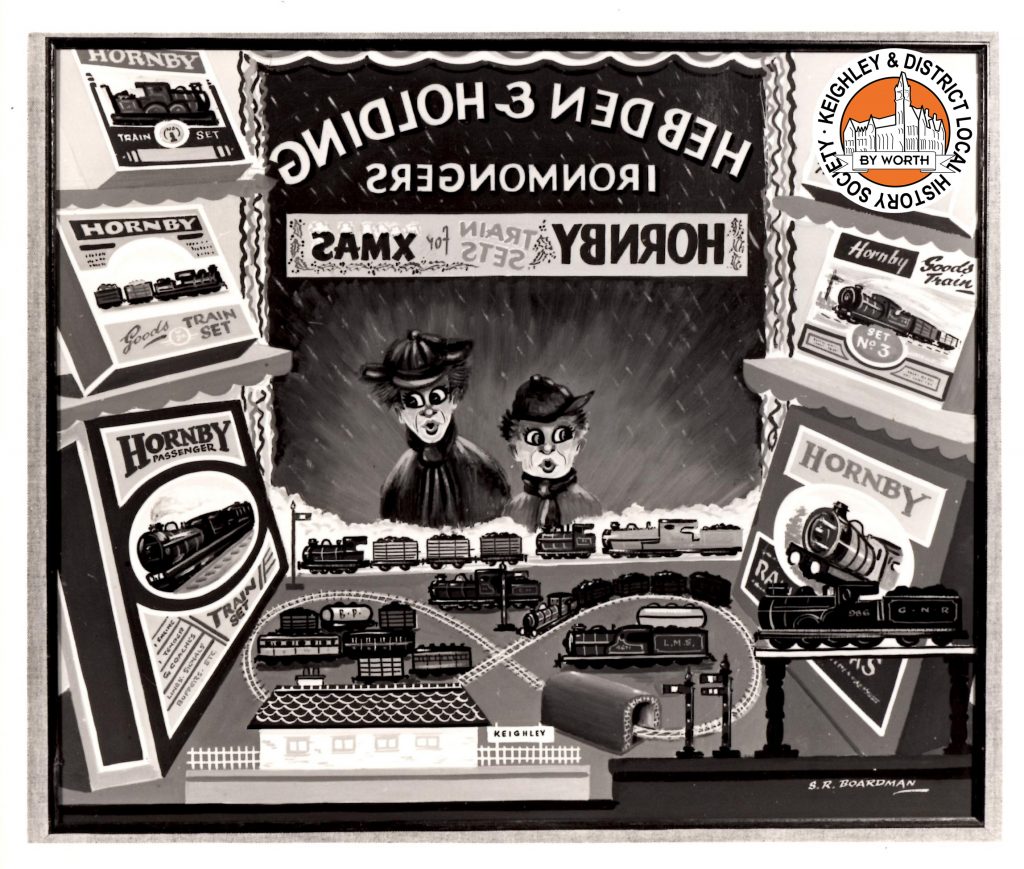
Christmas scene featuring 1920’s Boy, painted by Stanley R. Boardman (1915-1996).
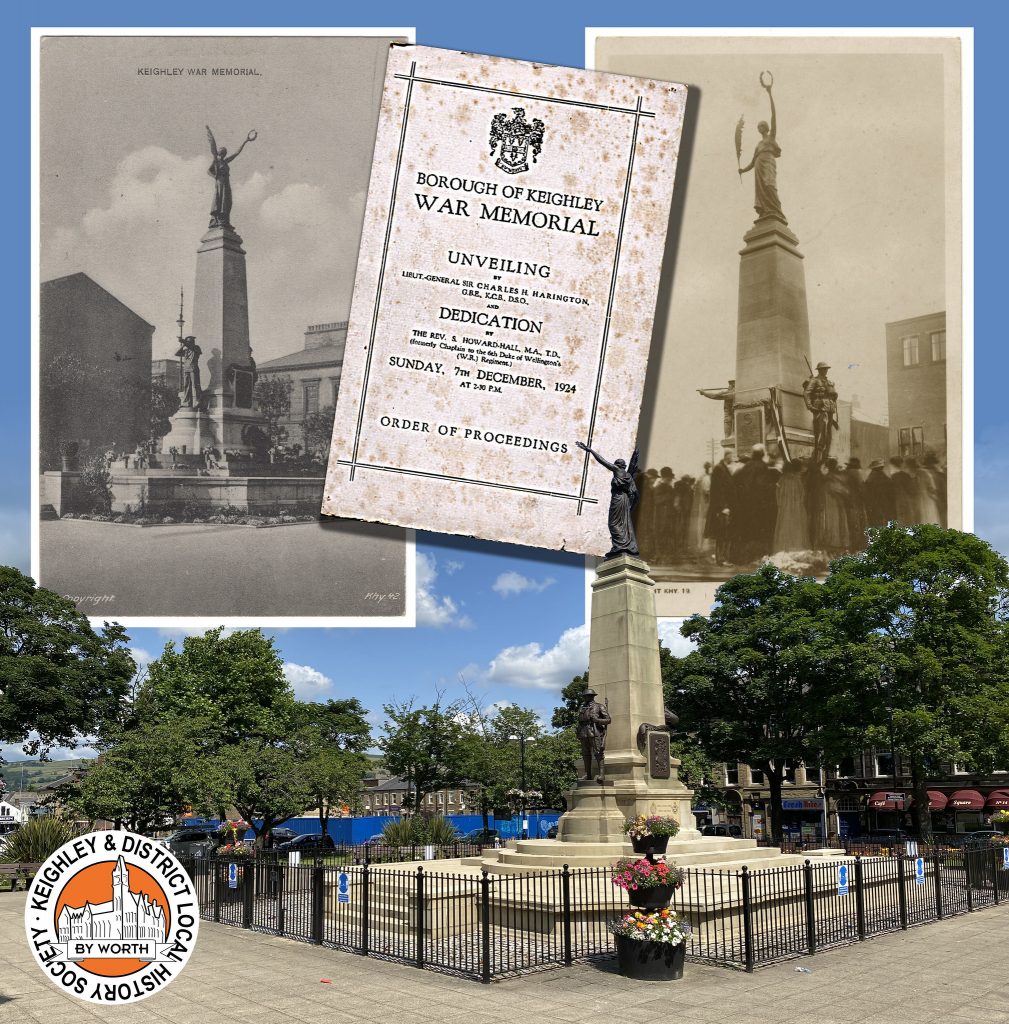
The War Memorial in Town Hall Square was officially unveiled on Sunday 7th December 1924, having been paid for by public subscription. The unveiling was conducted by Lieutenant-General Sir Charles H. Harington while the dedication was conducted by the Reverend S. Howard-Hall, former chaplain of the 6th Battalion of the Duke of Wellington’s Regiment (West Riding) in which many Keighley men had served. The plinth is topped by the figure of an angel holding a wreath aloft, while statues of a soldier and a sailor stand either side. The sculptor was Henry Charles Fehr (1867-1940) and the bronze statues were cast by J.W. Singer & Sons Ltd.
The area that is now the site of Town Hall Square used to a builders’ yard for Keighley Borough Council at the end of the nineteenth century. The area was boarded off from the surrounding streets by advertising hoarding. In the early 1900s, the area behind the Town Hall and bordered by Cooke Street, Cavendish Street and North Street became a civic space, with open walkways, seating and attractive flower beds. On many occasions in the past 100 years or so, the Square has acted as a focal point for people to gather, in celebration, in remembrance or in protest.
The war memorial originally commemorated those serving in the armed forces who died in the First World War (1914-1918), and then later those killed in the Second World War (1939-1945). The memorial was rededicated in January 2000, to the service people killed in all twentieth century wars. From 4th December 1986, the war memorial has been recognised by Historic England as a Grade II listed site “as an eloquent testament to the tragic impact of world events on the local community, and the sacrifice it made in the conflicts of the twentieth century”. The site is also included in the Imperial War Museum database of war memorials.
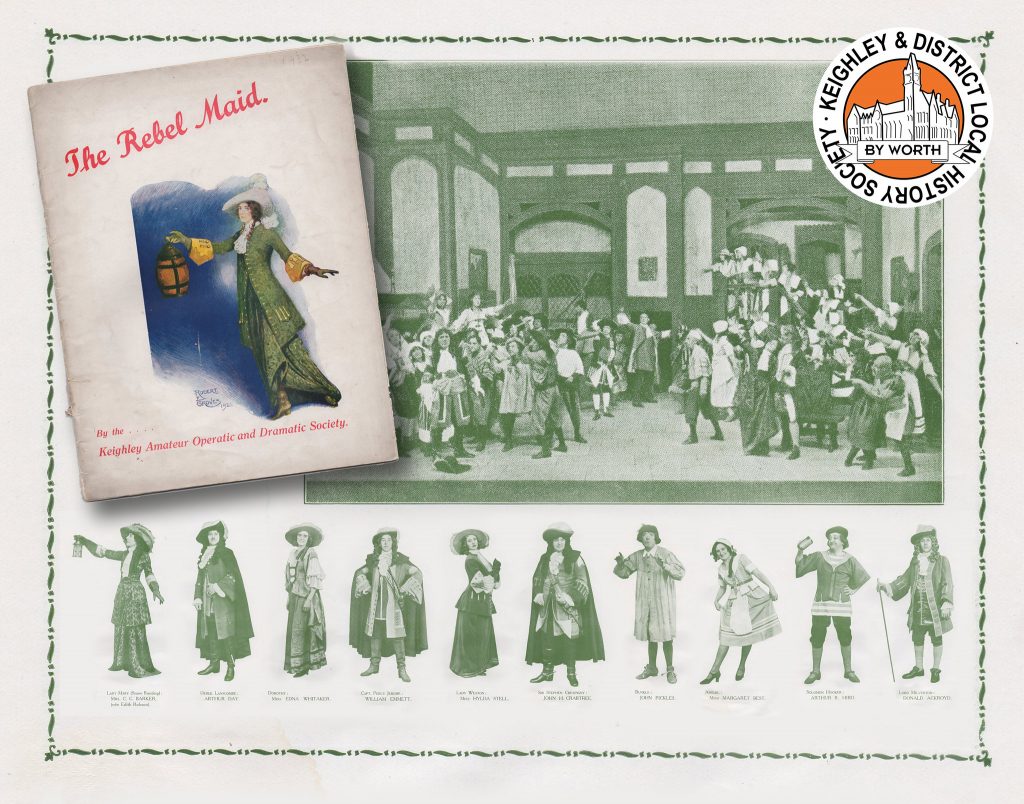
Keighley Amateur Operatic and Dramatic Society’s production of “The Rebel Maid” played at the Hippodrome Theatre in Keighley for six nights from Monday 5th December 1932. The romantic light opera was written by Alexander M. Thompson, with lyrics by Gerald Dalton and music by Montague F. Phillips. Dalton and Phillips had actually created the opera while serving in the Royal Naval Volunteer Reserve during the First World War. The musical director was Joseph Harker, while the producer was Herbert Coates. KAODS had first performed “The Rebel Maid” ten years earlier in 1922.
The story is set in the autumn of 1688 and centres around the rebellion against the Stuart dynasty, in the form of King James II, led by Prince William of Orange (played by local photographer W. Bruce Johnston). The action takes place in the mansion of Lord Milverton (played by Donald Ackroyd) on the coast of Devon, the local inn ‘The Jolly Fishers’ and the village green. Amongst the plots and counter-plots is a romance between Derek Lanscombe (Arthur Day) and Lady Mary Trefusis (Edith Robson, who had played the role for KAODS in 1922), who’s secret identity is ‘Snow Bunting’ a.k.a. the Rebel Maid. The production also starred John H. Crabtree, William Emmett, John Pickles, Arthur B. Hird, Albert E. Shepherd, Norman Boyes, Hylda Stell, Margaret Best, Edna Whitaker, Mabel Feather and Phyllis Turner.
The 40-page programme was printed by The Keighley Printers Ltd. of High Street, Keighley. The programme was part of an anonymous donation given in 2022. The photo montage was created by Tim Neal in 2022.
The History Society’s Christmas Meeting is on Wednesday 14th December. It will be held upstairs in Keighley Library, doors open at 7pm and the meeting starts at 7.30pm.
This is our usual Christmas meeting, so rather than a guest speaker there will be the chance to see some of the acquisitions we have made over the last 12 months, to hear about Christmas in Keighley 100 years ago, to take part in a just-for-fun quiz – and to have a mince pie!
Entry is free for paid-up members of the Society and guests can come along for £3 (payable on the door). This is also the last chance to join the Society or renew your membership at the 2022 rate (£10 for a single person, £15 for two people at the same address), before the prices go up (to £15/£20) from 1st January.
Christmas scene featuring 1920’s Boy, painted by Stanley R. Boardman (1915-1996).
Two events of local interest are happening in the next few days…
Firstly, Keighley Local Studies Library is launching a new town trail this Saturday (3rd December). The trail guides people around the town pointing out various landmarks that the Brontës would recognise. History Society members Eddie Kelly and Gina Birdsall have been involved in its creation. To celebrate the launch, Irene Lofthouse (who spoke to the Society earlier this year) is leading a guided tour around the town. There are still some spaces available on the tour and these can be booked by telephoning Keighley Library on 01535 618215.
Secondly, and slightly further afield, friend of the Society Sharon Wright (who spoke this year on balloonist Lily Cove and is booked to speak again next year) is speaking at Woodhouse Grove School near Apperley Bridge on 6th December. Tickets available via the school’s website.
Keighley Amateur Operatic and Dramatic Society’s production of “Florodora” played at the Hippodrome Theatre in Keighley for six nights (and a Saturday matinee) from Monday 22nd November 1926. The comic opera had music by Leslie Stuart, a libretto by Owen Hall, and lyrics by E. Boyd Jones and Paul Rubens. The KAODS production was produced and directed by G. Edward Hall, with musical director Joseph Harker.
The story takes place on the paradise-like island of Florodora and then in the Welsh castle of Abercoed. It involves an unscrupulous American Cyrus W. Gilfain (played by Arthur B. Hird) who now claims to own Florodora and has “distilled” its rare essence for exploitation purposes. The rightful owner of the island has died, and his surviving daughter Dolores (Edith Robson) is unaware of her inheritance. The Englishman handling Gilfain’s distillation process is Frank Abercoed (Arthur G. Ramsden) who has fallen in love with Dolores. Her true identity is discovered by ‘Professor’ Anthony Tweedlepunch (Ernest Marsden) with whom she then mysteriously disappears. All the characters then reassemble at Gilfain’s purchased family seat at Abercoed Castle and after much subterfuge everyone is partnered off appropriately and the secret of the island is maintained.
The show also starred Jack Crabtree, Louis G. Bacon, Alan Petty, Allan Potter, Edward Caswell, Leonard Jackson, Clarence Haigh, Jack Steele, Hilda Mitchell, Eva Robson, Mabel Feather, Elsie Butterfield, Mrs M. Asquith, Ethel Smith, Evie M. Carr, Peggy Eaton, Nellie Hardwick, Stella Dewhirst, Claire Mitchell, Elsie Pickles, Sallie Corban, Mrs John Spencer and Mrs Percy Taylor.
The cast photographs shown here were taken by Keighley-based professional photographer W. Bruce Johnston and feature in the 52-page programme for the production. The programme was part of an anonymous donation given in 2022. It can be viewed in full on the History Society’s Flickr site.