Morecambe Talk This Month

A reminder that this month’s meeting is upstairs at the Library on Wednesday 8th March. The meeting will be writer and researcher Pam Brook giving a talk entitled “Morecambe: Beauty Surrounds, Health Abounds.” The title is taken from the motto used by the town in its heraldic crest. The seaside resort has always been a popular destination for the residents of Keighley, as it is within easy reach courtesy of the direct rail line between both towns.

Pam says: “Between 1930 and 1938, 180 lidos were built in Britain to support the health and fitness of the nation. Sunshine and heliotherapy were all the rage and knitwear manufacturers competed to produce the most streamlined knitted swimming costumes. Morecambe’s Super Swimming Stadium opened in July 1936 and provided high diving, entertainment, displays and beauty competitions until its closure in the 1970s. My talk charts the pool and the bathing costume from the interwar period to the decline of Miss Great Britain.”

A limited number of copies of “In The Swim: Morecambe’s super swimming stadium” by Barry and Lesley Guise, to which Pam contributed, will be available on the night. The book costs £18 and is cash only if you are interested.

The meeting is on Wednesday 8th March at Keighley Library. Doors open at 7pm. Anyone is welcome to attend. It costs £3.50 to attend, unless you have joined the History Society (entry is free for members). Members can also choose to attend via Zoom if they prefer. You can join the History Society on the evening, membership costs £15 and covers the rest of this year.

Future talks include Graham Mitchell talking about life working on the buses in Keighley in the 1960s (12th April) and Andrew Heaton giving a talk on the Dockroyd graveyard project (10th May). For more details see the History Society’s website or Facebook pages.

Percy Taylor, 1871-1953

Percy Taylor, Managing Director of Timothy Taylor’s Brewery and former Chairman of the Committee for the Keighley Amateur Operatic and Dramatic Society, died on Saturday 28th February 1953.

He was born in 1871 to parents Timothy and Charlotte Taylor, who lived at Knowle Spring House. Timothy Taylor was the founder of Timothy Taylor’s Brewery. Percy Taylor lived his whole life at Knowle Spring House. The house had been built by his maternal grandfather, printer and publisher Robert Aked. The brewery was founded on Cook Lane in Keighley and operated from there throughout Timothy and Percy’s lifetimes.

Percy and his brother Robert Henry took over the running of the brewery following the death of their father in January 1898. They oversaw a considerable extension to the brewery in 1911. Robert died in 1931 but Percy continued as chairman until his death in 1953. According to ‘The Centenary Year of Timothy Taylor & Co. Ltd. (1858-1958)’: “Percy Taylor was an accomplished flautist, a good tennis player and chairman for many years of the Keighley Amateur Operatic and Dramatic Society.” His wife, also, was a musician and sang with the Amateurs.

He was a founder member of the Keighley Orchestral Society in 1898, took part in the formation of the Keighley Music Club and was involved with the Keighley Clef Club. According to the Keighley News of 7th March 1953: “Few people had done more for the advancement of music in the district or for the development of the amateur dramatic movement than Mr Taylor. He became associated with the Keighley Amateur Operatic and Dramatic Society on its re-formation in 1913, and held the chairmanship continuously for 23 years up to 1949. Much of the success of the Amateurs could be attributed to his enthusiasm and endeavour to give the public the best of shows. In 1938 he received the long service silver medal of the National Operatic and Dramatic Society. Since he resigned the chairmanship of the Keighley society in 1949 he had continued to serve as a member of the permanent committee.” His loss was noted on a page in the programme for the Amateurs’ production of ‘The Dancing Years’ in November 1953.

Percy’s funeral took place on Tuesday 3rd March 1953 and a service was held at Keighley Parish Church, attended by his widow and his son John Aked Taylor, licensees from various pubs owned by the brewery, business associates, and representatives from Keighley Orchestral Society, Keighley Music Club, Keighley Amateurs, Keighley Conservative Association and Keighley Lawn Tennis Club. Knowle Spring House was sold following Percy’s death. The brewery was relocated from Cook Lane to Knowle Park in the second-half of the 1950s.

Images taken from ‘The Centenary Year of Timothy Taylor & Co. Ltd. (1858-1958)’ and the KAODS programmes for ‘Florodora’ (1926), ‘The Rebel Maid’ (1932) and ‘The Dancing Years’ (1953). Researched and collated by Tim Neal.

Percy Taylor, 1871-1953

New Vicar for St. John’s in 1968

The eleventh vicar of St. John’s, Reverend Martin Wells Bull, was inducted on 29th February 1968. The institution was performed by the Right Reverend Michael Parker, Bishop of Bradford. Rev. Bull had become an ordained priest in 1964. Immediately before his appointment at St. John’s, he had been the assistant curate at the United Benefice of All Saints’ Church in Horton, and before that he was assistant curate at Blackley near Manchester.

He arrived with his wife and two children (Priscilla and Timothy), but initially they had to live about a mile away from the church because the old vicarage had been demolished and a new one was still being built.

He inherited a church in much need of repair and his time in post oversaw repairs to the church tower and roof, rewiring and a new lighting system, and work on the churchyard.

Rev. Bull preached his last service at St. John’s on Sunday 9th April 1978. After the service there was a short presentation in which Rev. Bull was presented with a cheque for £210 as a thank you, and his wife was given a vase of flowering plants. He left to become the vicar of All Saints Church in Bingley.

Researched and collated by Tim Neal. Images courtesy of the St. John’s Church archive.

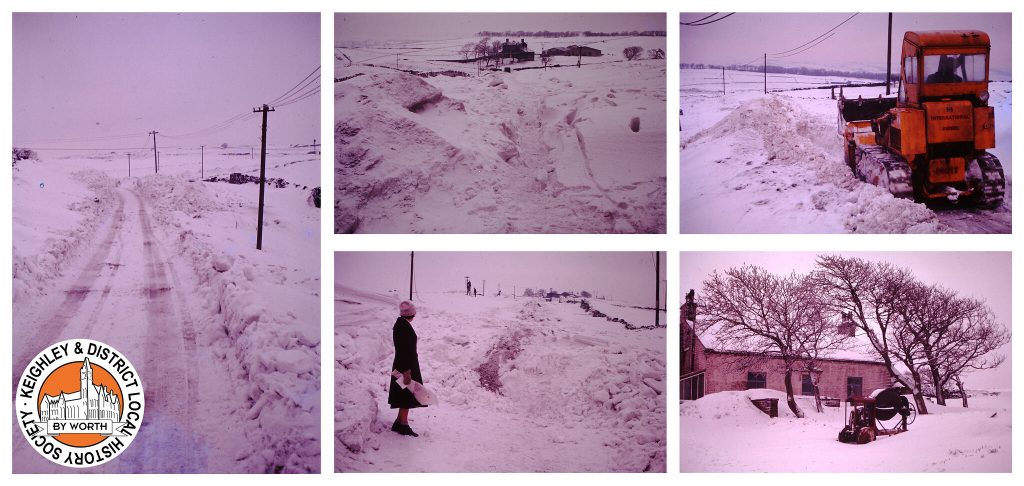
The Big Freeze of 60 Years Ago

The “Big Freeze” of the winter of 1962/63 saw weeks of freezing weather and several feet of snow that just seemed to go on and on.

Things were little better even by the middle of February. The Keighley News wrote on 16th February 1963: “With the weathermen having said on Wednesday night that the big thaw was confidently expected, it was a frustrating day for Keighley people on Thursday when heavy snow fell throughout the day – a similar experience to that of just a week earlier. The snow continued to fall yesterday and corporation workmen, obviously tired and jaded from weeks of snow clearing, were almost back where they started… Thursday’s big snowfall was a real set-back to these men. All week they had been engaged in the out-districts cutting out blocked-up roads… and now the new fall has filled in most of the cuttings.”

These pictures are from slides taken by John Normington around this time, in the area round the tarn and the back roads to Steeton and Glusburn. They were donated to the History Society by John’s daughter, Liz Hornby, in 2021.

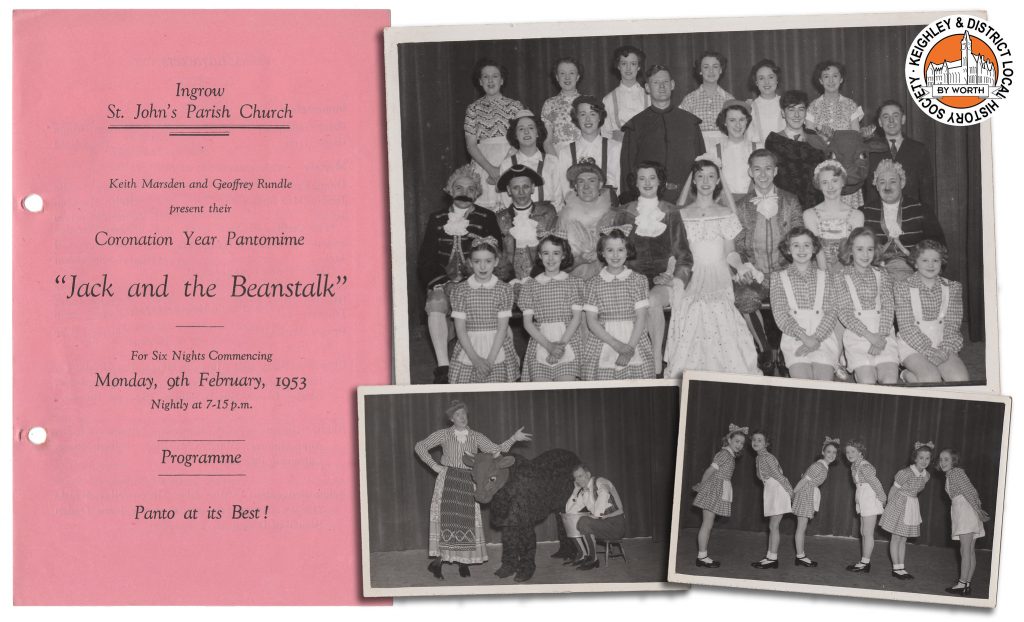
Jack and the Beanstalk, 1953

The third St. John’s Church annual pantomime produced by Keith Marsden and Geoffrey Rundle was announced in the Ingrow Parish Church Messenger of December 1952 as ‘Jack and the Beanstalk’. Rehearsals began after the church’s Christmas Fair with Margaret Shackleton playing the principal boy title character once more. Elsie Greenwell made her debut as the Squire’s daughter, Susan. Geoffrey played Dame Trot while Keith played that character’s son Jimmy. Stanley Peckover played Squire Grabbem and Shirley Lister played Prince Florizel. Victor Thompson concluded his trio of animal impersonations by playing one half of Jessie the cow, joined by Terry Marsden. The giant was played by Fred Kidd and his two henchmen (Blood and Thunder) were played by Derek Lund and William Bebb. This was the only one of the six pantomimes in which Joan Scott did not appear.

The show opened in the schoolroom on Monday 9th February 1953 and ran for six nights. It cost two shillings and six pence for adults and one shilling and six pence for children. Tickets were available in advance from Geoffrey’s father W. Rundle from his home on Caister Grove in Ingrow.

Press photographs were taken by the Keighley News and the paper’s review was published on closing night, Saturday 14th February 1953, and had this to say about the show: “The pantomime has fully lived up to the reputation set by the previous productions and with large audiences each evening this week it has been a distinct success. The pleasing back-cloths set off the bright and decorative costumes of the cast, while the subtle lighting effects and effects department each have a valuable contribution to make in enhancing the show. Topical scenes and comments gave an authentic up-to-date approach to the traditional pantomime fare while still retaining the age-old situations. Dame Trot’s cottage gives Keith and Geoffrey plenty of scope for laughs, and that scene in which a jet aeroplane is introduced are two of the highlights of the evening.”

Selling the majority of tickets in advance turned out to have been a financially fortuitous move because the week of the performances was hit by heavy snowfall, affecting the numbers able to attend. Those who did brave the elements were fully rewarded by the excellent entertainment and nearly £100 was raised.

The photographs and programme are all from the History Society archive on Flickr and were donated by Patsy Marsden (widow of Keith Marsden) and Liz Hornby (daughter of John Normington). Researched and compiled by Tim Neal.

Canal Talk Next Week

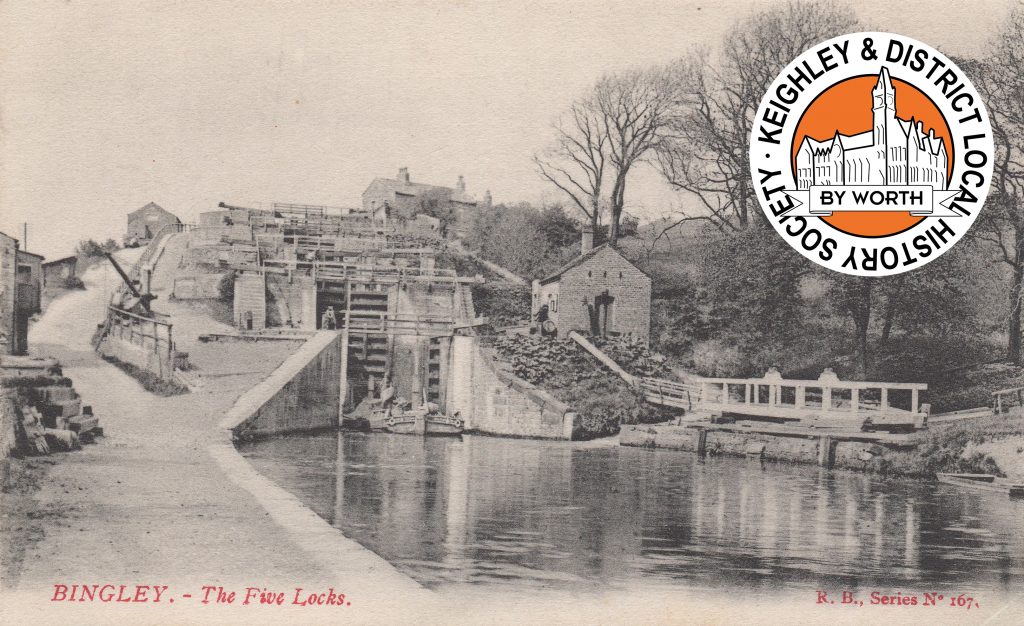
A reminder that this month’s guest speaker is Colin Thunhurst, of the Leeds & Liverpool Canal Society, giving a talk on the “The Local History of the Leeds & Liverpool Canal”.

Anyone is welcome to attend. The meeting is upstairs in Keighley Library on 8th February 2023. Doors open at 7pm and the meeting starts at 7.30pm. Admission is free to paid-up History Society members and £3.50 for non-members.

Paid-up members of the History Society also have the option to join this meeting via Zoom. Details are sent out to members a few days before the event is due to take place.

The Canal Society will also have a stall selling books and items that support the society. We can strongly recommend Mike Clarke’s comprehensive history of the canal!

Cavendish Street Postcard

Monday 1st February 1909

This “Colotint” postcard, produced by Raphael Tuck & Sons, shows Cavendish Street at the start of the twentieth century, and is postmarked 1st February 1909.

The Midland Railway goods office can be seen on right of the picture (now demolished and in its place the entrance to Sainsbury’s car park), the Victoria Hotel (still standing today) is on left. Further back on the right is the familiar parade of shops with its glass and iron canopy. Many of the buildings further back on the left were demolished as part of the 1960s redevelopment.

Addressed to Mr W. Pilkington, of Chorley in Lancashire, the card reads: “I am so glad you arrived home quite safely. I did enjoy myself when I was out with. Doris was so very pleased with the frame. Love to all, Amelia”. The back of the postcard includes a green half-penny stamp featuring the head of King Edward VII. Curiously though the card doesn’t seem to have been posted from Keighley.

Postcard from the personal collection of Keighley and District Local History Society member Tim Neal. The modern photograph of Cavendish Street was taken by Tim Neal in 2022.

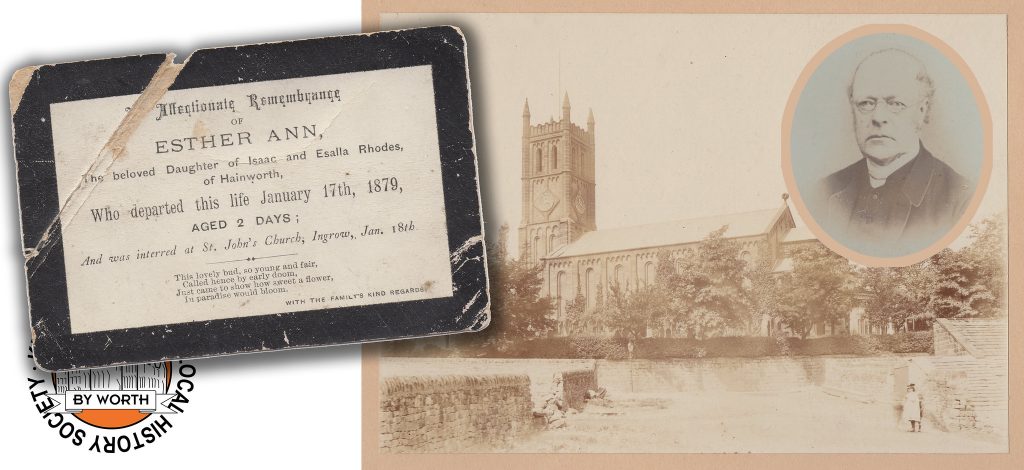
Esther Ann Rhodes, 1879

A small commemoration card for Esther Ann Rhodes, who died just two days old on Friday 17th January, 1879. She was born in Hainworth to father Isaac Rhodes and mother Isabella Rhodes (nee Towers). Esther Ann was interred at St John’s Church in Ingrow the following day.

The card carried a short poem: “This lovely bud, so young and fair, Called hence by early doom, Just came to show how sweet a flower, In paradise would bloom.”

The vicar in charge at St. John’s at the time was the Reverend Henry Weldy Marychurch, who was vicar from 1874 to 1882.

Esther had a twin sister, Susannah, who went on to marry William Henry Scattergood in 1905. They had two sons – Frank and Henry. Henry had two daughters – Coral and Jean.

The card was part of a collection brought along by Jean Battye (nee Scattergood) to a History Open Day held at St John’s Church on 3rd November 2019. The portrait of Rev. Marychurch and the photograph of the church are from the church’s archive.

The church of St. John’s is celebrating its 180th anniversary this year, with special services and a open-afternoon on 12th March 2023. Come along and discover more tales in connection with the church.

Rev. William Thompson Elliott

The Reverend William Thompson Elliott was formally inducted as the fifth vicar of St. John’s at the church itself on 9th February 1912. The officiating clergyman was the Venerable Archdeacon Francis Charles Kilner, assisted by the Reverend John Wood (curate of St. John’s) and the Reverend L. S. Robinson (rector of Keighley). Rev. Elliott had been serving as the vicar for Hainton-with-Sixhills in Lincolnshire, and had previously served as curate at Holy Trinity Church in Leeds and at St. Chad’s Church in Headingley. His father, the Reverend William Hayward Elliott, was Vicar of Bramhope. He was born on 15th November 1880 and was educated at Carlisle Grammar School and at Queen’s College, Oxford, from where he graduated with an M. A. in mathematics and history. He married Nora Walker and they had two sons and three daughters.

The church was closed in August 1913 for more redecorating and the installation of electric lights (the old gas light fittings went to Cullingworth Church). He was vicar of St. John’s at the outbreak of the First World War and was connected with local volunteers. Both the vicar and his curate, the Reverend Harry Francis Steel, were players with Ingrow Cricket Club (there wasn’t a church affiliated cricket team at this time). Reverend Elliott was also chaplain to the Keighley Branch of the Actors’ Church Union (including holding special services for the theatrical profession).

In December 1915, Rev. Elliott was offered the living of All Saints’ Church in Bradford. He preached his farewell sermon at St. John’s on Sunday 16th January 1916. He had served five years in the post. He became Canon and Sub-Dean of Liverpool Cathedral in 1924 and then Vicar and Rural Dean between 1926 and 1938. He was appointed Canon Residentiary of Westminster in 1938. He died suddenly of a heart attack on 20th June 1940 while visiting his wife in Streetly, near Birmingham. His ashes are buried in the vault in the lower Islip Chapel in Westminster Abbey.

His death was announced in the Keighley News of 22nd June 1940: “The death on Thursday, at the age of 60 (sic), of Canon W. Thompson Elliott, former Vicar of Leeds, who was Canon Residentiary of Westminster, has come as a great shock both to religious and lay life of the city, in which for 12 years his 6ft., broad-shouldered figure, broad smile, deep voice, and outspoken views had made him one of the most familiar and respected of men… He was a man of great intellectual ability who was always able to lighten his philosophy with a happy sense of humour which he could invariably make to fit the occasion.”

Portraits by Hall & Siggers, from the St. John’s Church archive. Researched and collated by Tim Neal.

Mayor William Smith

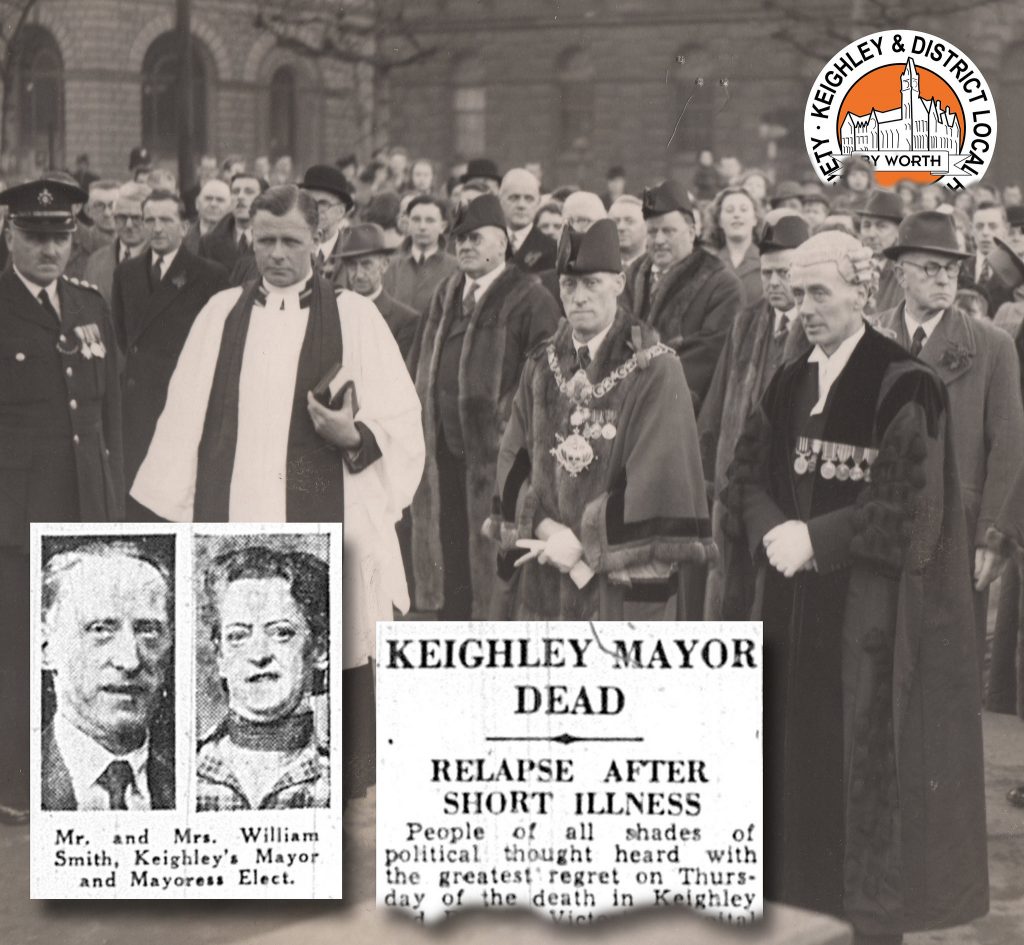
Mayor of Keighley, William Smith, died in Keighley and District Victoria Hospital on Thursday 10th January 1946, having served as Mayor for only two months. He’d been ill for a short period and had been admitted to Victoria Hospital before Christmas. Despite some signs of a recovery he died following a relapse. This was the first time one of the town’s mayors had died while in post. He was, according to the Keighley News, aged about 51. His funeral was held on 14th January 1946. It included a service at Keighley Parish church led jointly by the Reverend Eric Treacy, Rector of Keighley, and the Reverend Edward Askew John Miller, vicar of Ingrow St. John’s.

He commenced his time as Mayor on 9th November 1945 and his wife became Mayoress. His nomination to the post had been accepted back in July and was covered in the Keighley News of 21st July 1945: “Keighley’s next Mayor will be Mr. William Smith, of 207, Queen’s Road, Ingrow, whose nomination by the Labour members of the Town Council was accepted by the Mayoral Selection Committee on Monday. Mr. Smith is chairman of the Borough Labour Party, a former secretary of the Keighley Divisional Labour Party, and has served on the Keighley Town Council as a South Ward representative for two years… A native of Staincliffe, Batley, Mr. Smith has been in Keighley for about 40 years, and has long been prominently identified with the labour and trades union movement. An overlooker at Knowle Mills, he is a former president of the Keighley branch of the Managers’ and Overlookers’ Society, and as secretary and a member of the Executive Committee has rendered yeoman service to the movement… In the course of his work he had been agent to the late Mr. H. B. Lees-Smith, whose return to Parliament he materially helped to secure on a number of occasions. Mrs. Smith is a native of Keighley, and besides being intimately associated with the ladies’ section of the Labour Party has done useful work for 11 or 12 years on the Worth Valley Area Welfare Committee of the West Riding Public Assistance Committee.”

The main photograph shows the newly appointed Mayor, William Smith (centre with Mayoral chain), fulfilling one of the few duties he managed to carry out before becoming ill. He is laying a wreath at the base of the War Memorial in Town Hall Square on Remembrance Day, 11th November 1945, after his Mayoral Civic Service in Keighley Parish Church. On the right of the Mayor is the Reverend Eric Treacy, newly appointed Rector of Keighley, and to the Mayor’s left (in the wig) is town clerk Samson Walker.

He was succeeded as mayor by Alderman George H. Norton.

Cuttings from the Keighley News, main photograph from the archive of St. John’s Church. Researched and collated by Tim Neal.

Mayor William Smith