The Keighley’s Own Hobbies Exhibition was held in the Temple Street Sunday School for eight days between Saturday 17th and Saturday 24th November 1951. It was organised by the Rotary Club of Keighley in collaboration with the Hobbies Societies. It cost six pence for adults to go around and one pence for children.
As Mary S. Griffin says on the cover of the brochure for the event: “One hobby leads to another and they all lead to interesting people and without knowing interesting people, life is a bankrupt affair.”
Thirty clubs, societies, organisations or individuals had stalls promoting their hobbies and activities. These included Keighley Horticultural and Allotment Holders’ Association, Keighley Rifle Club, St. Joseph’s Physical Culture Club, Keighley Gramophone Circle, Keighley & District Cage Bird Society, Keighley & District Photographic Association, Keighley, Airedale & Craven Beekeepers’ Association, Keighley Amateur Operatic and Dramatic Society, and Keighley & District Chrysanthemum Society!
Even Temple Street Church had plenty to offer. Reverend T. Powley Addison in his introduction: “As religion is as wide as life, all aspects are covered in the normal life of the church, and in addition to public worship on Sundays, the following list will give the reader some idea of the scope of the interests we cater for. Young People’s Club, Badminton, Brownies, Cubs, Guides, Scouts, Table-tennis, Choir, Boys’ Handicraft Class, Junior Guild for Girls, Thursday Club for Adults, seven Methodist Society Classes.”
A 52-page brochure carried details of each exhibiting presence and adverts for many local businesses. It was printed by Sun Street Printing Works (Keighley) Ltd. A copy of the brochure was donated to Keighley and District Local History Society by Tim Neal in 2022. It can be seen in full on the History Society’s Flickr site. The colour photograph of the Sunday School was taken by Tim Neal in 2018.
This advert for John Smith Cranes was carried in an edition of The Engineer magazine dated 11th November 1960. It was inviting architects and engineers to get in touch with the company if considering overhead cranes in new buildings.
John Smith (Keighley) Ltd. was originally established in 1866, operating from a small millwright’s shop and manufacturing woodworking and stone-making machinery. The firm was founded by John Smith then run by his son Frank and then grandson George Albert Smith for around forty years. The firm became a private limited company in 1900, had moved into new works and started to focus on the design and manufacture of cranes (both derrick and overhead travelling cranes). During the Second World War, Smiths of Keighley were the sole manufacturers of specially designed cranes used to construct Bailey bridges, used by British and Allied Forces to advance troops and tanks.
In 1944 the company was acquired by Thos. W. Ward Ltd. of Sheffield but continued to operate as John Smith (Keighley) Ltd. Expansion of the Crane Works off Bradford Road in Stockbridge, Keighley, continued and by the 1960s the site covered nearly five acres. The range of cranes manufactured under the name John Smith Cranes stretched from small derricks to overhead cranes with a span of up to 120 feet, capable of lifting up to 150 tons. John Smith’s Electric Overhead Travelling Cranes were to be found in all the major industries including steelworks, power stations and atomic energy projects around the UK. There were clients around the world including those in Yugoslavia, New Zealand, Ghana, South Africa, Pakistan, India and Saudi Arabia.
They continued to trade throughout the 1970s and into the 1980s, adding John Smith Micromotive (remote radio control technology for overhead cranes). The company downsized in the late 1980s and relocated to Worth Way in Keighley. The Crane Works site was demolished in the late 1980s and is now occupied by the Alston Retail Park (with B&Q). Parent company Thos. W. Ward Ltd. went into administration in 1992 and John Smith (Keighley) Ltd. closed in Keighley in 1995.
Researched by Tim Neal. The advert was donated by Tim in 2020. The background photograph of a 75 ton John Smith crane installed in a Power Station Turbine House and the colour logo are from a brochure celebrating the centenary of John Smith (Keighley) Ltd., donated by Arthur Woollacott.
Keighley Little Theatre’s production of ‘A Message for Margaret’, by James Parish, was staged from Tuesday 6th November to Saturday 10th November 1951. It starred Pamela FitzJohn, Frederic W. Pye, Muriel Beatham and Peter Walton, and was produced by Ken Everett. At this point the President of the Theatre Group was Keighley Mayor, Councillor David C. Hudson.
Keighley Little Theatre was formed in June 1947 when Frederic W. Pye got together with seven like-minded people in a house in Oakworth and discussed the viability of forming a small amateur company to stage plays. The Theatre Group included Doreen Mary Hillary (known as Mary) who acted and was involved in productions for over three decades, and Eric B. Broster, who went on to direct many of their plays including the 100th production, ‘Celebration’ by Keith Waterhouse and Willis Hall, in March 1963. The first play produced was ‘When We Are Married’ by Bradford-born playwright J. B. Priestley (1894-1984), which was staged in January 1948. Pye directed, starred in, and costume designed this first production. The Theatre Group repeated ‘When We Are Married’ several times including in 1950 and as recently as 2014.
In the early months of 1949, the Theatre Group was offered the lease on the premises in Devonshire Street that became home to the amateur theatre company. Those premises were Devonshire Hall, originally part of the Liberal Club on Scott Street, which had been erected at the very end of the nineteenth century. Devonshire Hall had been used for lectures, functions, dances and so on (and continued to be for hire through Keighley Little Theatre). Having been looking for a permanent home, the lease was taken up. A stage and proscenium had to be built with an appropriate new lighting rig. The first production at Devonshire Hall was ‘Ladies in Retirement’ by Edward Percy and Reginald Denham, staged in September 1949 and directed by Eric B. Broster. The theatre remains the home of the Theatre Group to this day.
1951 was a busy year for the Theatre Group. It marked the Festival of Britain, and alongside producing six plays in Devonshire Hall, they also put on two plays as part of the Bronte Festival, performed in Haworth Church School. In 1969, Keighley Little Theatre re-branded as Keighley Playhouse and continues to put on amateur productions to this day.
Researched by Tim Neal. The original programme was donated by Tim in 2020. The photograph of Keighley Playhouse was taken by Tim in 2022. The portrait of Frederic W. Pye was taken by Keighley-based professional photographer N. K. Howarth in 1953.
Keighley Amateur Operatic and Dramatic Society’s production of “The Dancing Years” played at the Hippodrome Theatre in Keighley for six nights (and a Saturday matinee) from Monday 9th November 1953. The musical was devised, written and composed by Ivor Novello. The audience were probably familiar with the musical as the film version had only come out in the UK in 1950. The KAODS production was produced and directed by Gene Anderton, with musical director R. Lewis Scargill.
The story is set in early twentieth century Vienna and is told in four episodes between 1911 and 1938. Young composer Rudi Kleber (played by Frederic W. Pye) sells his first composition to travelling prima donna Maria Zeigler (Olive Kitchen), who then persuades him to write more songs for her. Rudi falls for Maria who is already committed to benefactor Prince Charles Metterling (Dennis P. Smith). As usual, misunderstandings abound, but for once, even over the 27 years, things are not resolved happily-ever-after, and the show ends with the shadow of the imminent World War II encroaching upon it.
The show also starred Alan Petty, Elsie Greenwell, Joan M. Corlas, Joyce Reed, Maureen F. Dacre, Sybil J. Calvert, Margaret Holmes, Joan Greenwood, Florence M. Bottomley, Dorothy Smith, Alice Chester, Frank Hopkinson, Richard Reed, Alice Hanson, Norman J. K. Langthorn, Betty M. Hird, Dennis Crocker, Reuben P. Drake, Norman Moulding and Glennis Copley. The dancing mistress was Irene Ogden.
The cast photographs shown here are from the programme for the production. The photographs were taken by N. K. Howarth of K. C. P. Studio on East Parade. The programme was part of an anonymous donation given in 2022.
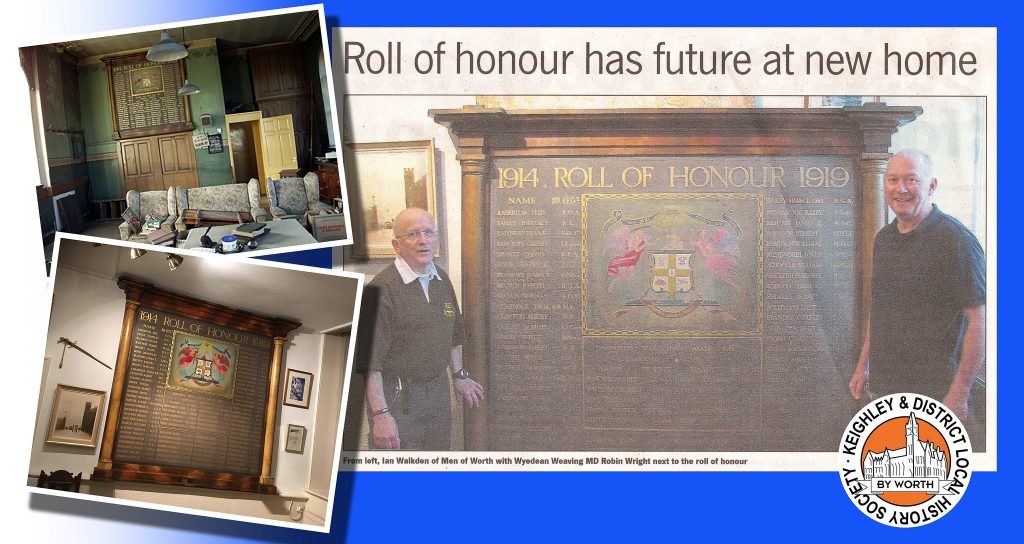
An important piece of history was unveiled in its new home in the article “Roll of honour has future at new home”, published in the Keighley News of Thursday 8th November 2018. The article told of a First World War Roll of Honour (1914-1918) that was previously housed at Haworth’s Woodlands Lodge branch of the Grand United Order of Oddfellows Friendly Society. It commemorated the names of those Oddfellows who fought in World War One, including the ten names of the men who were killed.
When the building that housed the Lodge was being converted to flats, the Men of Worth Project stepped in and arranged for the Roll of Honour to be relocated to The Wyedean Weaving Co. Ltd., Bridgehouse Mill, Haworth. The new home was unveiled to the public in November 2018.
Wyedean is a Haworth-based manufacturer of narrow fabrics for use in military uniforms, braid, insignia, regalia and accoutrement. Its customers include the British Ministry of Defence and the Armed Forces, the Metropolitan Police Force, the Australian, New Zealand and Canadian Armed Forces, the Oman Police and the Canadian Mounties.
The photograph in the article shows Ian Walkden of the Men of Worth Project (left) and Robin Wright, Managing Director of Wyedean (right). The top inset photograph shows the Roll of Honour in its previous location at the Woodlands Lodge hall (photographed by Keith Spencer in 2005). The bottom inset photograph shows the Roll of Honour in its new home in the boardroom of Wyedean (photographed by Andy Wade in 2019).
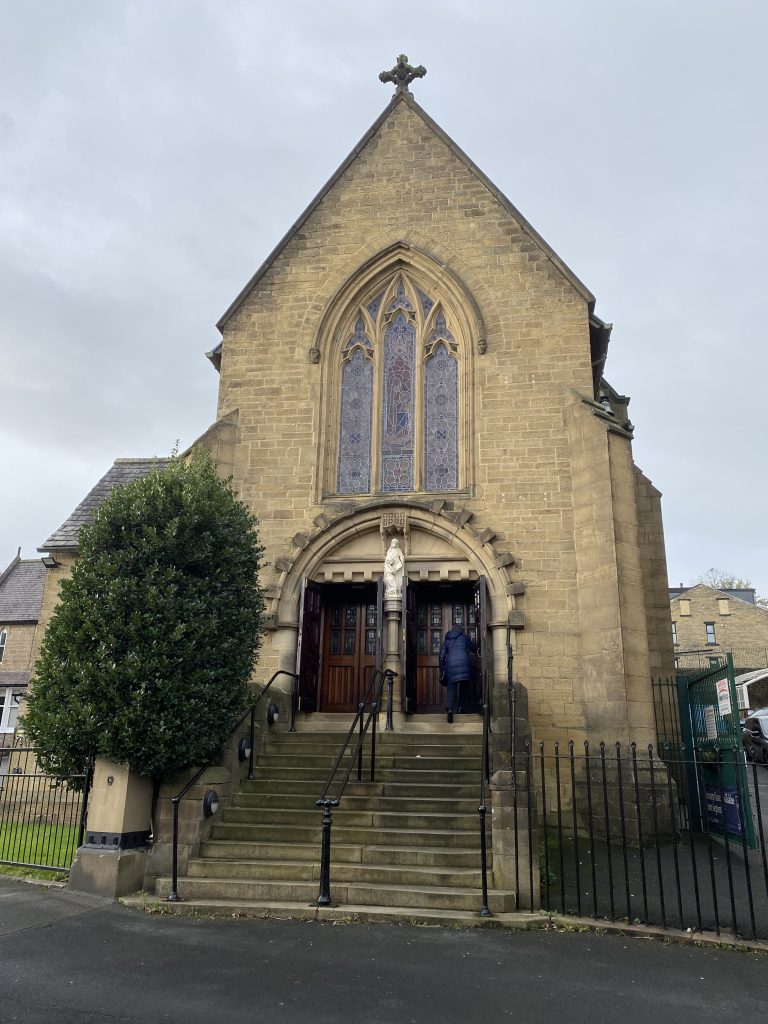
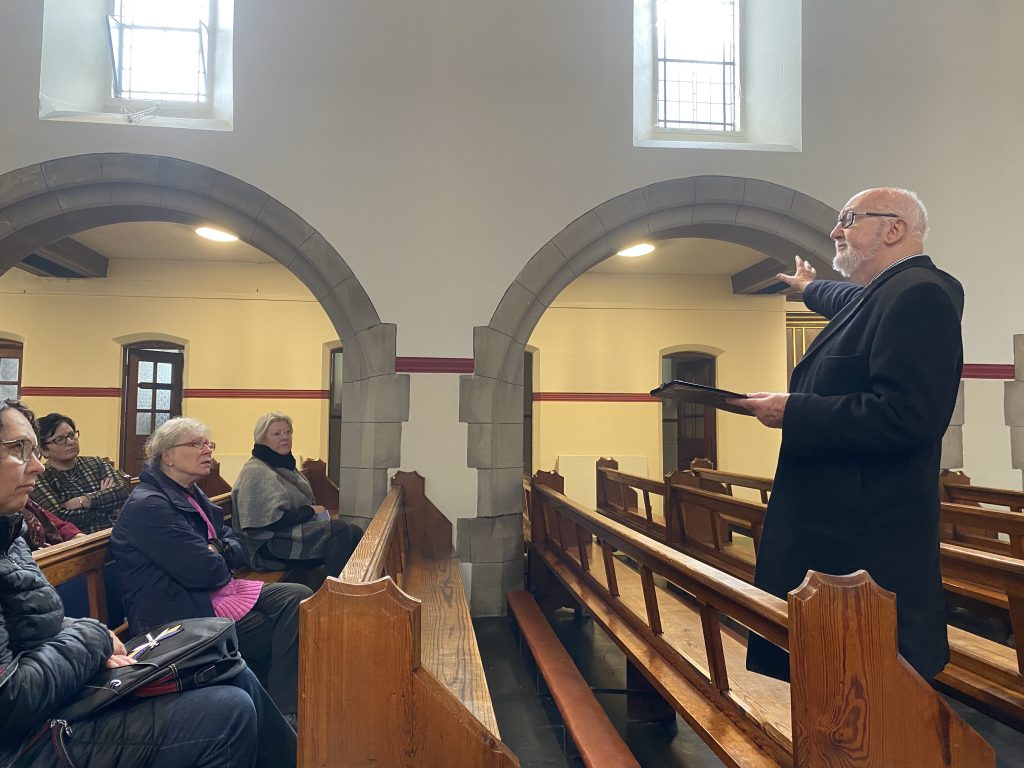
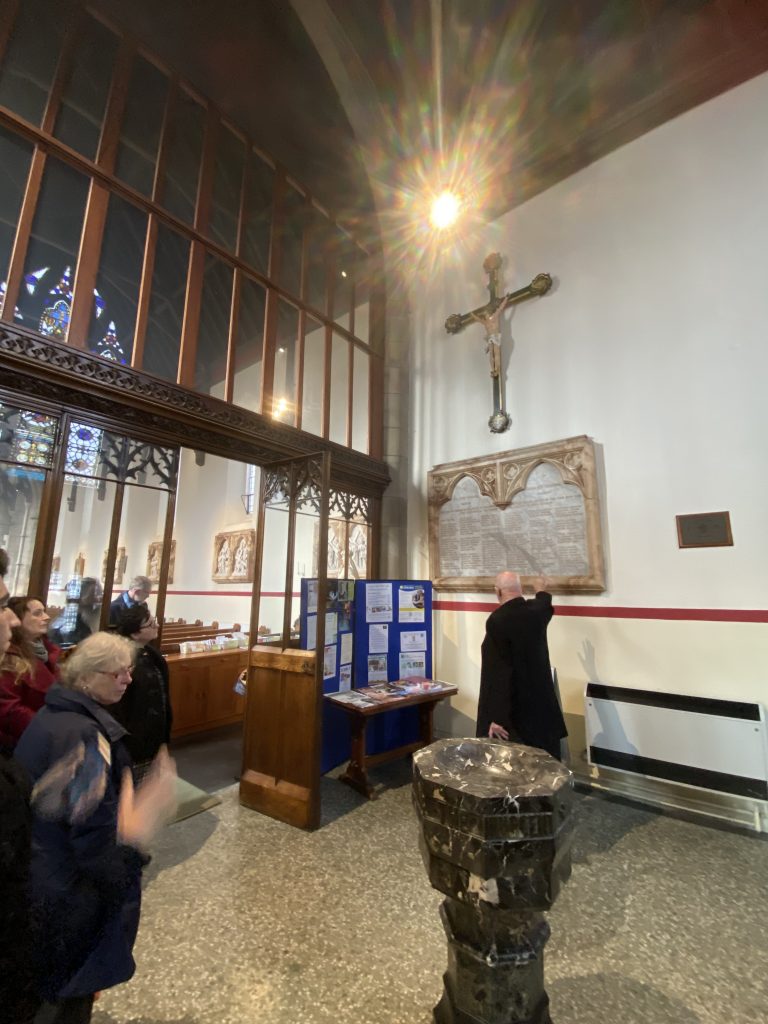
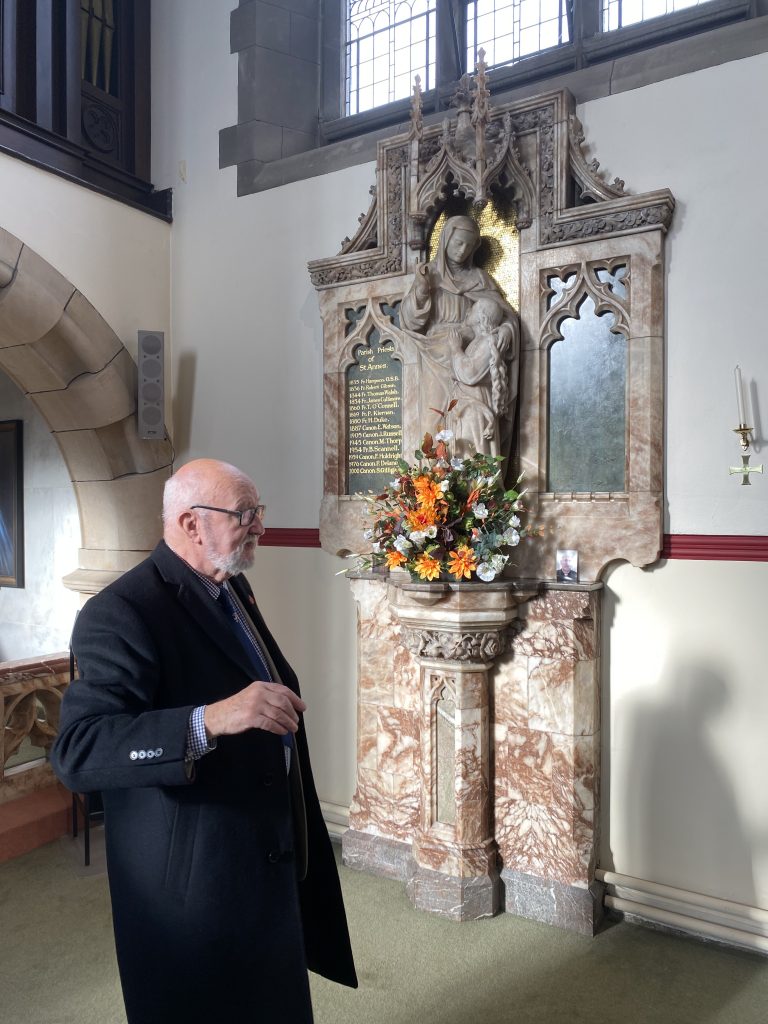
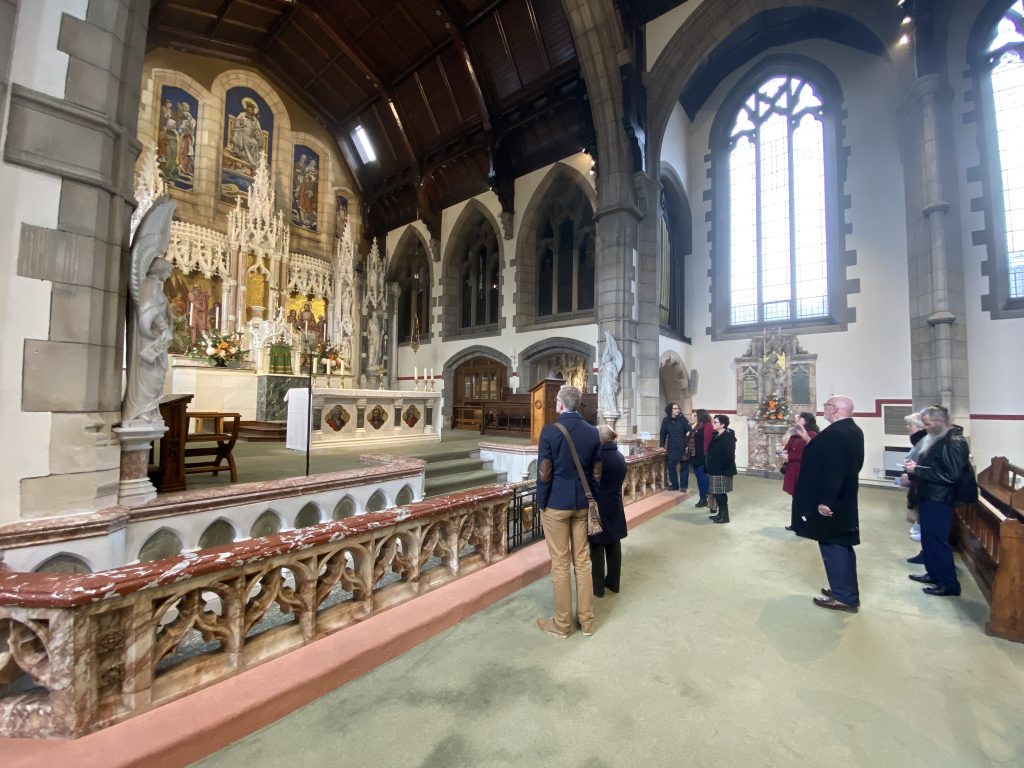
Several members of the the History Society attended the Mass given in St. Anne’s Church this morning, led by Canon Macreadie. We were then given an interesting and insightful history tour of the church by Graham Mitchell. We would like to thank Canon Macreadie and Graham for allowing and facilitating this visit. [Photographs by Tim Neal.]
This newspaper cutting of electrical fittings, cables and instruments that were damaged by a fire at a premises in Keighley is annotated as being from the ‘Electrician’ on 6th November 1925. The publication was possibly ‘The Model Engineer and Electrician’.
The premises belonged to Mr J. Ramsbottom, “a Keighley electrical engineer”. This was, presumably, the premises of J. S. Ramsbottom & Co. Ltd. of Bow Street in Keighley. The advert from 1928 gives us an idea of the kind of service offered by Mr Ramsbottom and the kind of domestic circumstances many people in Keighley were still enduring: “The dark evenings are drawing near. Will you be able to press a switch and flood your home with a cheerful glow? Or are you one of those unfortunates who struggle along in a dim half light. If so, consult us for everything Electrical.” The firm could also offer vacuum cleaners, electric kettles and other modern household appliances.
One of the services offered by the firm in the 1930s was a radio relay subscription service. This meant households, instead of having to buy and maintain their own radio, could hire a speaker and receive radio broadcasts via a relay system operated by Ramsbottom engineers (from a house on Lister Street according to the Keighley News). The service was taken up by nearly 1,500 households in the town.
J. S. Ramsbottom & Co. Ltd. continued to flourish and by 1966 it was described in the Official Keighley Borough Handbook thus: “J. S. Ramsbottom & Co. Ltd. are manufacturing electrical engineers and contractors and specialist engineers in radio, television and radio relay. This firm has extensive works and offices at Coney Lane Mills, and showrooms at present in Cooke Lane and Bow Street which, consequent upon Central Area Redevelopment, will, in the near future, be re-accommodated nearby. In Bow Street is an Account Payment Centre, enabling the many thousand weekly accounts to be paid by the customers with speed and efficiency. Also in Bow Street, in separate premises, is a modern Coffee Bar, offering a selection of light meals in addition to the usual coffee bar menu.”
The clipping was collected by George Crowther, who kept a scrapbook of photographs he took and articles he wrote for various publications. Crowther (d: 1960) spent 50 years with the Bradford and District Newspaper Company until his retirement in 1956. He started out as a press photographer in the 1920s and ended with six years as editor of the Keighley News (1950-1956). He was active in the St. John Ambulance Brigade and served on the Council of the Bronte Society.
The advert is from a guidebook to a Keighley Division Liberal Association Bazaar, held in the Municipal Hall in October 1928 and was donated by Tim Neal in 2019. The photograph of Bow Street was taken by Jan Perkins in 2006. Piece researched by Tim Neal.
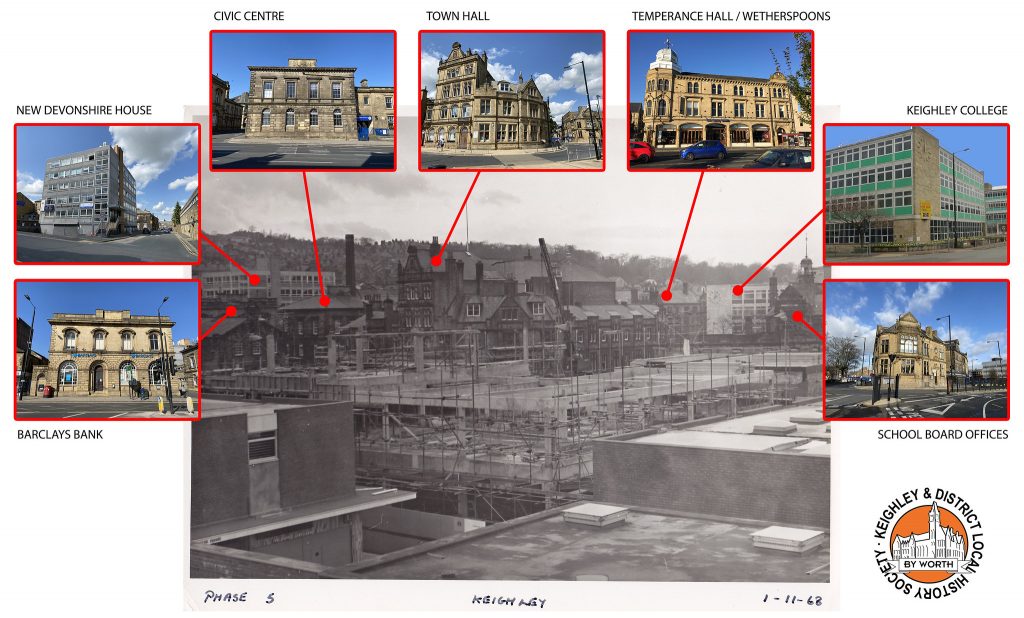
The main black and white photograph was taken near the end of the 1960s transformation of Keighley town centre on 1st November 1969. It was taken by Robert Long as part of a project to record progress on the restructuring.
Bob Long, writing on Facebook in 2021: “I took this photo of the town centre re-development. There should be about 200 photos in all, but I haven’t got a clue where they would be now [the History Society has over 50 of them]. They were taken for Seymour & Harris architects in London. This was a three year contract I had with them, from foundations to finished shop fronts. I was just starting my photographic business. A friend of mine, a Mr Bill Cusker, was the site supervisor for Token Construction Company and got me the job of photographing the redevelopment site. I had to climb up scaffolding onto top of the rooves to get the best shot required. The contract was to take photographs once a month to show the progress of the construction for the architects. I did this for about two years until the shops were ready for occupancy.”
The development saw the flattening of buildings on Cooke Lane, College Street, Adelaide Street, Queen Street and Brunswick Street. In their place was built the new shopping precinct. Work started around 1965 and took almost five years to complete. The photograph was taken near the end of the work and is looking out over what was Cook Lane towards North Street. You can see many of Keighley’s prominent buildings in the background and most of these are still standing today over fifty years later.
Barclays Bank (photographed by Tim Neal in 2021) at 77 North Street. It was built around 1900 to serve as Cravens Bank and became Martins Bank from the 1920s until the end of the 1960s. It was designated as a Grade II listed building in 1986.
New Devonshire House (photographed by Tim Neal in 2021) at the junction of Scott Street with Devonshire Street. This was built on the site of the Devonshire Street Congregational Church which had had to be demolished due to infrastructure faults in 1964.
Civic Centre (photographed by Tim Neal in 2021) at 81 North Street. Built in the late 19th century, The building previously housed the town’s police station. It was designated as a Grade II listed building in 1986.
Town Hall (photographed by Tim Neal in 2021) on Bow Street. Built as the Town Hall and Post Office in 1900 and officially opened in 1902. It was designated as a Grade II listed building in 1986.
Wetherspoons (photographed by Tim Neal in 2019) at 89-97 North Street. The building was originally built as the Temperance Hall for Keighley Temperance Society, founded in 1825, dedicated to abstinence from alcohol. It was built in the 1890s. The building was sold in 1970 and a charitable trust was established, which distributed funds from the sale up until 2018. It opened as a Wetherspoon’s pub in 2004, ironically named The Livery Rooms (the livery stables were actually the building next door, now the pub’s ‘garden’). It was also designated as a Grade II listed building in 1986.
Keighley College (photographed by David Seeley in 2014) at the junction of North Street and Cavendish Street. When the black and white photograph was taken this was a very new building, having been built on the site of the Mechanics’ Institute which had been badly damaged by a fire in 1962 and was demolished in 1967. By 2010 the college building was out of use and was itself demolished by 2018, leaving the grassed area currently running alongside North Street.
The School Board Offices (photographed by Tim Neal in 2022) at 1 Lawkholme Crescent were built in the 1890s. They were designed by designed by James Lechingham of Bradford after a competition to win the commission. Since August 2009 the building has been the Buddha Land Kadampa Buddhist Centre. It was designated as a Grade II listed building in 1991.
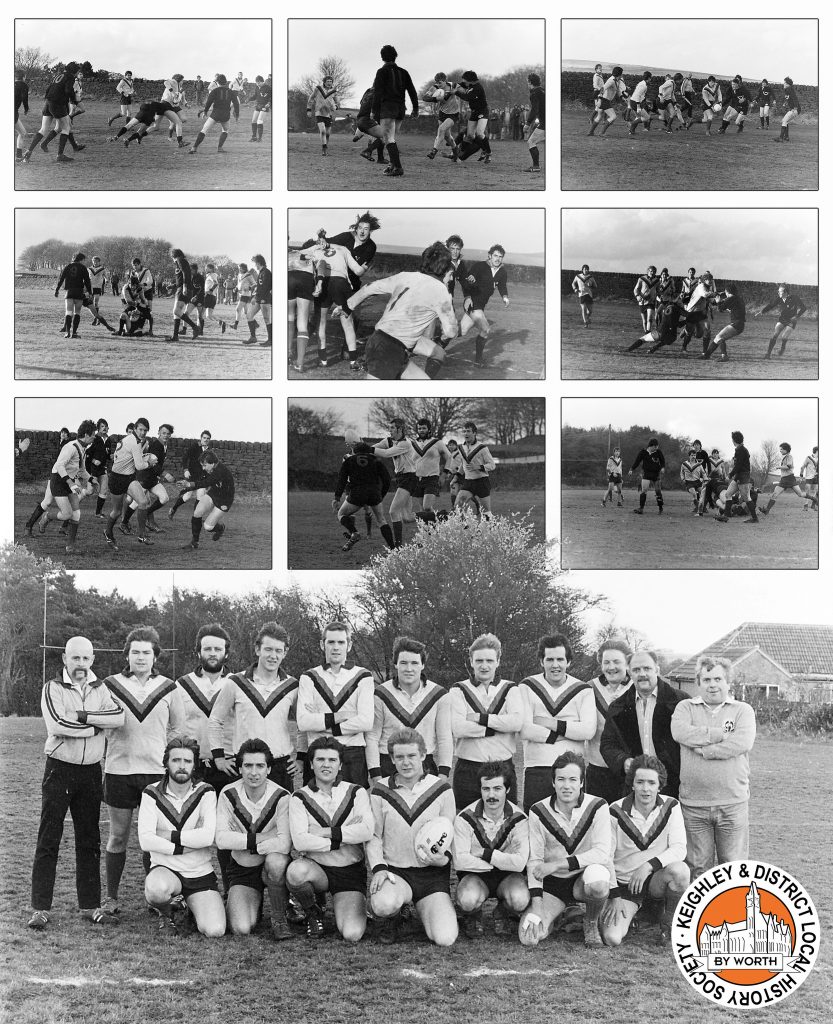
Team photograph of short-lived local rugby league team Oakworth Wanderers taken before a match held on Saturday 31st October 1981. Oakworth Wanderers’ came into being when former Hull and Bramley professional Allan Bancroft, then a coach, and Dave Ingham left Silsden and formed their own club.
Rob Grillo, ‘Trying Times: Keighley’s Amateur Rugby Teams 1876-2011’ (robgrillo.co.uk): “Initially based in Keighley, (Oakworth Wanderers) were accepted at the last minute by the Pennine League to the new division seven for the 1980-81 season as ‘The Wanderers’. The club subsequently secured the old football ground adjacent to Oakworth Cricket Club on Wide Lane, and despite initial objections from local residents began their first season there. Only a few players had actually followed Ingham and Bancroft from Silsden. In November 1980 the club registered with BARLA as ‘Oakworth Wanderers’. Their first season saw them finish at the foot of division 7, with 3 wins and a draw from their 16 fixtures… The 1981-82 campaign began with the formation of another new Keighley club… It was mooted that five clubs was one too many for the town, and that existing sides teams – might struggle to attract sufficient players. Within twelve months Oakworth had resigned from the league, although this was not due to a player shortage but a lack of committee members. Their absence was at the time hoped to be temporary, but Wanderers were never revived and died a quiet death.”
In 2021, Keighley and District Local History Society acquired an extensive collection of photograph negatives taken by the Keighley News. Groups of negatives were held in small wallets with the date and basic labelling written on the wallet. These photographs are from that collection.
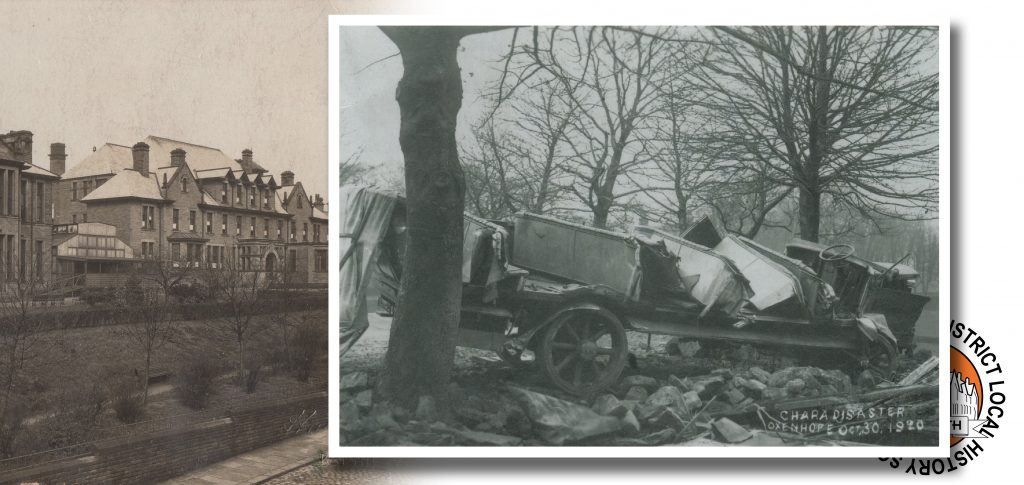
There was a fatal charabanc crash at Oxenhope on Saturday 30th October 1920. The vehicle had been travelling from Hebden Bridge to a knur-and-spell match in Laneshaw Bridge. Its brakes failed on the descent towards Oxenhope and it crashed through a wall at about 35 to 40 miles per hour. Tragically five occupants of the vehicle were killed.
A similar photograph to this accompanied a rather vivid report of the crash in the Keighley News of 6th November 1920: “Several char-a-bancs left the Hebden Bridge district about noon, carrying parties of sportsmen interested in a knur-and-spell match between a Hebden Bridge man and a Keighley man, which was to take place at Laneshaw Bridge, near Colne. One vehicle, a big 32-seater char-a-bancs, owned by Messrs. Greenoff and Shaw, of Rochdale, appears to have been the last to leave. It picked up passengers mostly from Pecket Well and Wadsworth district, and all went well during the climb up to Cockhill Moor, which lies between Hebden Bridge and Keighley.
“Everything appears to have gone well until the somewhat steep decline from the moors into the village of Oxenhope. For perhaps a mile and a-half the road from the moors drops steadily, and the approach to the village itself is fraught with many dangerous turns and twists. Near a well-known public-house, popularly known as ‘Dyke Nook’, something seemed to be wrong with the motor char-a-bancs, and, instead of answering to the movements of the brake levers, the heavy vehicle, weighing almost four tons, gradually got out of hand, and dashed along the highway at an ever-increasing speed.
“The driver stuck to his post, and fortunately was able to keep to the centre of the road. The race continued for almost a mile: the way was clear of traffic. Near Oxenhope Church, however, the sharp, left-hand bend was encountered, and because of its tremendous speed and weight it was impossible the char-a-bancs could take the corner. Scarcely any turn appears to have been made, however, and the vehicle dashed straight for the wall on the right-hand side of the road and through into the field.”
John Graham, recovering afterwards at Victoria Hospital for fractured ribs and a badly damaged hand, told the Keighley News that the vehicle must have been traveling at over 30 miles an hour, with the scenery whizzing by like when travelling by express train.
John Murgatroyd of Pecket Well, the passenger who had actually organised the trip, described the moments leading up to the crash to the Keighley News: “After going down the far slope for a quarter of a mile the driver tried to check the growing speed of the char-a-bancs. He applied both the foot and hand brakes to the full without checking the vehicle. It was an awful experience, for the motor was gaining speed at every yard. The driver held on to his steering wheel, and marvellously got round a couple of sharp bends. All the passengers must have realised that they were being carried along at a break-neck speed, but they remained calm, and there was no sign of panic. As we bowled on to the last long straight stretch, the char-a-bancs must have been going at forty miles an hour, and at the end was the hair-pin bend. No man breathing could have got a motor round at the speed at which we were travelling. As we approached the end I shut my eyes and awaited the end. It was an awful shock. Practically all were hurled out of the car, and I dropped in a field about twenty yards away.”
Keighley News: “The driver was a man named Tom Hay, of Rochdale, and he escaped with a cut hand and a severe shaking. Many of the passengers suffered from shock. One passenger, more daring than the rest, when he saw an accident was unavoidable, jumped from the rapidly-moving vehicle into the road. He rolled head over heels time and time again, and another passenger who was going to jump thought the man was killed, and decided not to leap, and crouched down behind a seat. He was practically unhurt, and the man who jumped received only slight injuries to the arm.
“All the passengers and debris from the vehicle, the wall, and from a hen-house which was in the field immediately behind the wall, were thrown into an indescribable heap. Thrown on to a heap of stones and against the trees the passengers sustained shocking injuries. Two passengers were picked up dead, and others were unconscious. The noise of the collision and the screams of the injured brought the villagers to the scene, and help was quickly rendered. Dr. McCracken, of Haworth, was in the village at the time and he was soon on the spot. Policemen, members of the St. John Ambulance Brigade, and nurses were on the scene quickly, and Dr. Maggs and Dr. Wilson, of Haworth, were summoned by telephone. A motor-ambulance from the Keighley Fire Station was called, and in this, on on a motor-lorry owned by Messrs. Merrall, spinners, Haworth, a number of the serious cases were taken to the Keighley Victoria Hospital, where medical men were awaiting the arrival of the patients.
“The great force with which the motor char-a-bancs hit the wall can be judged by the appearance of the vehicle after the accident. The radiator shows the marks where the stones hit it, and one side is broken away. The front axle is broken and the steering column fractured, but it was along the right side of the body that most damage was done. The whole of the side is broken completely away, the woodwork being in splinters, and all the aluminium panelling broken and twisted in all directions. The ends of the seats are directly in view, and instead of remaining parallel they are twisted in all directions.”
Amongst those who died were William Devenport Kershaw (35), an ex-soldier living at Keighley Road, Pecket Well, and his wife Alice (27 or 37 – the Keighley News quotes both ages). William died in Victoria Hospital, while Alice was killed at the scene. The other person who died at the scene was John Drake Turner (46) of Waterloo Bank, Wadsworth. William Ogden (56) of Ivy Cottage, Pecket Well, died on arrival at the hospital. Percy Brown Roe (30), Hebden View, Wadsworth, who had been a Sergeant throughout the First World War, died at the hospital during the evening. Four of the victims were buried in the cemetery at Wainsgate, near Hebden Bridge, on the following Thursday, following a service led by Mr J. T. Greenwood at the Baptist Chapel. William Ogden had been buried in the cemetery adjoining the Baptist Church the day before. Both services were attended by hundreds of locals, including people injured in the crash, and schools, pubs and businesses were shut in the victims’ honour.
The knurr and spell match at Laneshaw Bridge was delayed by an hour, but eventually took place in ignorance of what had occurred. On Thursday 4th November 1920, Keighley’s MP, Robert Clough, asked in the House of Commons whether an inspector from the Department of Transport would attend the scene of the accident and attend any follow-up inquiry. He was assured by Parliamentary Secretary to the Ministry of Transport, Arthur Neal, that an inspector was already engaged. Reportedly thousands of visitors went to inspect the scene of the accident over the few days following its occurrence.
According to local historian Ian Dewhirst in his book ‘Down Memory Lane’ (Keighley News, 1993), at the inquest that followed, some expert witnesses criticised the driver for having come down the hill in top gear, but the owner of the charabanc defended his driver by saying “if he had come down in second gear the passengers would have thought that he was not a capable driver and that he was nervous”. Certainly accounts captured by the Keighley News in the days immediately following the accident, many survivors praised the driver’s attempts to control the situation.
The photograph of the crash was donated to the History Society by David Holmes. The photograph of Victoria Hospital is a detail from a Hall & Siggers postcard from the personal collection of Tim Neal. Researched and collated by Tim Neal.