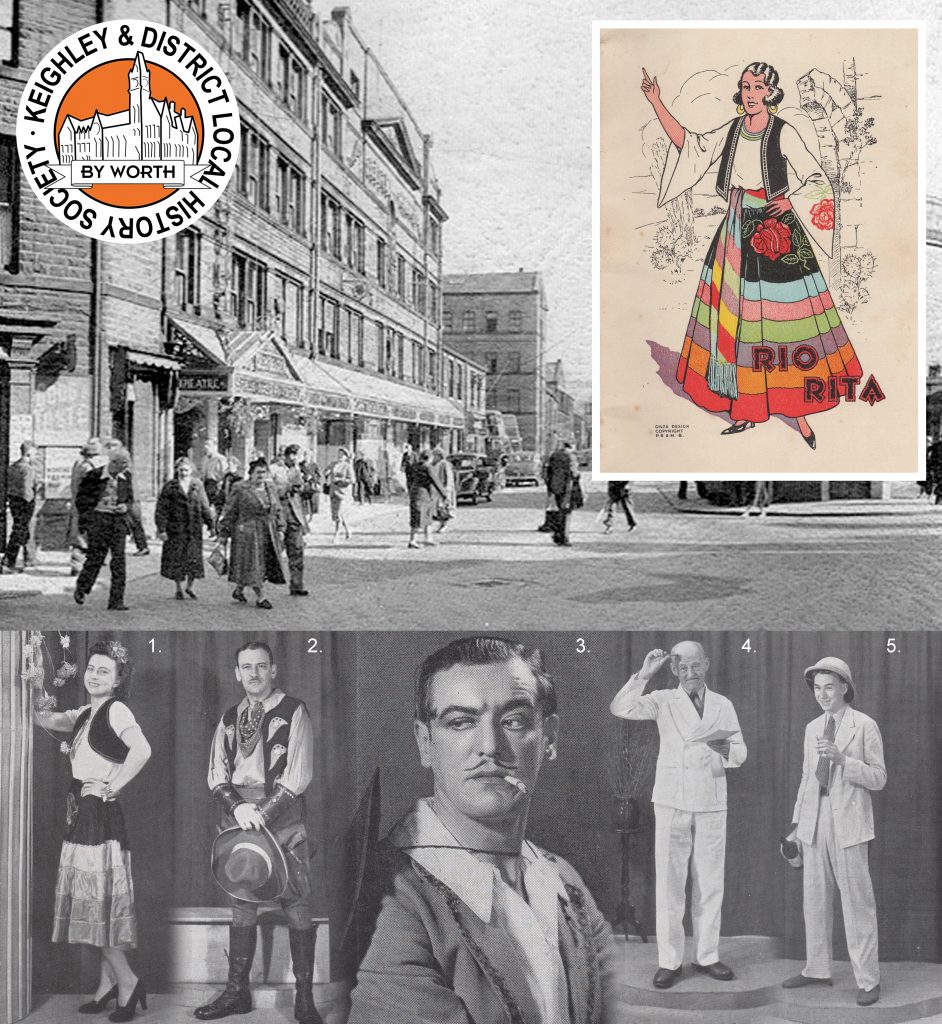
Monday 20th October 1947 was opening night of the musical play “Rio Rita”, performed by Keighley Amateur Operatic & Dramatic Society at the Hippodrome theatre in Keighley. The music was by Harry Tierney, with words by Joseph McCarthy, from the book by Guy Bolton and Fred Thompson. The original 1927 stage musical was turned into a RKO film in 1929, directed by Luther Reed.
The story is set on the US/Mexico border, where cabaret singer Rita Ferguson falls for Texas Ranger Captain Jim Stewart, while pursued by Mexican General Esteban. Meanwhile, Captain Stewart is seeking the notorious bandit Kinkajou, whose real identity is unknown (but could be Rita’s brother Roberto!). The climax is reached onboard the pirate barge owned by Esteban, which serves as a floating cabaret…
The Keighley production starred Hylda Saville Smith (1) as Rio Rita, Arthur Day (2) as Captain Jim Stewart, Eric B. Boster (3) as General Esteban, and Fred W. Pye as Roberto. Supporting roles were played by Albert E. Shepherd, Arthur Shackleton, Ernest Marsden (4), Dorothy M. Williams, Betty Phillips, Keith Marsden (5), John H. Crabtree, Pamela Fitzjohn, Victor J. Wood, Frank Hopkinson, Margaret Best and Marjorie Riley. It was produced by T. C. Wray. The cast photographs were taken by John Tobin of Keighley.
The programme was loaned to Keighley and District Local History Society for scanning by Tim Neal in April 2022. The full 48-page programme is available to view on our Flickr site.
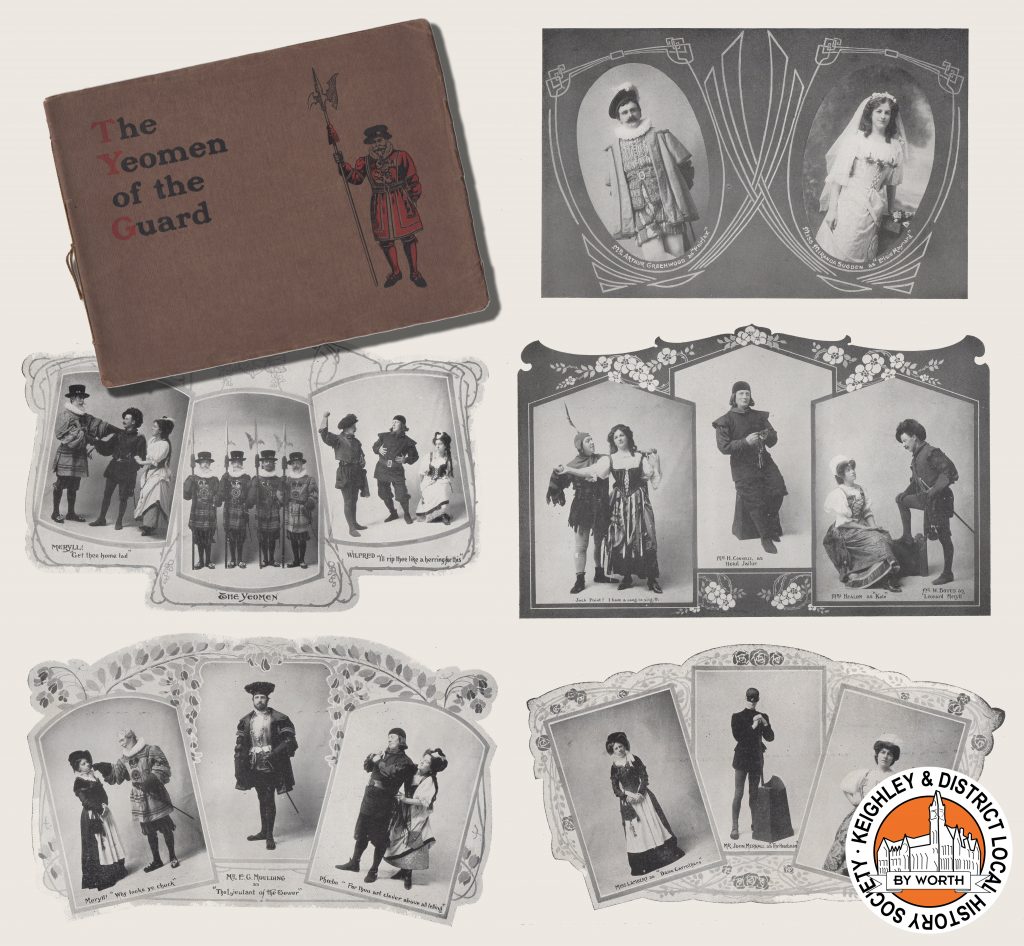
The Keighley Amateur Lyric and Dramatic Society staged a production of W. S. Gilbert and Arthur Sullivan’s ‘The Yeomen of the Guard (or The Merryman and his Maid)’ at the Hippodrome theatre in Keighley from 18th to 23rd October 1909.
The story is set in the sixteenth century and revolves around Colonel Fairfax, a condemned prisoner in the Tower of London, and his attempts to secure a wife before his execution for sorcery. He manages to escape the Tower disguised as a Yeoman and much confusion ensues before all is righted by the end.
It starred Arthur Greenwood as Colonel Fairfax, with E. G. Moulding, James Pearson, Willie Boyes, J. R. Hammond, H. Connelly, John Merrall, C. A. Greenwood, J. Greenwood, B. Hardacre, H. V. Wilkinson, Miranda Sugden, Ethel Bird, Miss Lambert and Mrs Heaton. The musical director was W. S. Wilkinson and the stage manager was W. G. Bedford. Scenery was hired from the Northern Theatres Co. Ltd. and was specially painted by F. G. Venimore.
The Keighley Amateur Lyric and Dramatic Society had only formed a year previous (in 1908) and the theatre had only been renamed the Hippodrome earlier that year (in 1909). Prior to that it was known as the Queen’s Theatre, although both names remained on the front of the building, and many programmes and adverts continued to refer to the ‘Hippodrome and Queen’s Theatre’.
This souvenir programme was a collaboration between photographer H. Charlton of Lawkholme Crescent, and the printers Wadsworth & Co. of The Rydal Press, Russell Street. The programme was donated to the Keighley and District Local History Society by Tim Neal in 2022. A second copy was received by the History Society from an anonymous donor later in 2022. Both copies are held in the History Society’s physical archive. The full document can be viewed on the History Society’s Flickr site.
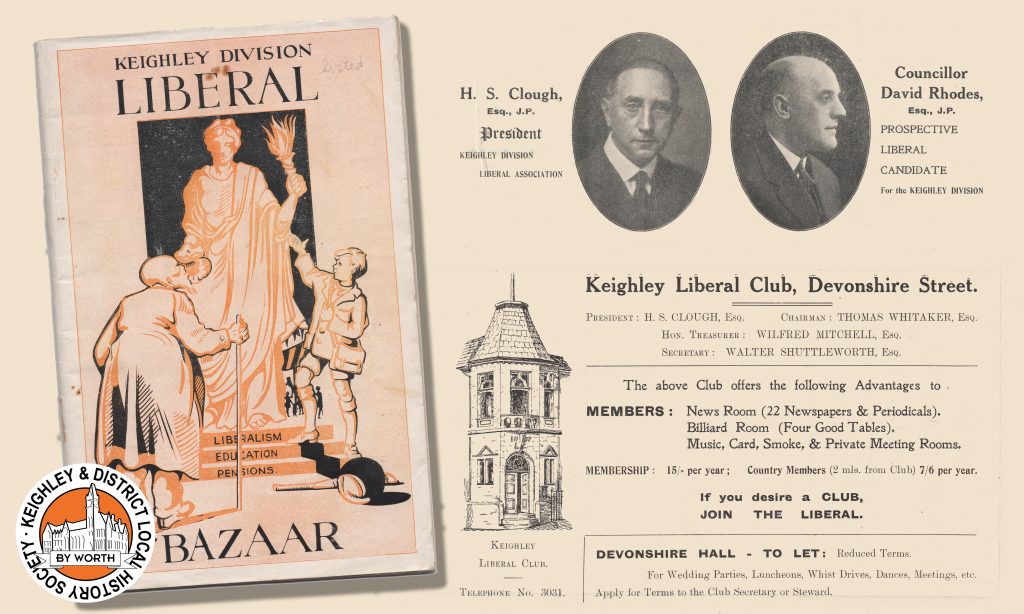
The Keighley Division of the Liberal Association held a Bazaar in the Municipal Hall (Mechanics’ Institute) from Wednesday 17th to Saturday 20th October 1928. The purposes of the Bazaar were “1. To free the Association from debt, 2. To provide the means of conducting Active Political Work throughout the (Keighley) Division, 3. To combine the workers throughout the Division in one common object for the benefit of the Party”.
Stalls within the Bazaar included plain and fancy needlework stalls, a fruit, flower and basket stall, a fancy stall, a sweet stall, a mystery parcels stall, a china and glass stall, a home produce and pound stall, a perfumery and toilet requisites stall, a men’s miscellaneous stall, and a cigarettes and tobacco stall.
On the first day, the Bazaar was officially opened by Lady Carey Evans at 2.30pm. Thursday was opened by Lady Bain, Friday by Lady Fisher Smith and Saturday by Sir Charles Starmer. Music across all four days was provided by G. S. Sugden’s Orchestra. Refreshments were supplied by Mr W. Day (who had a confectionary shop on North Street).
Entertainment and events went on well into the evening on each day. These included The Trocadero Dance Band, a Cabaret Show by members of the Keighley Amateur Operatic Society, picture shows, Knuts Komedy Koncert Party, performances by the Clifton, Devonshire and Orpheus Quartettes, Andrew Beaver giving dramatic and humorous recitals, and even ‘Baby Cinema’ organised by local photographer W. Bruce Johnston.
The cover of the souvenir programme included a design by Miss Mary Haggas of Park Lane, Keighley. It showed “the gracious figure of Liberalism giving the Bread of Sustenance to the old and the Torch of Knowledge to the young”. It was chosen in a competition by the Bazaar Publicity Committee.
The President of the Keighley Division at this time was H. S. Clough and the Chairman was Councillor David Rhodes. Keighley first elected its own MP in 1885. For over thirty years, between 1885 and 1918, it had elected Members from the Liberal Party (Sir Isaac Holden, Sir John Brigg, Stanley O. Buckmaster, Sir Swire Smith, and William H. Somervell). The most recent election by 1928 had been in 1924 when the Liberals came third in Keighley. The next general election was to be held in May 1929 for which David Rhodes had already been selected as the Liberal candidate (in the event he came second).
The Keighley Liberal Club at this time was situated at the junction of Devonshire Street with Scott Street (having originally been on High Street). Members had access to a newspaper reading room, a billiard room and private members rooms. The building included Devonshire Hall, available to hire for wedding parties, luncheons, dances and so on. (This hall was later converted to a theatre space and became Keighley Little Theatre.)
The souvenir booklet was donated and scanned by Tim Neal in 2019 and is held in the Keighley and District Local History Society physical archive. The image was created by Tim Neal in 2022. The full booklet is available to view on the History Society’s Flickr site.
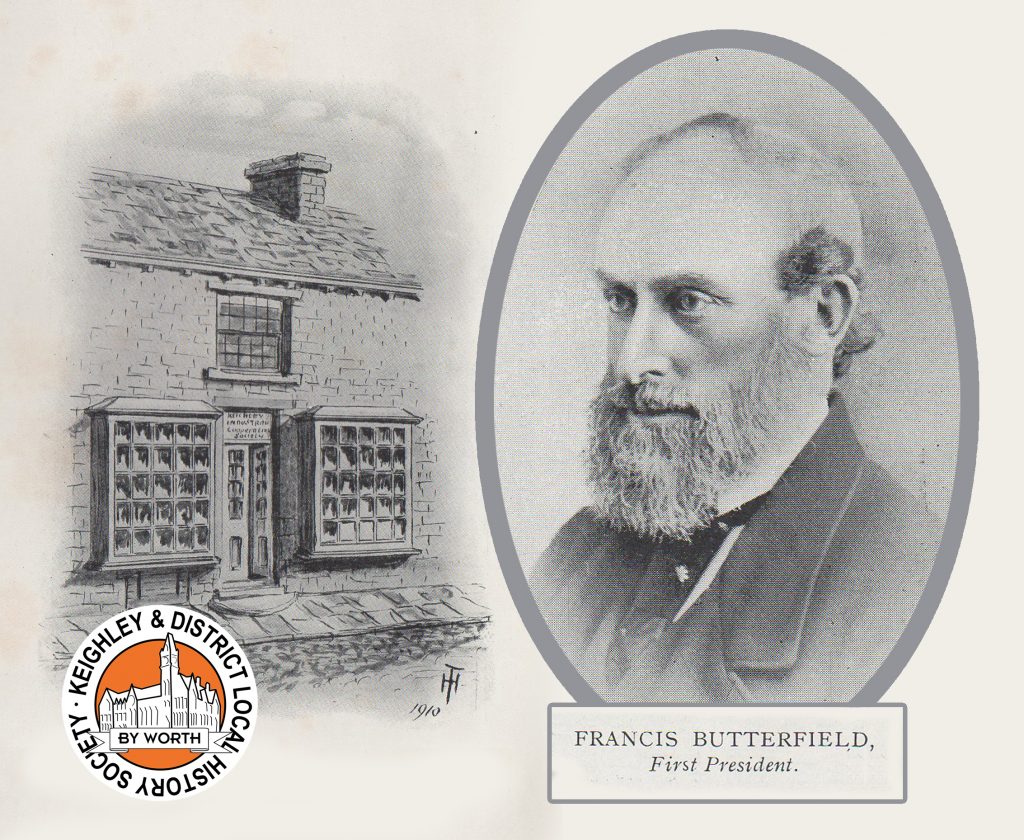
Francis Butterfield was appointed as the first President of the Keighley Industrial Co-operative Society, at the society’s second meeting held on 15th October 1860. Butterfield was a blacksmith on Beckside at the time.
Also shown, a sketch from memory of the first Co-Op shop on Church Green, Keighley, by Thomas Heaps, drawn in 1910. The shop, in which the Keighley Industrial Co-operative Society began its business life, was one of a block of three in Church Green between the Commercial Inn and the Devonshire Hotel. The shop was run by John Farrar Pickles, Benjamin Morrell and Joseph Moorhouse (Society Treasurer). Customers had to ascend two or three steps on entering the shop. The shop was originally occupied by Mr Cockshott, who remained as landlord of the site. The shop opened in October/November 1860. The original shop closed in March 1862 when Cockshott wanted to change the details of the rent, and the shop relocated to premises on New Bridge Street.
Illustrations from ‘Half a Century of Co-operation in Keighley – 1860-1910’ by Joseph Rhodes, published by the Keighley Industrial Co-operative Society Ltd. in 1911. Image created by Tim Neal in 2022.
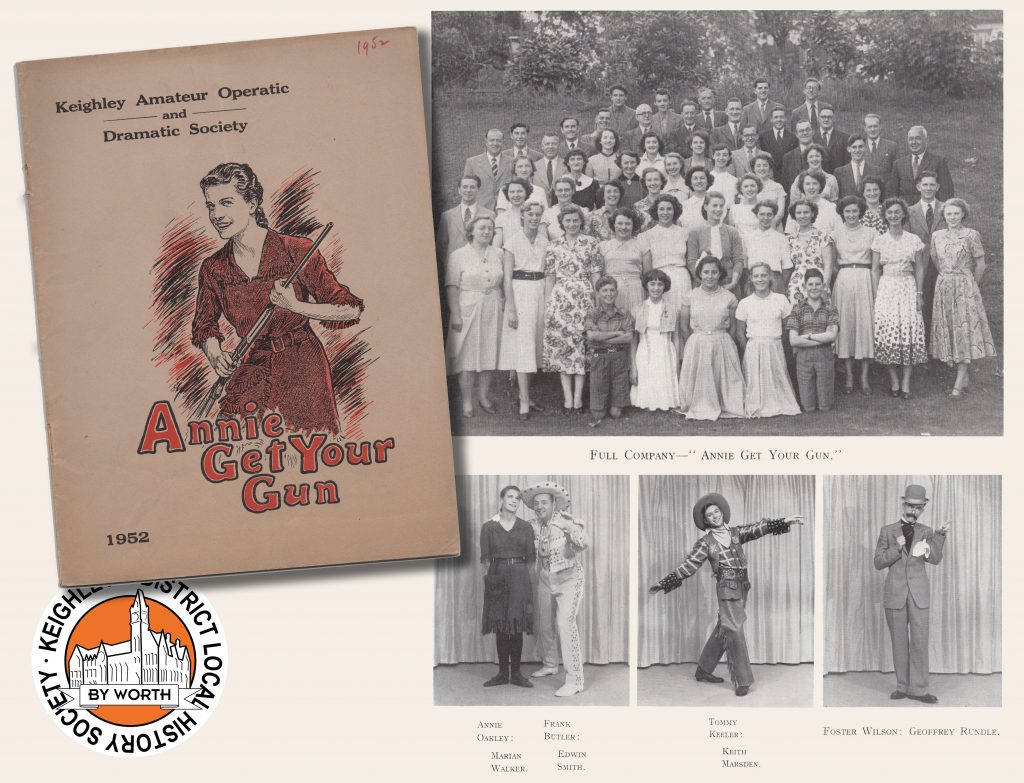
Keighley Amateur Operatic and Dramatic Society’s production of “Annie Get Your Gun” played at the Hippodrome Theatre in Keighley for six nights (and a Saturday matinee) from Monday 13th October 1952. The musical had lyrics and music by Irving Berlin, with book by Herbert and Dorothy Fields. The audience were probably familiar with the musical as the MGM film version had only come out in the UK almost exactly two years earlier. The KAODS production was produced and directed by Douglas T. Bailey, with musical director R. Lewis Scargill.
The story is loosely based on the life of real-life sharpshooter Annie Oakley. Annie (played by Marian Walker) and her brother Jake (Dennis Crocker) meet up with ‘Buffalo Bill’ (Frederic W. Pye) and his Wild West Show when it visits Cincinnati. Annie’s sharpshooting skills attract Bill’s attention and he signs her up for the show. Annie falls in love with fellow performer Frank Butler (Edwin Smith), whose position in the show she is inadvertently usurping, leading Frank to leave the show. Indian Chief Sitting Bull (Leonard M. Stockdale) finances the show on a European tour (which, in the real world, included Keighley in its itinerary!) which is a financial disaster. Ultimately Buffalo Bill’s Wild West Show combines with the show of Pawnee Bill (John H. Crabtree), which has recruited Frank. Annie and Frank settle their professional rivalry and reunite.
The show also starred Alan Shuttleworth, Frank Hopkinson, Norman Raistrick, Geoffrey Rundle, Marjorie J. Riley, Elsie Greenwell, Keith Marsden, Jean Sellars, Jesse G. Hamshaw, Anne Irving, Mary Wade, F. Bottomley, J. Street, L. Waite, J. D. Lee, A. Ridding, Janet Ogden, Eric S. Butterfield, Arthur Hague, N. Moulding, J. Derek Lee and Gwenda Binns. The dancing mistress was Irene Ogden.
The programme was part of an anonymous donation given in 2022. The cast portraits within the programme were taken by N. K. (Keith) Howarth of K. C. P. Studio on East Parade. This collage was created from images in the programme by Tim Neal in 2022.
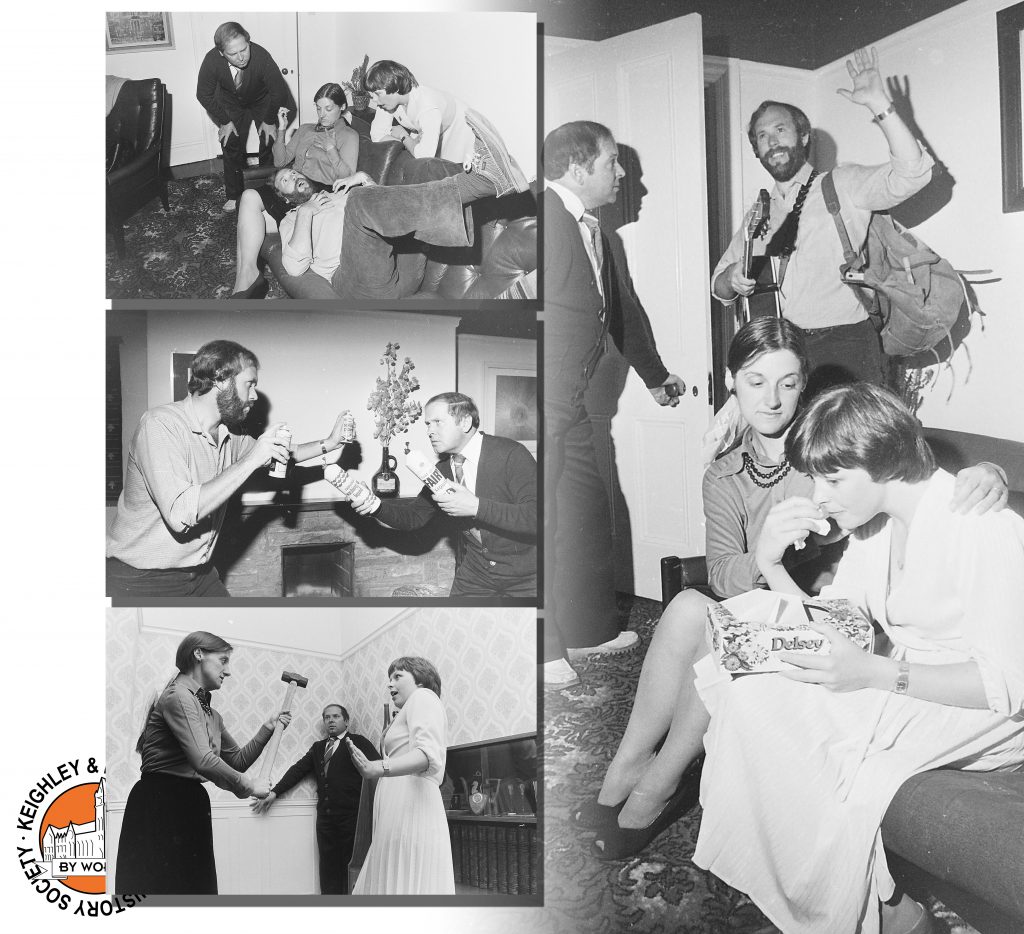
12th October 1981 was the opening night of Keighley Playhouse’s production of ‘One for the Road’ by Willy Russell. The play was produced by Geoff Whitley and starred Pauline Cain, Dennis Cain, Roger Fuller and Jane Fuller.
These press photographs were taken during rehearsals on 28th September 1981. In July 2021, Keighley and District Local History Society acquired an extensive collection of photograph negatives taken by the Keighley News in the early 1980s.
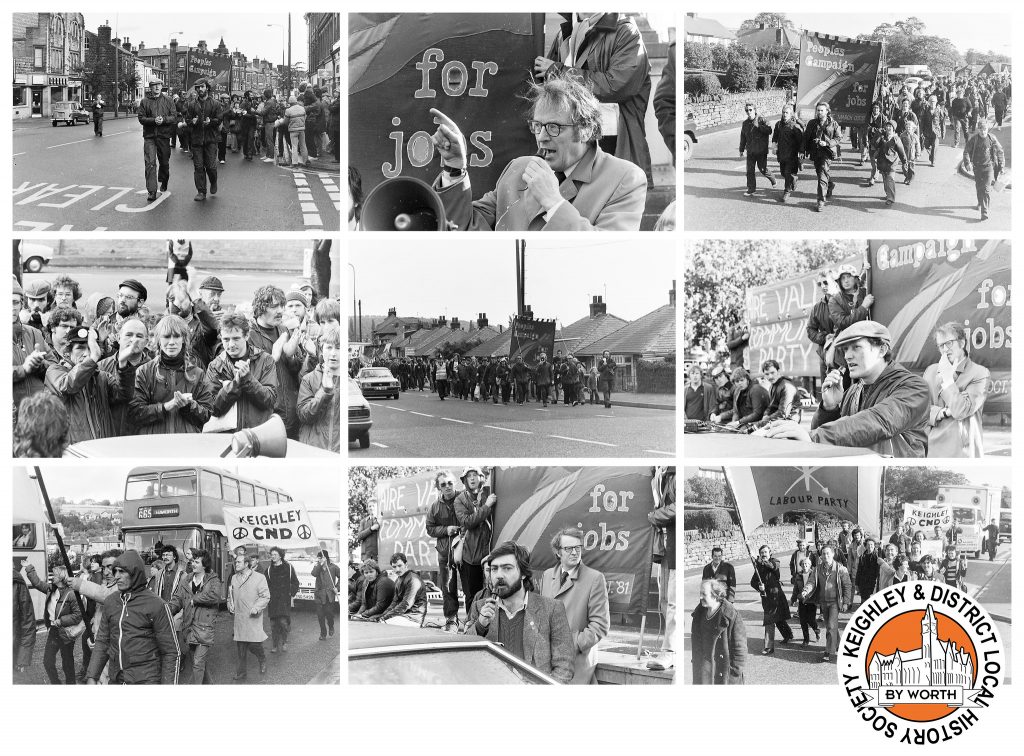
The Trans-Pennine March for Jobs from Sheffield to Blackpool passed through Keighley on Sunday 11th October 1981. 100 members of the People’s Campaign for Jobs marched into the town and joined a rally in Town Hall Square. There were cries of “Maggie, Maggie, Maggie, out, out, out!” The crowd gathered in Town Hall Square were addressed by Steve Davison, chairman of Keighley Trades Council, by Frank Brammah of Keighley Unemployed Workers Association, and by the town’s MP, Bob Cryer. A Keighley News photographer captured the event and the story was covered in the newspaper the following Friday.
Keighley News, 16th October 1981: “Left-wing Labour MP Mr Bob Cryer said the march was part of the struggle against Thatcher policies and with unity and determination they would win. He claimed the Prime Minister was using unemployment as a weapon against the organised trade union movement. Mr Cryer condemned government cuts in welfare benefits, social services and education while they were spending six or seven billion pounds on Trident and Cruise missiles.”
The marchers were given tea by St. Anne’s Justice and Peace Group followed by a service at St. Anne’s Roman Catholic Church. There was a civic reception from the Lord Mayor of Bradford, Councillor Danny Coughlin, and free entertainment in the evening at the Victoria Hotel. Marchers spent the night in private homes or at Keighley Central Youth Club.
In 2021, Keighley and District Local History Society acquired an extensive collection of photograph negatives taken by the Keighley News. Groups of negatives were held in small wallets with the date and basic labelling written on the wallet. These photographs are from that collection.
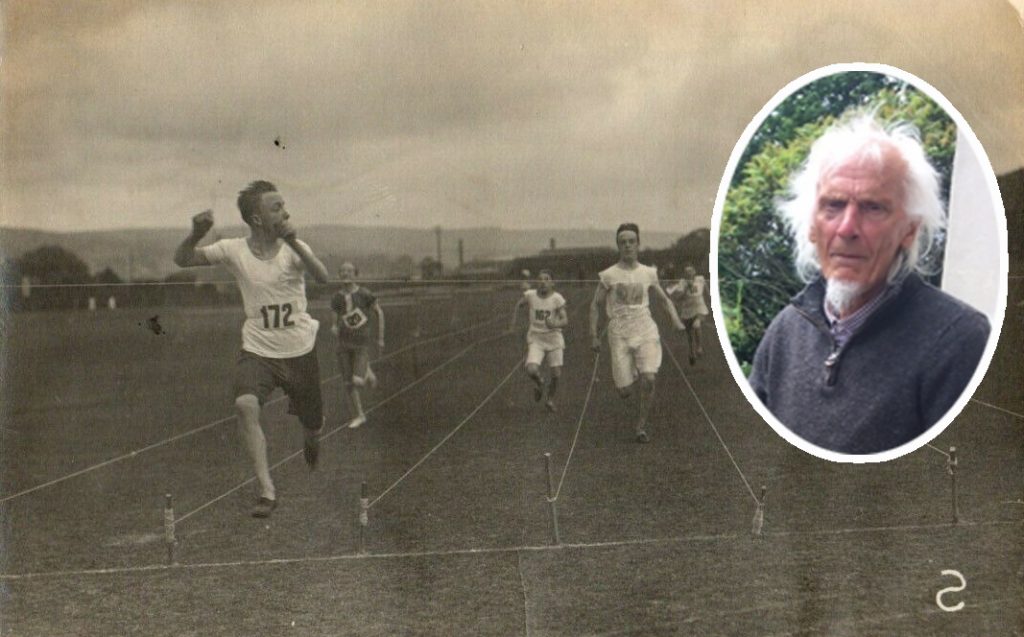
A reminder that this month’s History Society meeting (this Wednesday – 12th October) is on Zoom only (i.e. not in the Library) and will be medal-winning long-distance runner Colin Kirkham talking about the various running/athletics/walking clubs that proliferated in Keighley in the late 19th/early 20th century.
The talk is only open to paid-up members of the History Society. Members will have received their email from Anne-Marie with details on how to join. The talk starts at 7.30pm but it’s probably best to try joining up 15~20 minutes early in case there are difficulties (and we usually have an update/chat beforehand).
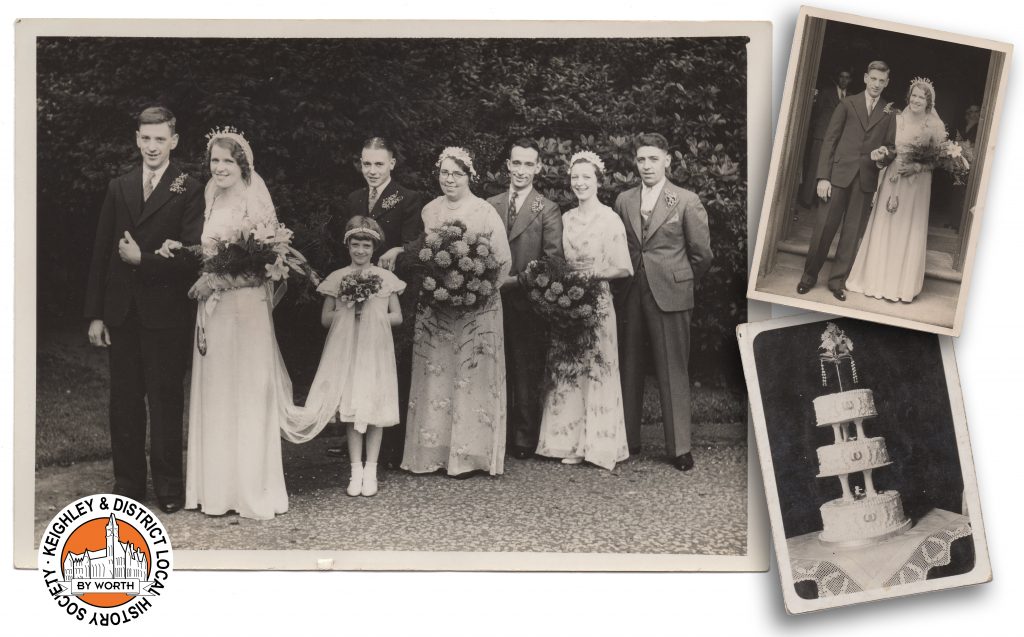
The marriage of George Bown (1904-1993) to Alice Ayers (1908-2010) took place at St John’s Church, Ingrow, on 10th October 1936. George and Alice lived at Cliffe Terrace in Ingrow. George was a pattern maker with Walter Denby’s. He was also a founder member of Ingrow St. John’s cricket team when it relaunched in February 1922, captained the team, and, much later, served as its president in the late 1980s/early 1990s.
During the Second World War George was an Air Raid Prevention (ARP) officer and served in the Keighley Civil Defence Ambulance Service. Wounded soldiers were repatriated to Keighley railway station and were then taken up into hospitals in the Yorkshire Dales. As a local agricultural engineer who used to work on farms, George knew the area and the routes to take during the blackouts.
Shown in the main photograph are (L to R) George Bown, Alice Bown, Joan Ayers (niece to Alice), Reuben Clegg, Ethel Ayers, Arthur Ayers, Madge Ayers, Herbert Ayers. George and Alice went on to have two children: Alison and Derek. Alison appeared in some of the 1950s pantomimes performed in the St. John’s Sunday School hall.
The wedding was photographed by Keighley photographer George A. Shore. Shore was a popular Keighley-based freelance photographer who simultaneously ran his photography business alongside running a carpet and linoleum store in Keighley market. Examples of his work exist from the 1930s and 1940s, and included outdoor events such as Keighley Gala, the coronation of King George VI, Victory street parties at the end of the Second World War, theatre productions, weddings, and landscapes. Many of his photographs were commissioned by and printed in the Keighley News. His original prints could be embossed “G. A. Shore” or stamped on the back in a circle “Geo. A. Shore”. In his other lines of business, Shore was an early member of Keighley Road Club and used to deliver rolls of carpet and linoleum via his motorbike and sidecar, aided by assistant Sam Scaife. Shore died in 1946.
The photographs are from the personal collection of Derek and Sonia Bown, loaned to Keighley and District Local History Society in 2017.
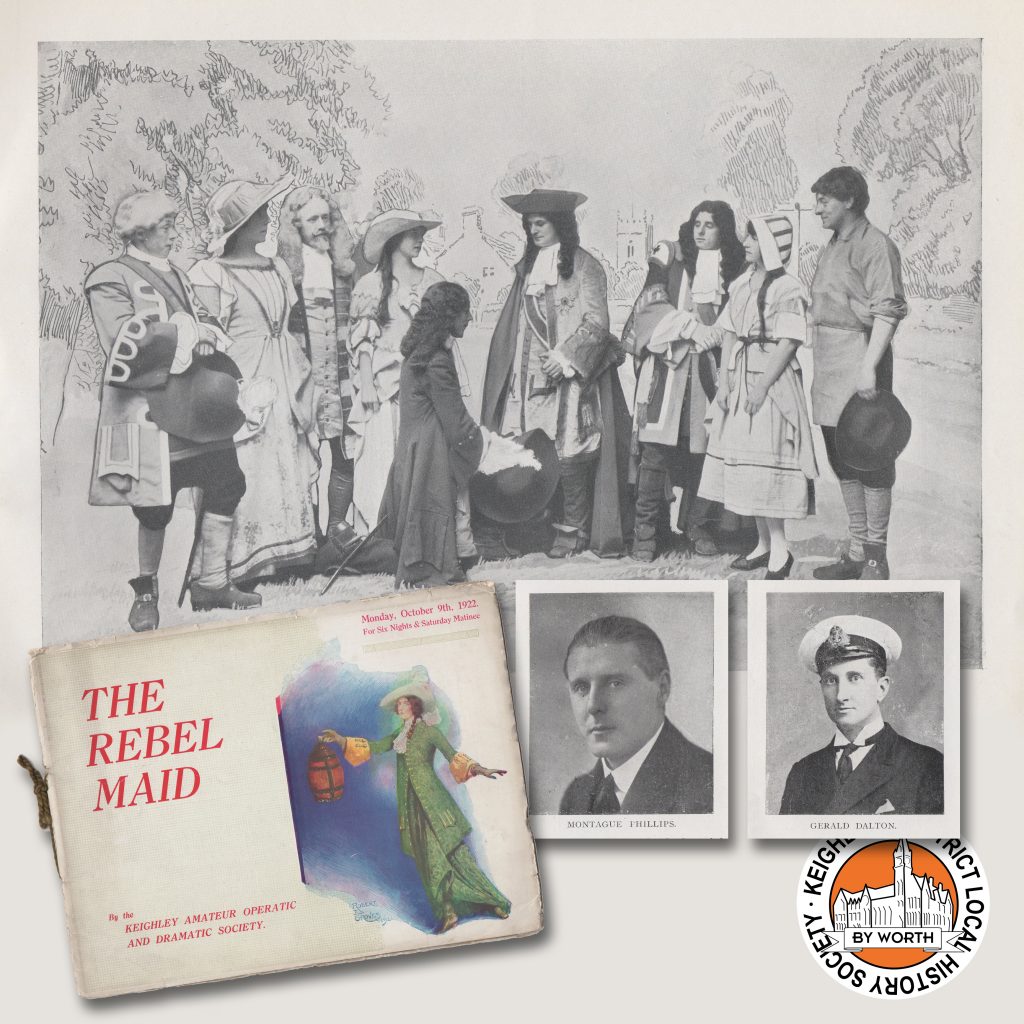
Keighley Amateur Operatic and Dramatic Society’s production of “The Rebel Maid” played at the Hippodrome Theatre in Keighley for six nights (and a Saturday matinee) from Monday 9th October 1922. The romantic light opera was written by Alexander M. Thompson, with lyrics by Gerald Dalton and music by Montague F. Phillips. Dalton and Phillips had actually created the opera while serving in the Royal Naval Volunteer Reserve during the First World War. The musical director was Joseph Harker, while the producer and stage director was Avalon Collard.
The story is set in the autumn of 1688 and centres around the rebellion against the Stuart dynasty, in the form of King James II, led by Prince William of Orange (played by George Best). The action takes place in the mansion of Lord Milverton (played by Edward Greenwood) on the coast of Devon, the local inn ‘The Jolly Fishers’ and the village green. Amongst the plots and counter-plots is a romance between Derek Lanscombe (Watson Walker) and Lady Mary Trefusis (Edith Robson), who’s secret identity is ‘Snow Bunting’ a.k.a. the Rebel Maid. The production also starred Tom Coates, Ernest Marsden, Frank Shuttleworth, Alan Petty, Sydney Calvert, Mrs Percy Taylor, Mabel Rothera, Hilda Smith, Kitty Connolly and Edith Smith.
The 44-page programme was printed by The Keighley Printers Ltd. of High Street, Keighley. It measures approximately 255 mm by 193 mm (although the internal pages are slightly smaller than the cover). The programme was part of an anonymous donation given in 2022.