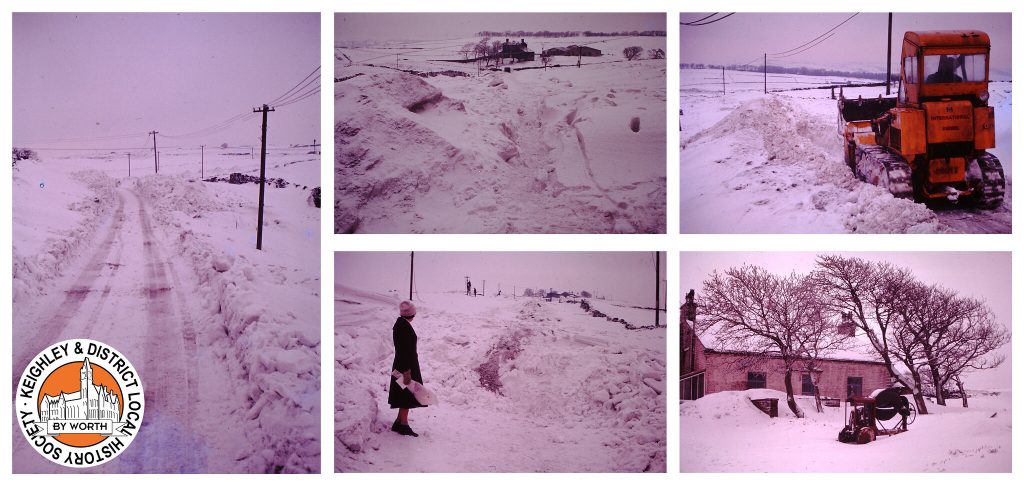
The “Big Freeze” of the winter of 1962/63 saw weeks of freezing weather and several feet of snow that just seemed to go on and on.
Things were little better even by the middle of February. The Keighley News wrote on 16th February 1963: “With the weathermen having said on Wednesday night that the big thaw was confidently expected, it was a frustrating day for Keighley people on Thursday when heavy snow fell throughout the day – a similar experience to that of just a week earlier. The snow continued to fall yesterday and corporation workmen, obviously tired and jaded from weeks of snow clearing, were almost back where they started… Thursday’s big snowfall was a real set-back to these men. All week they had been engaged in the out-districts cutting out blocked-up roads… and now the new fall has filled in most of the cuttings.”
These pictures are from slides taken by John Normington around this time, in the area round the tarn and the back roads to Steeton and Glusburn. They were donated to the History Society by John’s daughter, Liz Hornby, in 2021.
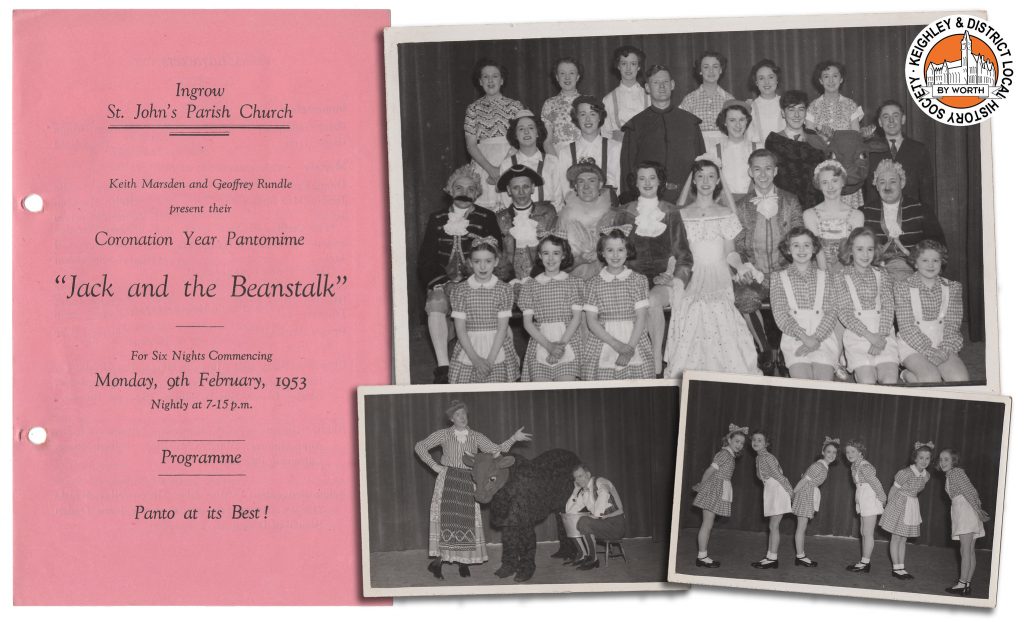
The third St. John’s Church annual pantomime produced by Keith Marsden and Geoffrey Rundle was announced in the Ingrow Parish Church Messenger of December 1952 as ‘Jack and the Beanstalk’. Rehearsals began after the church’s Christmas Fair with Margaret Shackleton playing the principal boy title character once more. Elsie Greenwell made her debut as the Squire’s daughter, Susan. Geoffrey played Dame Trot while Keith played that character’s son Jimmy. Stanley Peckover played Squire Grabbem and Shirley Lister played Prince Florizel. Victor Thompson concluded his trio of animal impersonations by playing one half of Jessie the cow, joined by Terry Marsden. The giant was played by Fred Kidd and his two henchmen (Blood and Thunder) were played by Derek Lund and William Bebb. This was the only one of the six pantomimes in which Joan Scott did not appear.
The show opened in the schoolroom on Monday 9th February 1953 and ran for six nights. It cost two shillings and six pence for adults and one shilling and six pence for children. Tickets were available in advance from Geoffrey’s father W. Rundle from his home on Caister Grove in Ingrow.
Press photographs were taken by the Keighley News and the paper’s review was published on closing night, Saturday 14th February 1953, and had this to say about the show: “The pantomime has fully lived up to the reputation set by the previous productions and with large audiences each evening this week it has been a distinct success. The pleasing back-cloths set off the bright and decorative costumes of the cast, while the subtle lighting effects and effects department each have a valuable contribution to make in enhancing the show. Topical scenes and comments gave an authentic up-to-date approach to the traditional pantomime fare while still retaining the age-old situations. Dame Trot’s cottage gives Keith and Geoffrey plenty of scope for laughs, and that scene in which a jet aeroplane is introduced are two of the highlights of the evening.”
Selling the majority of tickets in advance turned out to have been a financially fortuitous move because the week of the performances was hit by heavy snowfall, affecting the numbers able to attend. Those who did brave the elements were fully rewarded by the excellent entertainment and nearly £100 was raised.
The photographs and programme are all from the History Society archive on Flickr and were donated by Patsy Marsden (widow of Keith Marsden) and Liz Hornby (daughter of John Normington). Researched and compiled by Tim Neal.
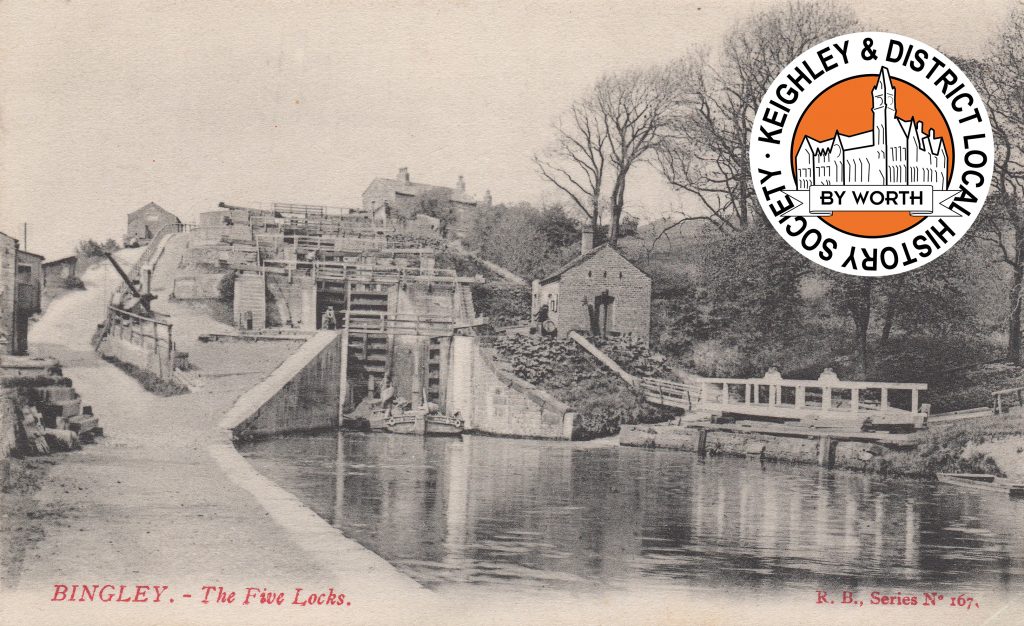
A reminder that this month’s guest speaker is Colin Thunhurst, of the Leeds & Liverpool Canal Society, giving a talk on the “The Local History of the Leeds & Liverpool Canal”.
Anyone is welcome to attend. The meeting is upstairs in Keighley Library on 8th February 2023. Doors open at 7pm and the meeting starts at 7.30pm. Admission is free to paid-up History Society members and £3.50 for non-members.
Paid-up members of the History Society also have the option to join this meeting via Zoom. Details are sent out to members a few days before the event is due to take place.
The Canal Society will also have a stall selling books and items that support the society. We can strongly recommend Mike Clarke’s comprehensive history of the canal!
This “Colotint” postcard, produced by Raphael Tuck & Sons, shows Cavendish Street at the start of the twentieth century, and is postmarked 1st February 1909.
The Midland Railway goods office can be seen on right of the picture (now demolished and in its place the entrance to Sainsbury’s car park), the Victoria Hotel (still standing today) is on left. Further back on the right is the familiar parade of shops with its glass and iron canopy. Many of the buildings further back on the left were demolished as part of the 1960s redevelopment.
Addressed to Mr W. Pilkington, of Chorley in Lancashire, the card reads: “I am so glad you arrived home quite safely. I did enjoy myself when I was out with. Doris was so very pleased with the frame. Love to all, Amelia”. The back of the postcard includes a green half-penny stamp featuring the head of King Edward VII. Curiously though the card doesn’t seem to have been posted from Keighley.
Postcard from the personal collection of Keighley and District Local History Society member Tim Neal. The modern photograph of Cavendish Street was taken by Tim Neal in 2022.
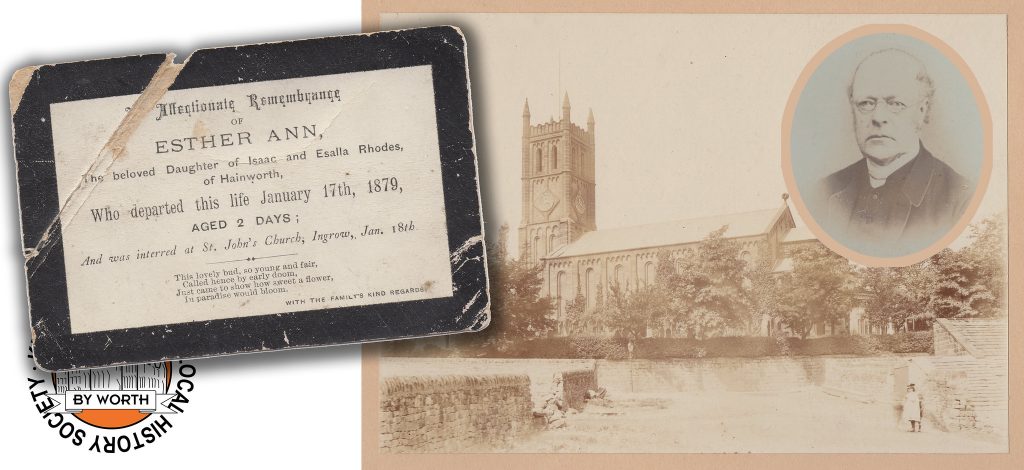
A small commemoration card for Esther Ann Rhodes, who died just two days old on Friday 17th January, 1879. She was born in Hainworth to father Isaac Rhodes and mother Isabella Rhodes (nee Towers). Esther Ann was interred at St John’s Church in Ingrow the following day.
The card carried a short poem: “This lovely bud, so young and fair, Called hence by early doom, Just came to show how sweet a flower, In paradise would bloom.”
The vicar in charge at St. John’s at the time was the Reverend Henry Weldy Marychurch, who was vicar from 1874 to 1882.
Esther had a twin sister, Susannah, who went on to marry William Henry Scattergood in 1905. They had two sons – Frank and Henry. Henry had two daughters – Coral and Jean.
The card was part of a collection brought along by Jean Battye (nee Scattergood) to a History Open Day held at St John’s Church on 3rd November 2019. The portrait of Rev. Marychurch and the photograph of the church are from the church’s archive.
The church of St. John’s is celebrating its 180th anniversary this year, with special services and a open-afternoon on 12th March 2023. Come along and discover more tales in connection with the church.
The Reverend William Thompson Elliott was formally inducted as the fifth vicar of St. John’s at the church itself on 9th February 1912. The officiating clergyman was the Venerable Archdeacon Francis Charles Kilner, assisted by the Reverend John Wood (curate of St. John’s) and the Reverend L. S. Robinson (rector of Keighley). Rev. Elliott had been serving as the vicar for Hainton-with-Sixhills in Lincolnshire, and had previously served as curate at Holy Trinity Church in Leeds and at St. Chad’s Church in Headingley. His father, the Reverend William Hayward Elliott, was Vicar of Bramhope. He was born on 15th November 1880 and was educated at Carlisle Grammar School and at Queen’s College, Oxford, from where he graduated with an M. A. in mathematics and history. He married Nora Walker and they had two sons and three daughters.
The church was closed in August 1913 for more redecorating and the installation of electric lights (the old gas light fittings went to Cullingworth Church). He was vicar of St. John’s at the outbreak of the First World War and was connected with local volunteers. Both the vicar and his curate, the Reverend Harry Francis Steel, were players with Ingrow Cricket Club (there wasn’t a church affiliated cricket team at this time). Reverend Elliott was also chaplain to the Keighley Branch of the Actors’ Church Union (including holding special services for the theatrical profession).
In December 1915, Rev. Elliott was offered the living of All Saints’ Church in Bradford. He preached his farewell sermon at St. John’s on Sunday 16th January 1916. He had served five years in the post. He became Canon and Sub-Dean of Liverpool Cathedral in 1924 and then Vicar and Rural Dean between 1926 and 1938. He was appointed Canon Residentiary of Westminster in 1938. He died suddenly of a heart attack on 20th June 1940 while visiting his wife in Streetly, near Birmingham. His ashes are buried in the vault in the lower Islip Chapel in Westminster Abbey.
His death was announced in the Keighley News of 22nd June 1940: “The death on Thursday, at the age of 60 (sic), of Canon W. Thompson Elliott, former Vicar of Leeds, who was Canon Residentiary of Westminster, has come as a great shock both to religious and lay life of the city, in which for 12 years his 6ft., broad-shouldered figure, broad smile, deep voice, and outspoken views had made him one of the most familiar and respected of men… He was a man of great intellectual ability who was always able to lighten his philosophy with a happy sense of humour which he could invariably make to fit the occasion.”
Portraits by Hall & Siggers, from the St. John’s Church archive. Researched and collated by Tim Neal.
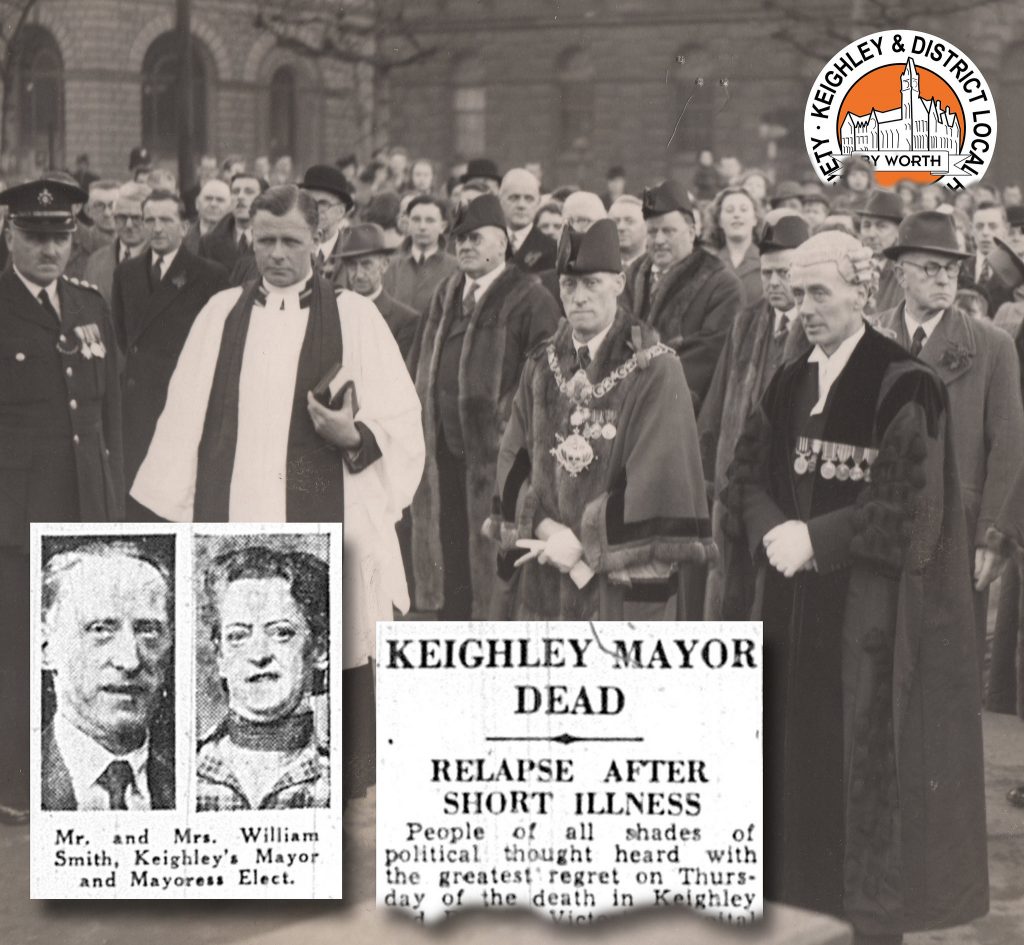
Mayor of Keighley, William Smith, died in Keighley and District Victoria Hospital on Thursday 10th January 1946, having served as Mayor for only two months. He’d been ill for a short period and had been admitted to Victoria Hospital before Christmas. Despite some signs of a recovery he died following a relapse. This was the first time one of the town’s mayors had died while in post. He was, according to the Keighley News, aged about 51. His funeral was held on 14th January 1946. It included a service at Keighley Parish church led jointly by the Reverend Eric Treacy, Rector of Keighley, and the Reverend Edward Askew John Miller, vicar of Ingrow St. John’s.
He commenced his time as Mayor on 9th November 1945 and his wife became Mayoress. His nomination to the post had been accepted back in July and was covered in the Keighley News of 21st July 1945: “Keighley’s next Mayor will be Mr. William Smith, of 207, Queen’s Road, Ingrow, whose nomination by the Labour members of the Town Council was accepted by the Mayoral Selection Committee on Monday. Mr. Smith is chairman of the Borough Labour Party, a former secretary of the Keighley Divisional Labour Party, and has served on the Keighley Town Council as a South Ward representative for two years… A native of Staincliffe, Batley, Mr. Smith has been in Keighley for about 40 years, and has long been prominently identified with the labour and trades union movement. An overlooker at Knowle Mills, he is a former president of the Keighley branch of the Managers’ and Overlookers’ Society, and as secretary and a member of the Executive Committee has rendered yeoman service to the movement… In the course of his work he had been agent to the late Mr. H. B. Lees-Smith, whose return to Parliament he materially helped to secure on a number of occasions. Mrs. Smith is a native of Keighley, and besides being intimately associated with the ladies’ section of the Labour Party has done useful work for 11 or 12 years on the Worth Valley Area Welfare Committee of the West Riding Public Assistance Committee.”
The main photograph shows the newly appointed Mayor, William Smith (centre with Mayoral chain), fulfilling one of the few duties he managed to carry out before becoming ill. He is laying a wreath at the base of the War Memorial in Town Hall Square on Remembrance Day, 11th November 1945, after his Mayoral Civic Service in Keighley Parish Church. On the right of the Mayor is the Reverend Eric Treacy, newly appointed Rector of Keighley, and to the Mayor’s left (in the wig) is town clerk Samson Walker.
He was succeeded as mayor by Alderman George H. Norton.
Cuttings from the Keighley News, main photograph from the archive of St. John’s Church. Researched and collated by Tim Neal.
The History Society wishes everyone a Merry Christmas. We have made available our latest newsletter for everyone. Usually this is one of the perks of being a paid-up member, but hey, it’s Christmas!
The newsletter comes out four times a year and is between 12 and 20 pages of articles and news about the society. This edition has articles on a stage production of Jane Eyre, the Big Freeze of winter 1963, a KAODS production of the musical Sybil, news about the anniversary of St. John’s Church in Ingrow, an interview with society member and former town mayor Graham Mitchell, and a list of guest speakers and events for 2023.
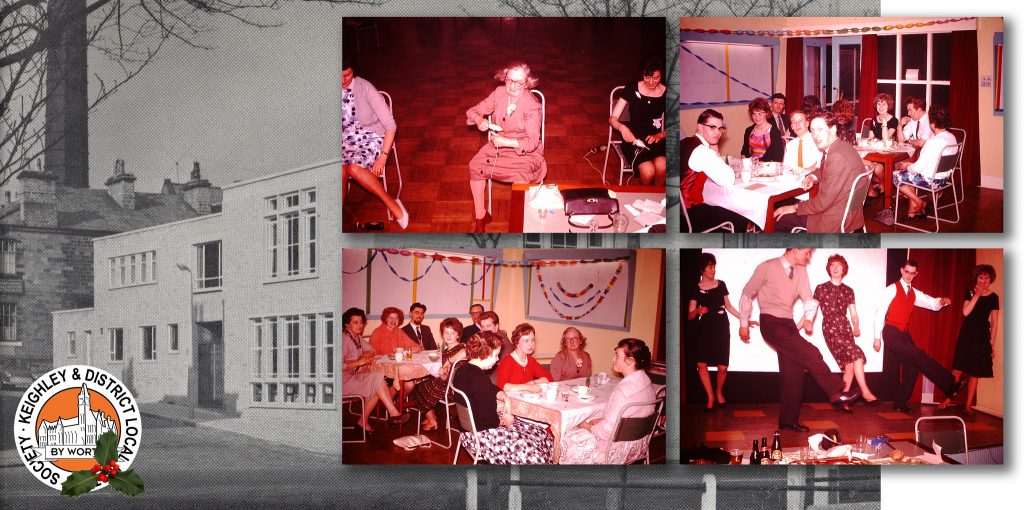
Members of Keighley Library staff enjoy themselves at their work Christmas party in December 1962. The party was held in the lecture hall, part of the new extension to the library. Those attending included Chief Librarian Fred Taylor and Mrs Taylor, Margaret Allsopp, Dorothy Beckwith, Betty Cardwell, Stewart Cardwell, John Cox, Nancy Crick, Michael Davison, Ian Dewhirst, Sally Hudson, Janet Kennedy, Dorothy Major, Doreen Nolan, and Barbara Watson.
All of the images are part of the John Normington Collection, donated to Keighley and District Local History Society by John’s daughter Liz Hornby in 2021.
John Normington was born in Keighley on 26th May 1929 and grew up in the Exley Head area of the town. He was joined by younger brother William five years later. John attended Ingrow Primary School and later won a scholarship for Keighley Boys’ Grammar School. His interest in music started with playing the drums at the age of six, then swapping to take up the piano.
His first job was at Keighley Library, where he remained (except for a break for National Service in 1947-49) until taking early retirement in March 1984. He was made Chief Assistant (Deputy) in 1953 having studied at the Leeds School of Librarianship. He ultimately became a lecturer himself in Cataloguing and Classification. He worked alongside local historian Ian Dewhirst for many years. Six months after he retired from Keighley Library in 1984, he took up the part-time role of Library Assistant at South Craven School.
One of his passions beyond the library was his music, and in performing. In the 1940s and 1950s he both acted with and played the drums for the Ingrow St. John’s Parish Church Players. Later he played the piano (and occasionally the drums) for Keighley Amateurs (of which he was a member for 72 years). Utilising his musical skills, he joined the Good Time Jazz Band in 1978. Another passion was potholing, having been introduced to it in the late 1940s, and he joined the Craven Pothole Club in 1952. He served as President of the Club in 1982 and as treasurer from 1984 to 1992. He was also a member of the 40 Club, the Grafton Club and Haworth Round Table. John died on 11th January 2020 at the age of 90.
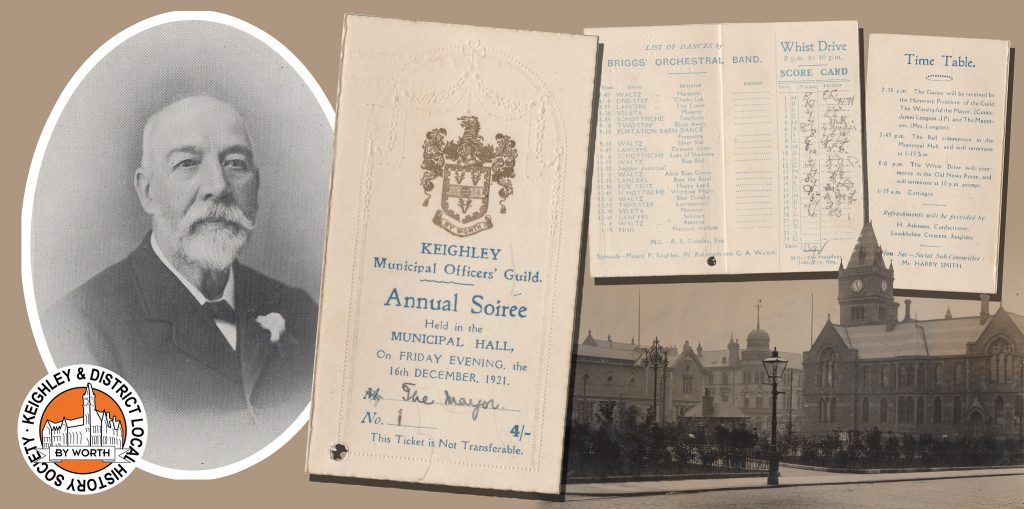
The Keighley Municipal Officers’ Guild held their Annual Soiree in the Municipal Hall on the evening of Friday 16th December 1921. The guest with ticket number one was the Mayor of Keighley, Mr James Longton, who served as Honorary President of the Guild.
Longton had been a member of Keighley Town Council since 1911. He was born in Withnell, near Chorley, in 1854. He served as Headmaster at Eastwood School in Keighley from 1881 to 1911 when he retired. He was Chairman of the Keighley Education Committee at the time he was made Mayor. He died on 4th July 1925.
The soiree commenced at 7.30pm with guests arriving to be greeted by the Mayor and Mayoress, Mrs Longton. The Ball began at 7.45pm with music provided by the Briggs’ Orchestral Band playing a selection of waltzes, lancers, two-steps and others (including a Flirtation Barn Dance!). A whist drive took place in the Old News Room from 8pm, and it appears from his dance card that the Mayor spent most of the evening playing whist. Refreshments for the evening were provided by H. Atkinson, a confectioner based on Lawkholme Crescent.
The portrait of the Mayor was taken by W. Bruce Johnston. The ticket is part of an archive relating to the mayoral year of James Longton, purchased by the History Society in 2022. The picture of Town Hall Square circa 1920 is from a postcard donated by Liz Hornby. Researched and collated by Tim Neal.