Photographs of Whinburn house in Utley taken by Keith Spencer (Fellow of the Royal Photographic Society) during a History Society visit to the house on 6th September 2005.
Whinburn is a Grade II listed building on Hollins Lane, Utley. The main hall consists of a baronial hall, seven reception rooms and thirteen bedrooms, with adjoining outbuildings, coach house, dilapidated gatehouse, and detached bungalow, and stands in approximately 7 acres of gardens. Fittings of the highest standard were used throughout Whinburn both externally and internally, so creating an Arts & Crafts house of supreme quality.
It was built in 1897 (designed by James Ledingham) for Prince Smith III (later Sir Prince Prince-Smith), a partner in the textile machinery manufacturing business of Prince Smith and Son. The house was redesigned and extended in 1912-13, and by 1919 a setting of formal terraces had been laid out to the north-east of the house. Following the death of Sir Prince Prince-Smith in 1940, Whinburn was used as a training centre by the National Institute of House-workers and in the early 1950s was purchased by the Local Authority for use as a school, initially residential.
The school closed in mid 2002 and the house remained empty until 2008 when the City of Bradford Metropolitan District Council sold it to businessman James Sheldon. Sheldon bought the estate with the intention of developing the house and reclaiming the gardens, with advice from English Heritage. Sheldon, 42, died from multiple injuries having jumped from the tower on 23rd June 2015 due to rising business debts. The house was put up for sale again for around £1,000,000 in the last few years.
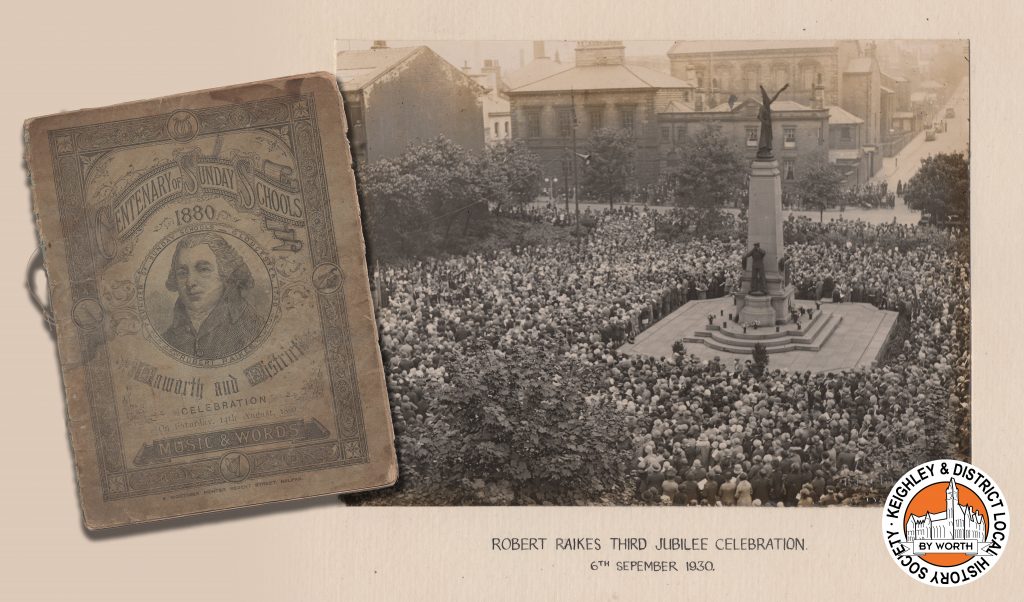
A gathering was held in Town Hall Square on 6th September 1930 to mark the 150th anniversary of the founding of the Sunday School movement by Robert Raikes in 1780. The photograph taken by George A. Shore.
Robert Raikes (1735-1811) was credited as the Founder of Sunday Schools. He founded his first school in St Catherine Street in Gloucester in July 1780. 1930 marked 150 years (a ter-jubilee or third jubilee being three times fifty years – the biblical definition of ‘jubilee’) since the movement was started. There were celebrations celebrating the anniversary held around the country throughout the year.
George A. Shore was a popular Keighley-based freelance photographer who simultaneously ran his photography business alongside running a carpet and linoleum store in Keighley market. Examples of his work exist from the 1930s and 1940s, and included outdoor events such as Keighley Gala, the coronation of King George VI, Victory street parties at the end of the Second World War, theatre productions, weddings, and landscapes. Many of his photographs were commissioned by and printed in the Keighley News. His original prints could be embossed “G. A. Shore” or stamped on the back in a circle “Geo. A. Shore”. In his other lines of business, Shore was an early member of Keighley Road Club and used to deliver rolls of carpet and linoleum via his motorbike and sidecar, aided by assistant Sam Scaife. Shore died in 1946.
The photograph is probably taken from a second floor window of a building on Cooke Street, looking across to North Street. There is a stage on the very left of the photograph from which the crowd is being addressed via speakers. Many of the crowd appear to be holding sheets – possibly hymn sheets – possibly for “Sabbath Schools are England’s Glory,” an old-time hymn, first sung in a Lancashire United Methodist School, which the National Sunday School Union republished for use in the Raikes Ter-Jubilee celebrations.
Also shown is the front cover of a booklet containing hymns and music to be sung at the Haworth and District Celebration of the Sunday School Centenary, to be held at Marsh Bottom, Haworth, on Saturday 14th August 1880. The beautifully designed cover includes a portrait of Robert Raikes.
Both items were donated in 2019 by Susan Hyde on behalf of her father, Hubert Spencer.
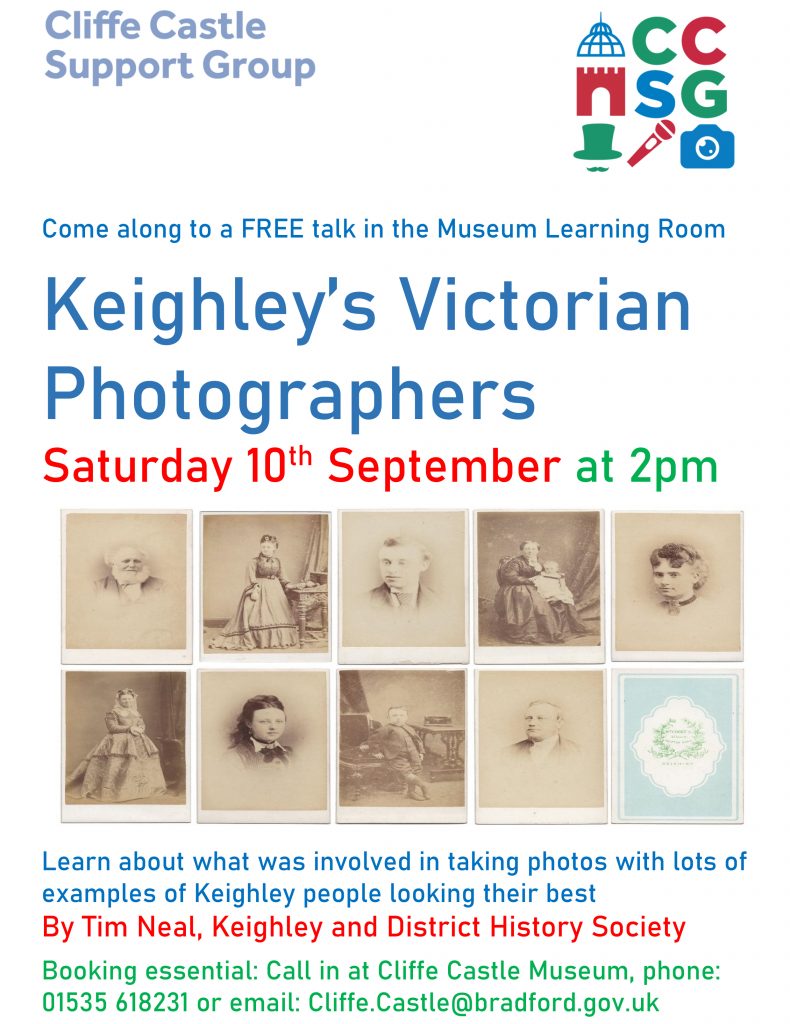
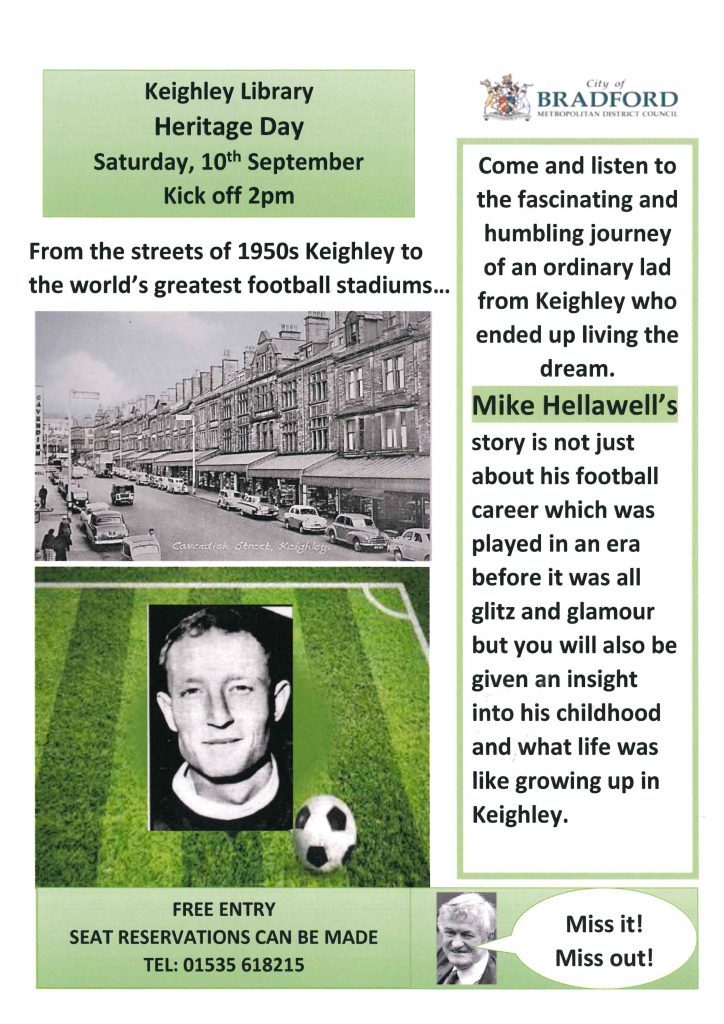
There are two very different talks happening this coming Saturday (10th September). History Society member Tim Neal is giving a talk on Keighley’s Victorian Studio Photographers at Cliffe Castle at 2pm and Mike Hellawell will be giving a talk on his football career and on growing up in Keighley in the 1950s at Keighley Library at 2pm.
The hard part is deciding which to attend!
Both advise booking in advance (see posters below for details).
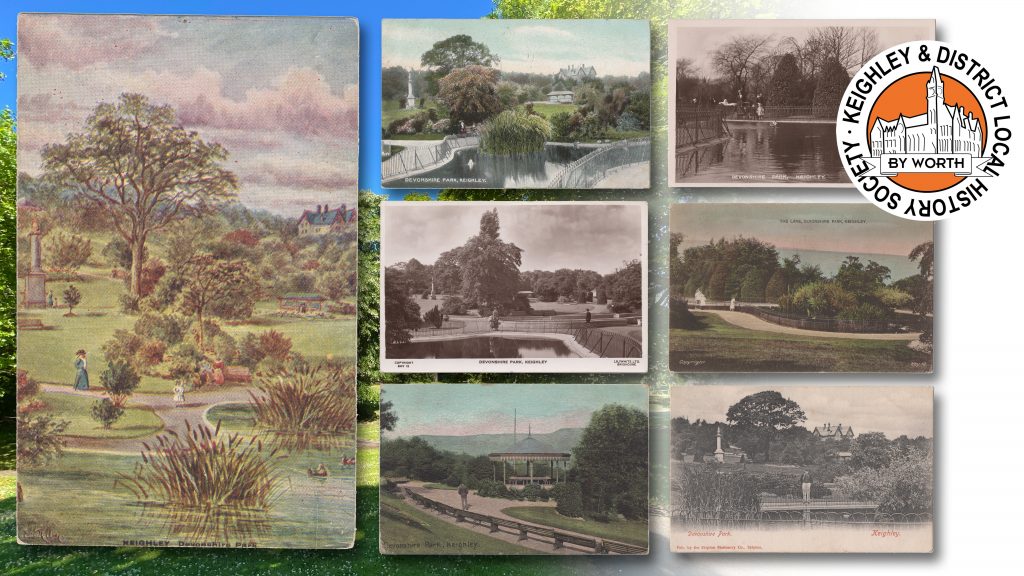
Devonshire Park was officially opened to the public on 4th September 1888 and remains open today.
The Devonshire Park and Cliffe Castle Conservation Area Assessment (City of Bradford Metropolitan District Council, April 2002): “(Devonshire Park) was laid out on the nine acres of land that were presented to the town of Keighley by the Duke of Devonshire in celebration of Queen Victoria’s Jubilee, and was formally opened to the public on 4th September 1888. The establishment of Devonshire Park reflects the fashion in the closing decades of the nineteenth century for rich members of society to demonstrate their benevolence by gifting land and resources for use in municipal projects. It was a period of philanthropic gestures… The layout of Devonshire Park is typical of late Victorian parks, with serpentine paths curving around islands of formal planting and an ornamental lake, leading up to a broad gravel terrace just above the bandstand, ideal for its intended purpose as an area for peramble. In 1888, Devonshire Park was bounded on three sides by a Wesleyan Chapel, the residences of Mr. Summerscales, Mr. Prince Smith Junior and Mr. Henry Wright and the precincts of Cliffe Castle. It is evident that at this time a number of wealthy professionals had already set up home in the area, but to the masses the area remained relatively inaccessible, as it could only be reached by the use of private transport. The area continued to expand as a residential quarter throughout the closing decades of the nineteenth century and the early years of the twentieth century, with the attractiveness of the park no doubt contributing to its appeal. The smaller roads were constructed to allow access to the new properties and as streets on which to site new developments.”
Postcards from the History Society’s digital archive on Flickr.
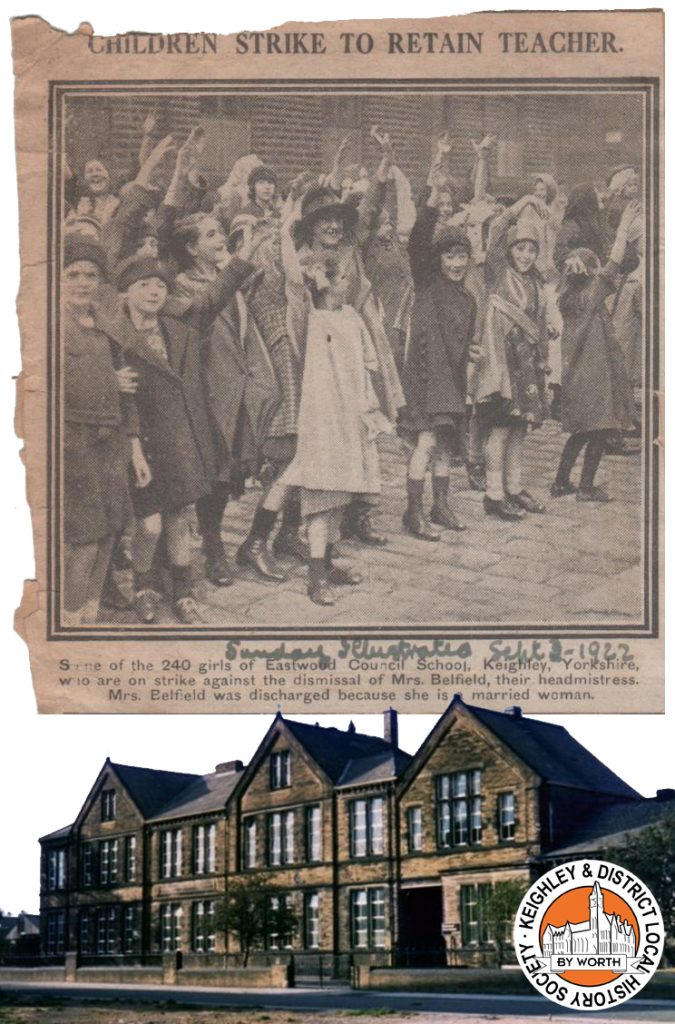
This newspaper clipping is from an edition of Sunday Illustrated, published on the 3rd of September 1922. The headline and caption reads: “Children strike to retain teacher: Some of the 240 girls of Eastwood Council School, Keighley, Yorkshire, who are on strike against the dismissal of Mrs Belfield, their headmistress. Mrs Belfield was discharged because she is a married woman.”
Sunday Illustrated was a short-lived national newspaper that ran from July 1921 to November 1923. As the name implies, its content relied heavily on photographs over text.
Cutting from a scrapbook of clippings kept by George Crowther of photographs he took and articles he wrote for various publications. Crowther (d: 1960) spent 50 years with the Bradford and District Newspaper Company until his retirement in 1956. He started out as a press photographer in the 1920s and ended with six years as editor of the Keighley News (1950-1956). He was active in the St. John Ambulance Brigade and served on the Council of the Bronte Society.
The Penguin Players’ production of ‘Little Women’, by Marian De Forest (from the novel by Louisa M. Alcott), opened at the Hippodrome and Queen’s Theatre in Keighley for one week only from Monday 1st September 1952.
Amongst the cast were Monty Vane-Tempest and Louise Ralston as Mr and Mrs March. The play was produced by Peter Davey and the manager of the players was Kathleen Willis. Linda Dale accompanied proceedings on the piano.
The programme also included adverts for the Regal Milk Bar (proprietor J. W. Dutton) on North Street; H. Wilkinson (television dealer) in The Arcade on North Street; Shackleton and Sagar’s Minerals from Spring Bank in Ingrow; the cocktail bar of the Victoria Hotel on Cavendish Street; J. Scheerer & Sons (sound firm) of Leeds; C. Holmes (plumber and sanitary engineer) of Sandywood Street; A. Lord & Co. (modern furnishers) with showrooms on High Street; Jack Hey (joiner and undertaker) of Albert Yard off Bridge Street; Katheena (prize-winning ladies’ hair stylist) on Fell Lane; John W. Laycock Ltd. (fireplace specialists) of North Street; Timothy Taylor’s Prize Ales (“for men of the North”); Rightway School of Motoring on Lawkholme Crescent; Harry Stowell (plumber and sanitary engineer) of Bradford Road, Riddlesden; Renee Coats, Gowns and Knitwear of Church Street; and Windser Pottery (H. Brearley and Sons) of North Street.
The 1950s was a turbulent decade in the history of the Hippodrome and Queen’s Theatre in Keighley. Long-time Managing Director Francis Laidler (who also owned the Alhambra Theatre in Bradford) died in 1955 and was succeeded by his widow Gwladys. Television was providing a significant challenge to theatre-going by the middle of the decade, and the Hippodrome had to try more extreme forms of entertainment to draw in the crowds. But to no avail, and the theatre finally closed its doors in 1956, before being demolished in 1961 to make way for the new town centre’s multi-storey car park.
The programme was donated to Keighley and District Local History Society by Tim Neal in 2022. It is held in the History Society’s physical archive.
Trackless trolleybuses ran for the last time in Keighley on Wednesday 31st August 1932. From the following day motorised buses provided all the public transport around the town.
Trolleybuses travelled on wheels with tyres but drew their power from overhead power cables. They succeeded the electrified trams that ran along tracks laid on the main roads in and out of the town up until 1924, when the tracks were taken up but the overhead power cables were kept in place.
The colour photograph was taken in the College car park during the Keighley Transport Festival held in June 2022, and shows the restored Keighley No. 5, the Straker-Clough trolleybus that came into service in 1924.
These three gentlemen were all prize-winners at the 63rd annual show of the Haworth, Cross Roads, Lees and Oxenhope Gardeners and Allotment Holders Association, held on Saturday 29th August 1981. All three winners had the surname Shackleton (although only two were related) and between them they took home four out of the eight cups awarded. The story was covered in the 4th September edition of the Keighley News.
In 2021, Keighley and District Local History Society acquired an extensive collection of photograph negatives taken by the Keighley News. Groups of negatives were held in small wallets with the date and basic labelling written on the wallet. The photographs are from this set. The colour photograph of Haworth Village Hall was taken by Tim Neal in 2020.
William Anderton Brigg was born on 27th August 1862. He was the second son of Sir John Brigg, who became the second MP for Keighley (1895-1911, Liberal), and Mary Brigg. William was second son only by a matter of moments as he was one of twins and was just the junior to John Jeremy Brigg (1862-1945). He and his twin brother lived at Kildwick Hall between Keighley and Skipton from around 1875 to 1945. They lived there with their younger brother, and later were joined by their sister Mary following the death of her husband.
William became Mayor of Keighley in 1912, following in the footsteps of his own uncle, Benjamin Septimus Brigg, who had been Keighley’s first mayor in 1882/83. William became the longest serving Mayor, being in post for four years (1912-16). As William was a bachelor, his sister, Mary Sharpe of Darley Dale, undertook the role of mayoress. He also served as a magistrate and the Police and court report columns of local newspapers of the time are full of his deeds in dealing with the strikes and riots of 1914. He was Mayor at the start of the First World War and was very active raising funds for war bonds, aeroplanes and recruitment, and the extension buildings at the Morton Banks War Hospital.
His time as Mayor is recorded in the Keighley News Borough Jubilee supplement of 10th September 1932: “The distinction of having been Mayor of Keighley longer than anyone else belongs to Alderman William Anderton Brigg, who filled the position with great credit for four successive terms. There is practically no phase of Keighley’s public and social life in which his name does not figure. (He) entered the Town Council in 1912, and he has remained a member down to the present time. As Deputy Town Clerk for the late Mr George Burr and as Clerk to the Denholme District Council he had already had much experience of local government work. On the retirement of his uncle, Mr B. S. Brigg, Alderman Brigg was appointed his successor as chairman of the Waterworks Committee, and it was under him that the great Sladen Valley waterworks project finally grew to fruition, though, because of the war, at a cost undreamed of when the venture was first begun. He was Mayor when the Great War broke out, and two of the most difficult years in Keighley’s history passed with him at the head. His generosity for war relief objects was outstanding. Time, energy, and money were freely spent. He took a leading share in the formation of Keighley’s War Hospital; he opened war funds, and, indeed, when he retired from the Mayoralty a sum of something like £39,000 had been raised in the borough and surrounding efforts in war funds.”
Along with his twin brother, William bought East Riddlesden Hall in 1913. The hall was in a pretty poor state, having been largely refashioned in the 19th century when it was divided up to house tenant farmers. They sought, unsuccessfully, to raise funds to preserve the house, and the house ended up for sale in an auction in 1921. Finally, in 1933, it was sold to a builder with plans to redevelop the whole site, but the Briggs brothers stepped in again. The Hall and estate were handed over to the National Trust on 31st May 1934 on the understanding that it would be looked after for ever and that the land surrounding it would be used for recreation by the local communities.
William served as honorary secretary of the Keighley and District Victoria Hospital and was a staunch supporter of the Y.M.C.A. He stood for election as a Liberal MP in Skipton in 1918 and in Keighley in 1922. He was unsuccessful on both occasions, losing in Keighley to H. B. Lees-Smith who was elected as the town’s first Labour MP (by a majority of over 4000). In 1925, William became the thirteenth Honorary Freeman of Keighley, following in his father’s footsteps who was the fifth person to have the honour bestowed upon them.
He was chairman of the Board of Governors of Drake and Tonson’s School in Strawberry Street, Keighley, and in 1931 he laid a foundation stone for what would become the Keighley Girls’ Grammar School in Stoneycroft Lane, Utley. The school was officially opened in 1934 by the Right Honourable Viscount Halifax, president of the Board of Education.
William died on the 4th January 1938, aged 75. He is buried in the Quaker cemetery established by Thomas Brigg in the 17th century, located between Lustre Street and North Dean Road in the Guardhouse area of Keighley.
The portrait of William is taken from the Keighley News Borough Jubilee Supplement of 10th September 1932; the Borough Council photograph with William is his Mayoral chain is a Hill and Siggers portrait; the postcard of East Riddlesden Hall is a Walter Scott postcard; and the newspaper cutting is from the The Yorkshire Observer of 16th November 1922, photograph by George Crowther.
This is a quotation from Hird Bros. & Co. Ltd. (builders, joiners and contractors) of King Street and Otley Street, Keighley, dated 27th August 1959. It was for William Normington who lived at 118 Wheathead Lane who wanted some kitchen work done.
We know Hird Bros. & Co. Ltd. operated in the 1950s and 1960s because we have these two adverts from (top) a 1953 coronation newsletter from Keighley Parish Church and (bottom) a 1961 Keighley Amateurs’ programme.
The quotation paperwork includes the logos for the National Federation of Building Trades Employers, and the National Scheme for Disabled Men. The inclusion of the logo for the National Scheme for Disabled Men indicated the firm had undertaken to employ an approved percentage of disabled ex-servicemen, following the end of the First World War. In September 1919, King George V issued a proclamation charging employers to engage disabled sailors and soldiers, and ordering the names of employers who do so to be inscribed on the King’s National Roll. It was expected that one place in twenty in any establishment should be reserved for a disabled man, and that employers fulfilling the condition would be permitted to use a special-design, with the words “National Scheme for Disabled Men”, on their business notepaper. It was thus easy for the public to distinguish the patriotic from the unpatriotic employer.
The main picture shows Wheathead Lane taken from number 118 by John Normington in the 1950s.
The quotation and photograph is part of the John Normington Collection, donated to Keighley and District Local History Society by John’s daughter Liz Hornby in 2021.