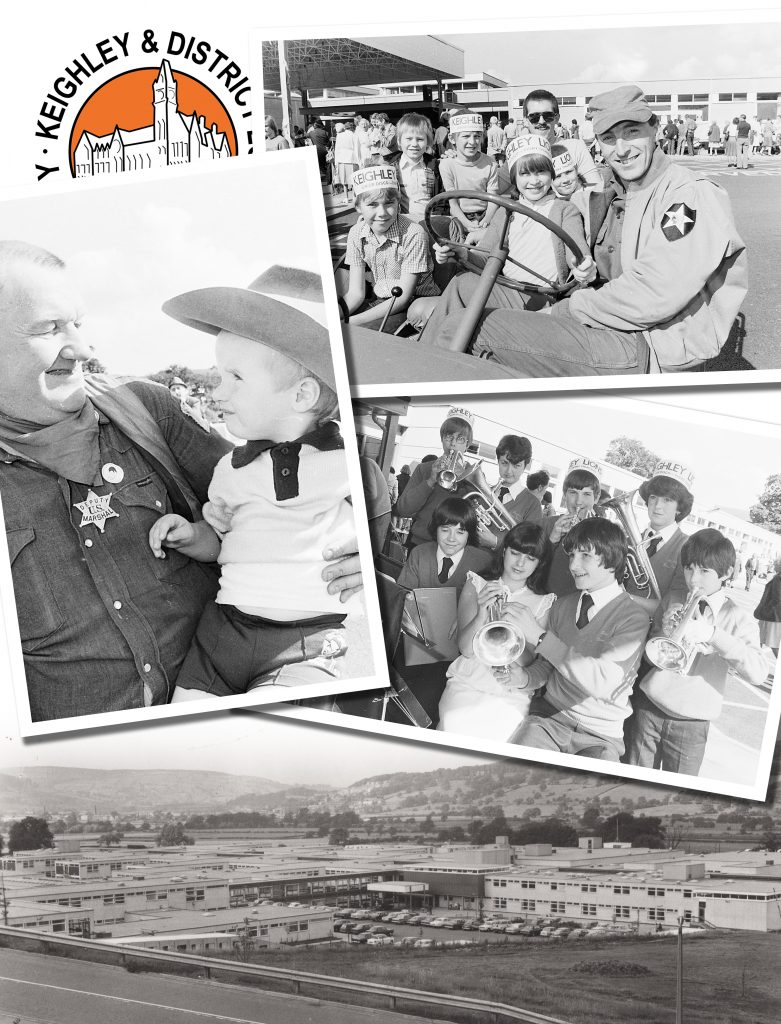
Three photographs taken by a Keighley News reporter at the Friends of Airedale Hospital September Fete held at the Hospital on Saturday 12th September 1981. The event was covered in the Keighley News of 18th September 1981.
Left: Regular fete attender Tex Slack lends his hat to two year old James Brown. Top right: Peter Whitaker of Glusburn, a member of the U.S. Army Vehicle Club, gives children a ride in one of his U.S. Army Jeeps. Bottom right: Junior members of Keighley Band offer tuition to ‘Miss Airedale’ Diane Khan. Some of the children sitting in the photographs are wearing hats advertising ‘Keighley Lions’ Junior Disco – Every Thursday’.
In 2021, Keighley and District Local History Society acquired an extensive collection of photograph negatives taken by the Keighley News. Groups of negatives were held in small wallets with the date and basic labelling written on the wallet. These images are from that collection.
This postcard was posted to Workington in Cumbria on 16th September 1941 (although to be fair the postmark is a little hard to read – it could be 18th September and it might 1940-something else).
But it’s still interesting on several levels – the postcard was produced by Lilywhite Ltd., based in Brighouse, who produced dozens of postcards of Keighley between the 1920s and 1960s. They occasionally get a few details wrong – and in this case it’s the street name (the photographer is standing pretty much where North Street and Skipton Road meet, but the view is definitely along North Street).
The sender of the postcard writes: “Having a nice time and lovely weather. Keighley is still the same – no change from last time at all.” And that’s pretty much true of this view 80 years on. St. Anne’s Primary School still dominates the right hand side of the road, and the dome of the Temperance Hall (now Wetherspoon’s) can still be seen in the distance. The clocktower of the Mechanics’ Institute on the left is long gone, but you can’t tell because of the ‘Get in lane’ road sign. The main additions are the various bits of signage, the road markings and the volume of traffic.
Postcard from the personal collection of Tim Neal, modern photograph taken by Tim in 2022.
A reminder that Cliffe Castle community curator Heather Millard will be giving her talk on ‘The Butterfield Women’ this Wednesday (14th September).
We hear a lot about the Butterfield men who lived in Cliffe Castle but this time Heather is telling us about the interesting lives of the women of the Butterfield Family and their influence on more than just the family.
This talk is planned for upstairs at the Library and is open to everyone. £3 on the door for non-members. Paid-up History Society members will have received their emails on how to join the Zoom meeting if they would prefer. Doors open at 7pm for a 7.30pm start.
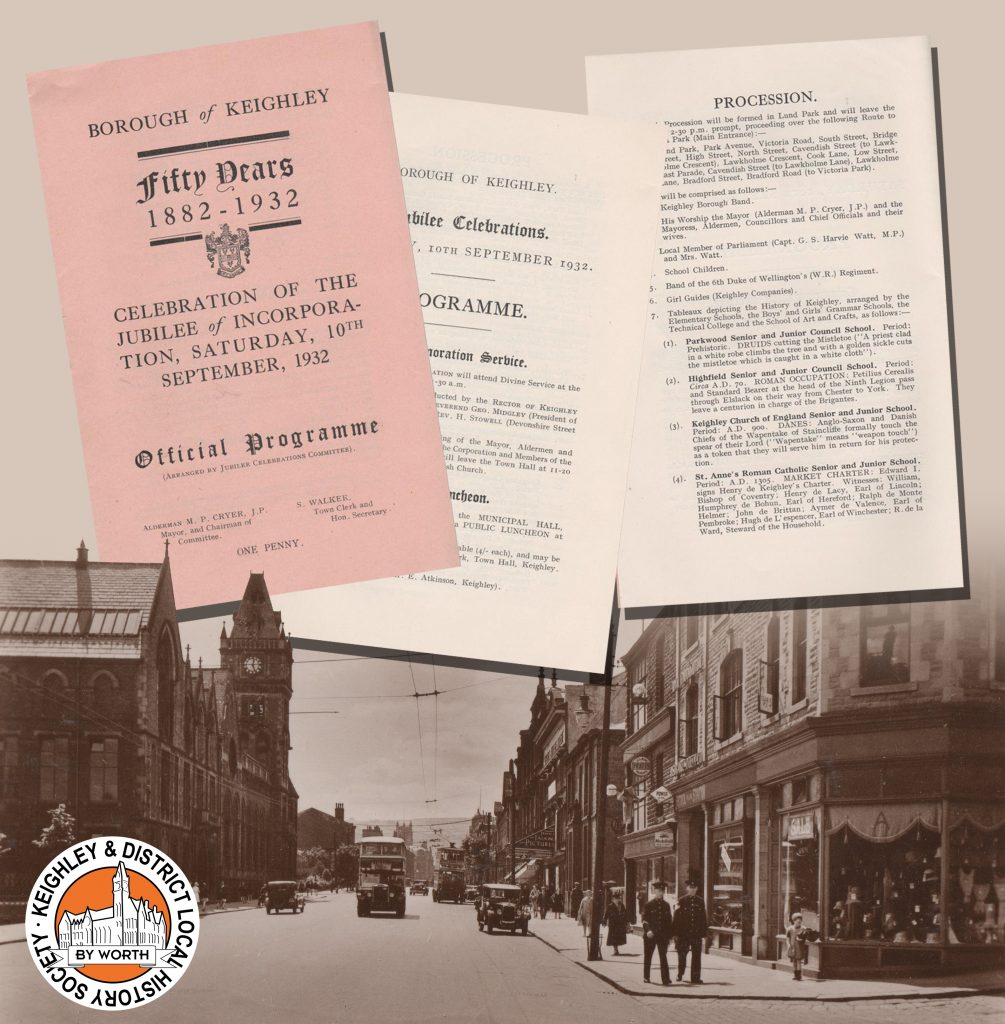
On Saturday 10th September 1932, the town celebrated fifty years since the Borough of Keighley was formed. The actual incorporation had taken place in July 1884. This meant a local town council and mayor taking on responsibility for running various services within the area.
The jubilee celebrations on that Saturday started with a civic procession led by the Mayor (Alderman Michael P. Cryer) from the Town Hall to Keighley Parish Church for a commemoration service. The service was led jointly by the Rector of Keighley (Reverend J. C. F. Hood), the President of the Free Church Council (Reverend George Midgley) and the vicar of Devonshire Street Congregational Church (Reverend H. Stowell). There followed a public luncheon in the Municipal Hall (Mechanics’ Institute), catered by Mr E. Atkinson. Tickets were four shillings each.
The main event was a procession that set off from Lund Park at 2.30pm and headed down to Victoria Park (in a rather loopy fashion!). The procession was made up of the Mayor, Mayoress, and members of the town council, the local MP (George S. Harvie Watt) and his wife, Keighley Borough Band and the Band of the Sixth Duke of Wellington’s West Riding Regiment, children from many of the local schools who formed historic tableaux on the back of lorries and carts, and students from the Technical College who also created tableaux.
A tea party in Victoria Park (catered by Keighley Industrial Co-operative Society Ltd.) was held for school children, at which they were presented with commemorative mugs. Various entertainments were provided for all from a stage erected in the park, there was an exhibition netball match between a team from Keighley Girls’ Grammar School and a team from various Keighley elementary schools, tree planting led by the Mayor, and a massed male voice choirs concert. To end the evening at 9pm there was a grand display of fireworks staged by Messrs Henry Shaw & Sons of Huddersfield.
A 12-page Official Programme for the day was available, printed by Wadsworth & Co. Ltd. of Russell Street. The full programme can be found on the History Society’s Flickr site. The main photograph is a detail from a Valentine’s postcard showing North Street in 1930.
Photographs of Whinburn house in Utley taken by Keith Spencer (Fellow of the Royal Photographic Society) during a History Society visit to the house on 6th September 2005.
Whinburn is a Grade II listed building on Hollins Lane, Utley. The main hall consists of a baronial hall, seven reception rooms and thirteen bedrooms, with adjoining outbuildings, coach house, dilapidated gatehouse, and detached bungalow, and stands in approximately 7 acres of gardens. Fittings of the highest standard were used throughout Whinburn both externally and internally, so creating an Arts & Crafts house of supreme quality.
It was built in 1897 (designed by James Ledingham) for Prince Smith III (later Sir Prince Prince-Smith), a partner in the textile machinery manufacturing business of Prince Smith and Son. The house was redesigned and extended in 1912-13, and by 1919 a setting of formal terraces had been laid out to the north-east of the house. Following the death of Sir Prince Prince-Smith in 1940, Whinburn was used as a training centre by the National Institute of House-workers and in the early 1950s was purchased by the Local Authority for use as a school, initially residential.
The school closed in mid 2002 and the house remained empty until 2008 when the City of Bradford Metropolitan District Council sold it to businessman James Sheldon. Sheldon bought the estate with the intention of developing the house and reclaiming the gardens, with advice from English Heritage. Sheldon, 42, died from multiple injuries having jumped from the tower on 23rd June 2015 due to rising business debts. The house was put up for sale again for around £1,000,000 in the last few years.
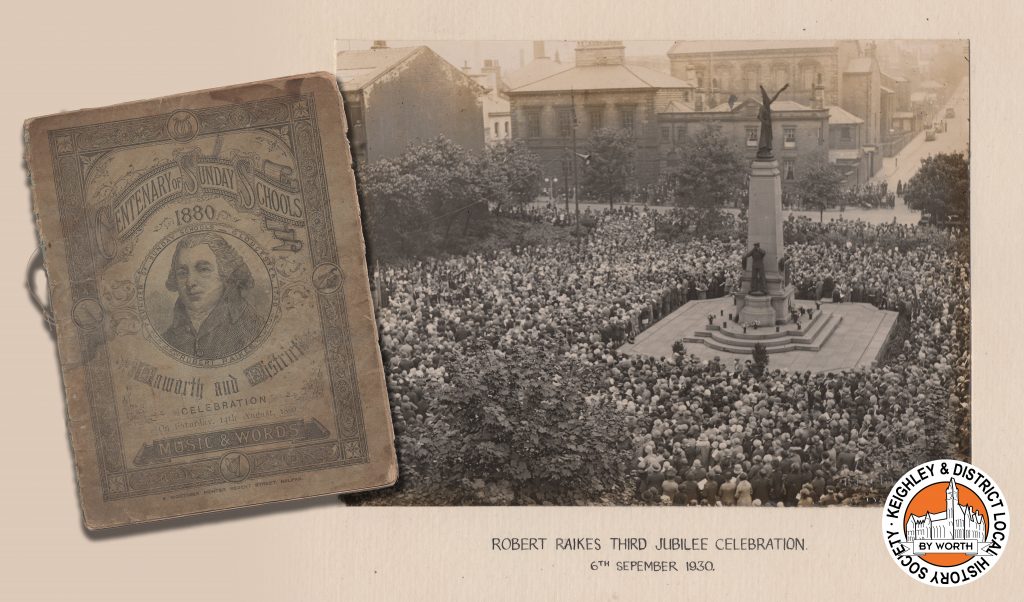
A gathering was held in Town Hall Square on 6th September 1930 to mark the 150th anniversary of the founding of the Sunday School movement by Robert Raikes in 1780. The photograph taken by George A. Shore.
Robert Raikes (1735-1811) was credited as the Founder of Sunday Schools. He founded his first school in St Catherine Street in Gloucester in July 1780. 1930 marked 150 years (a ter-jubilee or third jubilee being three times fifty years – the biblical definition of ‘jubilee’) since the movement was started. There were celebrations celebrating the anniversary held around the country throughout the year.
George A. Shore was a popular Keighley-based freelance photographer who simultaneously ran his photography business alongside running a carpet and linoleum store in Keighley market. Examples of his work exist from the 1930s and 1940s, and included outdoor events such as Keighley Gala, the coronation of King George VI, Victory street parties at the end of the Second World War, theatre productions, weddings, and landscapes. Many of his photographs were commissioned by and printed in the Keighley News. His original prints could be embossed “G. A. Shore” or stamped on the back in a circle “Geo. A. Shore”. In his other lines of business, Shore was an early member of Keighley Road Club and used to deliver rolls of carpet and linoleum via his motorbike and sidecar, aided by assistant Sam Scaife. Shore died in 1946.
The photograph is probably taken from a second floor window of a building on Cooke Street, looking across to North Street. There is a stage on the very left of the photograph from which the crowd is being addressed via speakers. Many of the crowd appear to be holding sheets – possibly hymn sheets – possibly for “Sabbath Schools are England’s Glory,” an old-time hymn, first sung in a Lancashire United Methodist School, which the National Sunday School Union republished for use in the Raikes Ter-Jubilee celebrations.
Also shown is the front cover of a booklet containing hymns and music to be sung at the Haworth and District Celebration of the Sunday School Centenary, to be held at Marsh Bottom, Haworth, on Saturday 14th August 1880. The beautifully designed cover includes a portrait of Robert Raikes.
Both items were donated in 2019 by Susan Hyde on behalf of her father, Hubert Spencer.
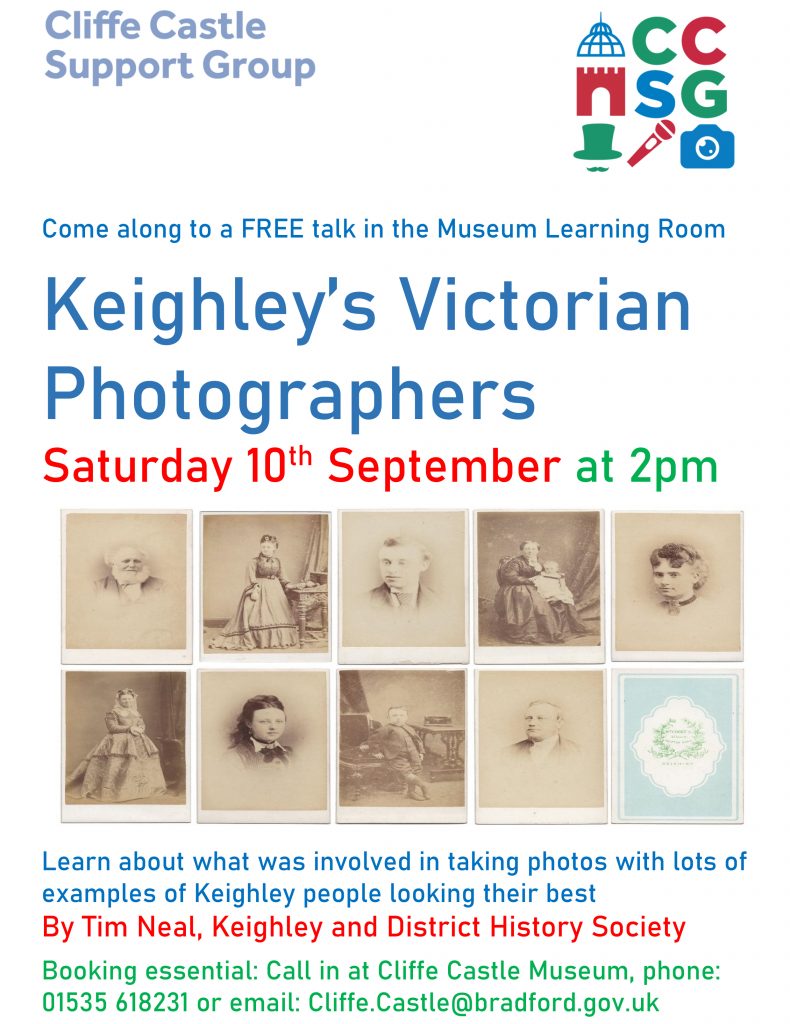
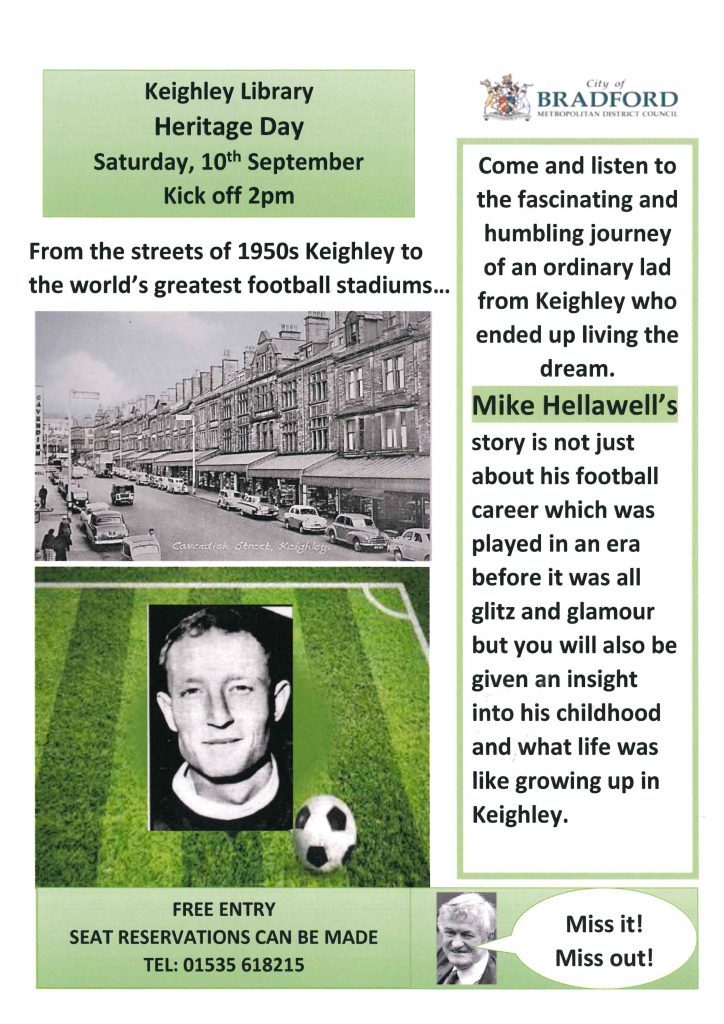
There are two very different talks happening this coming Saturday (10th September). History Society member Tim Neal is giving a talk on Keighley’s Victorian Studio Photographers at Cliffe Castle at 2pm and Mike Hellawell will be giving a talk on his football career and on growing up in Keighley in the 1950s at Keighley Library at 2pm.
The hard part is deciding which to attend!
Both advise booking in advance (see posters below for details).
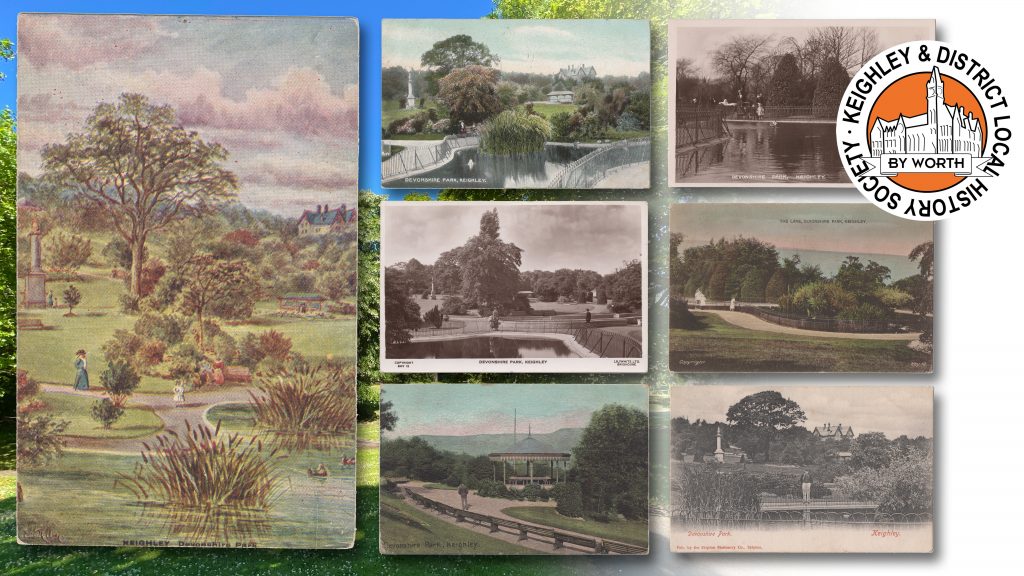
Devonshire Park was officially opened to the public on 4th September 1888 and remains open today.
The Devonshire Park and Cliffe Castle Conservation Area Assessment (City of Bradford Metropolitan District Council, April 2002): “(Devonshire Park) was laid out on the nine acres of land that were presented to the town of Keighley by the Duke of Devonshire in celebration of Queen Victoria’s Jubilee, and was formally opened to the public on 4th September 1888. The establishment of Devonshire Park reflects the fashion in the closing decades of the nineteenth century for rich members of society to demonstrate their benevolence by gifting land and resources for use in municipal projects. It was a period of philanthropic gestures… The layout of Devonshire Park is typical of late Victorian parks, with serpentine paths curving around islands of formal planting and an ornamental lake, leading up to a broad gravel terrace just above the bandstand, ideal for its intended purpose as an area for peramble. In 1888, Devonshire Park was bounded on three sides by a Wesleyan Chapel, the residences of Mr. Summerscales, Mr. Prince Smith Junior and Mr. Henry Wright and the precincts of Cliffe Castle. It is evident that at this time a number of wealthy professionals had already set up home in the area, but to the masses the area remained relatively inaccessible, as it could only be reached by the use of private transport. The area continued to expand as a residential quarter throughout the closing decades of the nineteenth century and the early years of the twentieth century, with the attractiveness of the park no doubt contributing to its appeal. The smaller roads were constructed to allow access to the new properties and as streets on which to site new developments.”
Postcards from the History Society’s digital archive on Flickr.