The History Society’s Christmas Meeting is on Wednesday 14th December. It will be held upstairs in Keighley Library, doors open at 7pm and the meeting starts at 7.30pm.
This is our usual Christmas meeting, so rather than a guest speaker there will be the chance to see some of the acquisitions we have made over the last 12 months, to hear about Christmas in Keighley 100 years ago, to take part in a just-for-fun quiz – and to have a mince pie!
Entry is free for paid-up members of the Society and guests can come along for £3 (payable on the door). This is also the last chance to join the Society or renew your membership at the 2022 rate (£10 for a single person, £15 for two people at the same address), before the prices go up (to £15/£20) from 1st January.
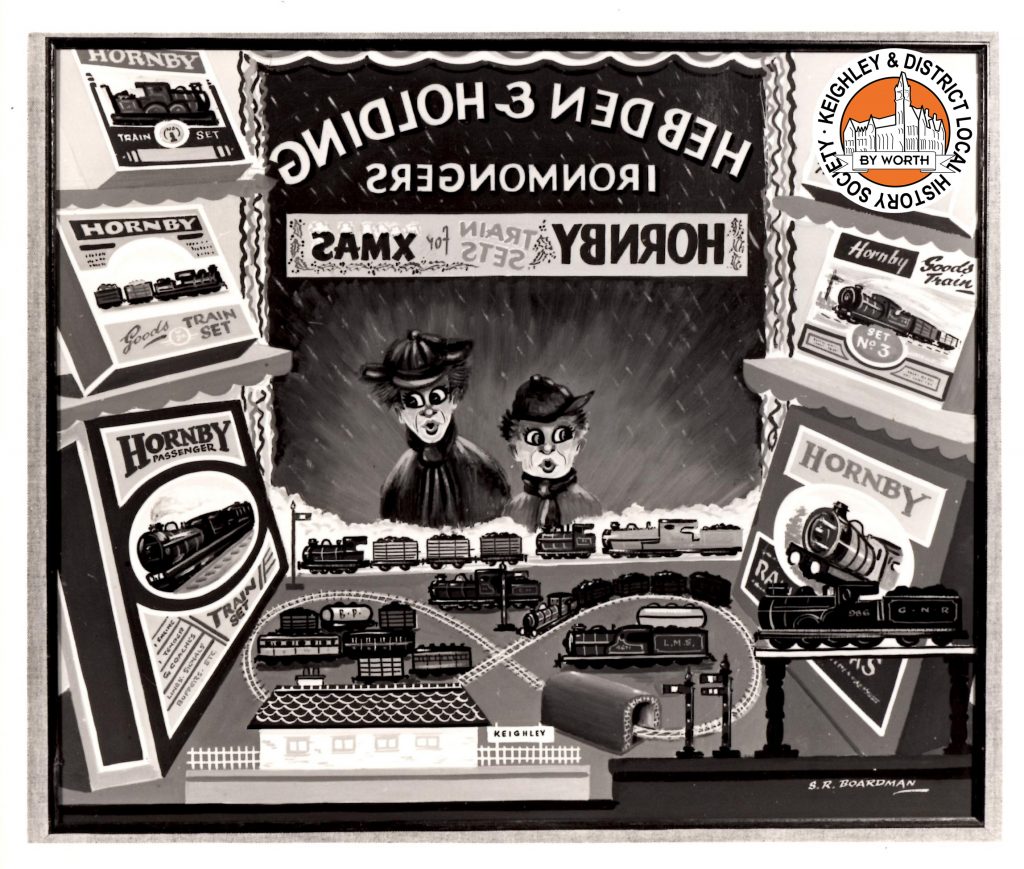
Christmas scene featuring 1920’s Boy, painted by Stanley R. Boardman (1915-1996).
Two events of local interest are happening in the next few days…
Firstly, Keighley Local Studies Library is launching a new town trail this Saturday (3rd December). The trail guides people around the town pointing out various landmarks that the Brontës would recognise. History Society members Eddie Kelly and Gina Birdsall have been involved in its creation. To celebrate the launch, Irene Lofthouse (who spoke to the Society earlier this year) is leading a guided tour around the town. There are still some spaces available on the tour and these can be booked by telephoning Keighley Library on 01535 618215.
Secondly, and slightly further afield, friend of the Society Sharon Wright (who spoke this year on balloonist Lily Cove and is booked to speak again next year) is speaking at Woodhouse Grove School near Apperley Bridge on 6th December. Tickets available via the school’s website.
Keighley Amateur Operatic and Dramatic Society’s production of “Florodora” played at the Hippodrome Theatre in Keighley for six nights (and a Saturday matinee) from Monday 22nd November 1926. The comic opera had music by Leslie Stuart, a libretto by Owen Hall, and lyrics by E. Boyd Jones and Paul Rubens. The KAODS production was produced and directed by G. Edward Hall, with musical director Joseph Harker.
The story takes place on the paradise-like island of Florodora and then in the Welsh castle of Abercoed. It involves an unscrupulous American Cyrus W. Gilfain (played by Arthur B. Hird) who now claims to own Florodora and has “distilled” its rare essence for exploitation purposes. The rightful owner of the island has died, and his surviving daughter Dolores (Edith Robson) is unaware of her inheritance. The Englishman handling Gilfain’s distillation process is Frank Abercoed (Arthur G. Ramsden) who has fallen in love with Dolores. Her true identity is discovered by ‘Professor’ Anthony Tweedlepunch (Ernest Marsden) with whom she then mysteriously disappears. All the characters then reassemble at Gilfain’s purchased family seat at Abercoed Castle and after much subterfuge everyone is partnered off appropriately and the secret of the island is maintained.
The show also starred Jack Crabtree, Louis G. Bacon, Alan Petty, Allan Potter, Edward Caswell, Leonard Jackson, Clarence Haigh, Jack Steele, Hilda Mitchell, Eva Robson, Mabel Feather, Elsie Butterfield, Mrs M. Asquith, Ethel Smith, Evie M. Carr, Peggy Eaton, Nellie Hardwick, Stella Dewhirst, Claire Mitchell, Elsie Pickles, Sallie Corban, Mrs John Spencer and Mrs Percy Taylor.
The cast photographs shown here were taken by Keighley-based professional photographer W. Bruce Johnston and feature in the 52-page programme for the production. The programme was part of an anonymous donation given in 2022. It can be viewed in full on the History Society’s Flickr site.
Martha Hannah Midgley, wife of Barwick Midgley, died on 21st November 1902 at the age of 67. She was followed by her husband on 24th December 1908 at the age of 75. The couple lived in Cross Roads with Lees. Both are buried in the churchyard of St. John the Evangelist Church in Ingrow. Their gravestone also carries the name of their son, Walker, who died on 19th May 1919, age 62, but who was interred at Oakworth Wesleyan Cemetery.
The inset photographs were taken by Jan Perkins in 2008. The main photograph was taken by Tim Neal in 2019.
Membership of the Keighley and District Local History Society goes up to £15 (for a single person) or £20 (for two people at the same address) from 1st January 2023, BUT if you join or renew before the end of December you can get the year’s membership at 2022 prices (£10/£15).
Membership can be taken out online through GenFair (https://genfair.co.uk/…/keighley-and-district-local…/) or by paying in person at one of our monthly meetings in the Library (December’s meeting is on Wednesday 14th December at 7pm, upstairs in the Local Studies Library).
Membership entitles you to attend our monthly meetings at no extra cost (guests are charged £3.50), to receive four digital newsletters a year, to come along on exclusive membership visits arranged during the year, and gets you involved with helping us archive and research our collection. Most of our meetings are also hosted on Zoom so members living beyond Keighley can also join in.
The money supports us in our mission “to preserve and share” a vast array of stories about the history of the town and the area, through things like the website, Zoom and Flickr.
The “Keighley for Britain” exhibition was held in the Drill Hall off Lawkholme Lane between Saturday 19th and Saturday 26th November 1949. It was to showcase several businesses from Keighley and to stress the need for productivity and savings in the post-Second World War period. The exhibition was opened by Lord Calverley (Deputy Lord Lieutenant of the West Riding of Yorkshire) at 1.30pm on the first Saturday.
Exhibitors included Trico (The Rustless Iron Co. Ltd.), Keighley Grinders (Machine Tools) Ltd., Keighley Lifts Ltd., Wimsol Ltd., Timothy Taylor & Co. Ltd., Rhone Spinning Co. Ltd., Elma Manufacturing Co. Ltd., Verniers (Keighley) Ltd., J. H. Binns & Co. Ltd., T. Holmes & Co., Keighley Laboratories Ltd., Jonas Wells Ltd., D. Mitchell & Co. Ltd., Peter Black (Keighley) Ltd., Dean, Smith & Grace Ltd., R. V. Marriner Ltd., Airedale Dying & Finishing Co. Ltd., Driver, Hartley & Co. Ltd., J. H. Heaton Ltd., J. Mitchell & Co. (Tinners) Ltd., Beechey, Many & Co. Ltd., Prince-Smith & Stells Ltd. and British N. S. F. Co. Ltd.
A 40-page guide to the exhibition was printed by The Keighley Printers Ltd., High Street, and cost six pence to buy. The cover design was by Norman Whitaker of the Keighley School of Art and Crafts. The booklet was donated by Tim Neal. The full booklet can be viewed on the History Society’s Flickr site.
The booklet contained a message from Councillor C. A. Harrison (square inset), Chairman of the Keighley National Savings Committee: “The town’s magnificent Savings record during the war and the continued support for the Movement since are well known. The present economic situation is as serious a threat to our national life as any war-time dangers and your Committee, in assisting the organisation of this Exhibition, trusts that it will be an incentive towards additional production of the many goods for which the town is world-famous and a reminder that the regular savings of all sections of the community can also play a vital part in assisting our national recovery.”
The booklet also contained a message from the Mayor of Keighley, Councillor G. Samuel Mason (oval inset): “Keighley is proud of its industries and its craftsmen and I trust that this opportunity of seeing their products will be a great stimulus to everyone to increase the productivity which is such a vital need at the present time.”
The advert for the exhibition (top right) appeared in the Keighley News of 5th November 1949 and was donated by Eddie Kelly. Colour photograph of the Drill Hall taken by Tim Neal in 2018.
The Keighley’s Own Hobbies Exhibition was held in the Temple Street Sunday School for eight days between Saturday 17th and Saturday 24th November 1951. It was organised by the Rotary Club of Keighley in collaboration with the Hobbies Societies. It cost six pence for adults to go around and one pence for children.
As Mary S. Griffin says on the cover of the brochure for the event: “One hobby leads to another and they all lead to interesting people and without knowing interesting people, life is a bankrupt affair.”
Thirty clubs, societies, organisations or individuals had stalls promoting their hobbies and activities. These included Keighley Horticultural and Allotment Holders’ Association, Keighley Rifle Club, St. Joseph’s Physical Culture Club, Keighley Gramophone Circle, Keighley & District Cage Bird Society, Keighley & District Photographic Association, Keighley, Airedale & Craven Beekeepers’ Association, Keighley Amateur Operatic and Dramatic Society, and Keighley & District Chrysanthemum Society!
Even Temple Street Church had plenty to offer. Reverend T. Powley Addison in his introduction: “As religion is as wide as life, all aspects are covered in the normal life of the church, and in addition to public worship on Sundays, the following list will give the reader some idea of the scope of the interests we cater for. Young People’s Club, Badminton, Brownies, Cubs, Guides, Scouts, Table-tennis, Choir, Boys’ Handicraft Class, Junior Guild for Girls, Thursday Club for Adults, seven Methodist Society Classes.”
A 52-page brochure carried details of each exhibiting presence and adverts for many local businesses. It was printed by Sun Street Printing Works (Keighley) Ltd. A copy of the brochure was donated to Keighley and District Local History Society by Tim Neal in 2022. It can be seen in full on the History Society’s Flickr site. The colour photograph of the Sunday School was taken by Tim Neal in 2018.
This advert for John Smith Cranes was carried in an edition of The Engineer magazine dated 11th November 1960. It was inviting architects and engineers to get in touch with the company if considering overhead cranes in new buildings.
John Smith (Keighley) Ltd. was originally established in 1866, operating from a small millwright’s shop and manufacturing woodworking and stone-making machinery. The firm was founded by John Smith then run by his son Frank and then grandson George Albert Smith for around forty years. The firm became a private limited company in 1900, had moved into new works and started to focus on the design and manufacture of cranes (both derrick and overhead travelling cranes). During the Second World War, Smiths of Keighley were the sole manufacturers of specially designed cranes used to construct Bailey bridges, used by British and Allied Forces to advance troops and tanks.
In 1944 the company was acquired by Thos. W. Ward Ltd. of Sheffield but continued to operate as John Smith (Keighley) Ltd. Expansion of the Crane Works off Bradford Road in Stockbridge, Keighley, continued and by the 1960s the site covered nearly five acres. The range of cranes manufactured under the name John Smith Cranes stretched from small derricks to overhead cranes with a span of up to 120 feet, capable of lifting up to 150 tons. John Smith’s Electric Overhead Travelling Cranes were to be found in all the major industries including steelworks, power stations and atomic energy projects around the UK. There were clients around the world including those in Yugoslavia, New Zealand, Ghana, South Africa, Pakistan, India and Saudi Arabia.
They continued to trade throughout the 1970s and into the 1980s, adding John Smith Micromotive (remote radio control technology for overhead cranes). The company downsized in the late 1980s and relocated to Worth Way in Keighley. The Crane Works site was demolished in the late 1980s and is now occupied by the Alston Retail Park (with B&Q). Parent company Thos. W. Ward Ltd. went into administration in 1992 and John Smith (Keighley) Ltd. closed in Keighley in 1995.
Researched by Tim Neal. The advert was donated by Tim in 2020. The background photograph of a 75 ton John Smith crane installed in a Power Station Turbine House and the colour logo are from a brochure celebrating the centenary of John Smith (Keighley) Ltd., donated by Arthur Woollacott.
Keighley Little Theatre’s production of ‘A Message for Margaret’, by James Parish, was staged from Tuesday 6th November to Saturday 10th November 1951. It starred Pamela FitzJohn, Frederic W. Pye, Muriel Beatham and Peter Walton, and was produced by Ken Everett. At this point the President of the Theatre Group was Keighley Mayor, Councillor David C. Hudson.
Keighley Little Theatre was formed in June 1947 when Frederic W. Pye got together with seven like-minded people in a house in Oakworth and discussed the viability of forming a small amateur company to stage plays. The Theatre Group included Doreen Mary Hillary (known as Mary) who acted and was involved in productions for over three decades, and Eric B. Broster, who went on to direct many of their plays including the 100th production, ‘Celebration’ by Keith Waterhouse and Willis Hall, in March 1963. The first play produced was ‘When We Are Married’ by Bradford-born playwright J. B. Priestley (1894-1984), which was staged in January 1948. Pye directed, starred in, and costume designed this first production. The Theatre Group repeated ‘When We Are Married’ several times including in 1950 and as recently as 2014.
In the early months of 1949, the Theatre Group was offered the lease on the premises in Devonshire Street that became home to the amateur theatre company. Those premises were Devonshire Hall, originally part of the Liberal Club on Scott Street, which had been erected at the very end of the nineteenth century. Devonshire Hall had been used for lectures, functions, dances and so on (and continued to be for hire through Keighley Little Theatre). Having been looking for a permanent home, the lease was taken up. A stage and proscenium had to be built with an appropriate new lighting rig. The first production at Devonshire Hall was ‘Ladies in Retirement’ by Edward Percy and Reginald Denham, staged in September 1949 and directed by Eric B. Broster. The theatre remains the home of the Theatre Group to this day.
1951 was a busy year for the Theatre Group. It marked the Festival of Britain, and alongside producing six plays in Devonshire Hall, they also put on two plays as part of the Bronte Festival, performed in Haworth Church School. In 1969, Keighley Little Theatre re-branded as Keighley Playhouse and continues to put on amateur productions to this day.
Researched by Tim Neal. The original programme was donated by Tim in 2020. The photograph of Keighley Playhouse was taken by Tim in 2022. The portrait of Frederic W. Pye was taken by Keighley-based professional photographer N. K. Howarth in 1953.
Keighley Amateur Operatic and Dramatic Society’s production of “The Dancing Years” played at the Hippodrome Theatre in Keighley for six nights (and a Saturday matinee) from Monday 9th November 1953. The musical was devised, written and composed by Ivor Novello. The audience were probably familiar with the musical as the film version had only come out in the UK in 1950. The KAODS production was produced and directed by Gene Anderton, with musical director R. Lewis Scargill.
The story is set in early twentieth century Vienna and is told in four episodes between 1911 and 1938. Young composer Rudi Kleber (played by Frederic W. Pye) sells his first composition to travelling prima donna Maria Zeigler (Olive Kitchen), who then persuades him to write more songs for her. Rudi falls for Maria who is already committed to benefactor Prince Charles Metterling (Dennis P. Smith). As usual, misunderstandings abound, but for once, even over the 27 years, things are not resolved happily-ever-after, and the show ends with the shadow of the imminent World War II encroaching upon it.
The show also starred Alan Petty, Elsie Greenwell, Joan M. Corlas, Joyce Reed, Maureen F. Dacre, Sybil J. Calvert, Margaret Holmes, Joan Greenwood, Florence M. Bottomley, Dorothy Smith, Alice Chester, Frank Hopkinson, Richard Reed, Alice Hanson, Norman J. K. Langthorn, Betty M. Hird, Dennis Crocker, Reuben P. Drake, Norman Moulding and Glennis Copley. The dancing mistress was Irene Ogden.
The cast photographs shown here are from the programme for the production. The photographs were taken by N. K. Howarth of K. C. P. Studio on East Parade. The programme was part of an anonymous donation given in 2022.