Keighley Local Studies Library is hosting a Crime Fiction Day on SATURDAY 8th OCTOBER 2022. The talk at 11am is by Ann Dinsdale and Sharon Wright (who presented a talk to the History Society earlier this year on balloonist Lily Cove) speaking about local crime writer Rev. Austin Lee. The event is free to attend but places must be booked (telephone 01535 618215).
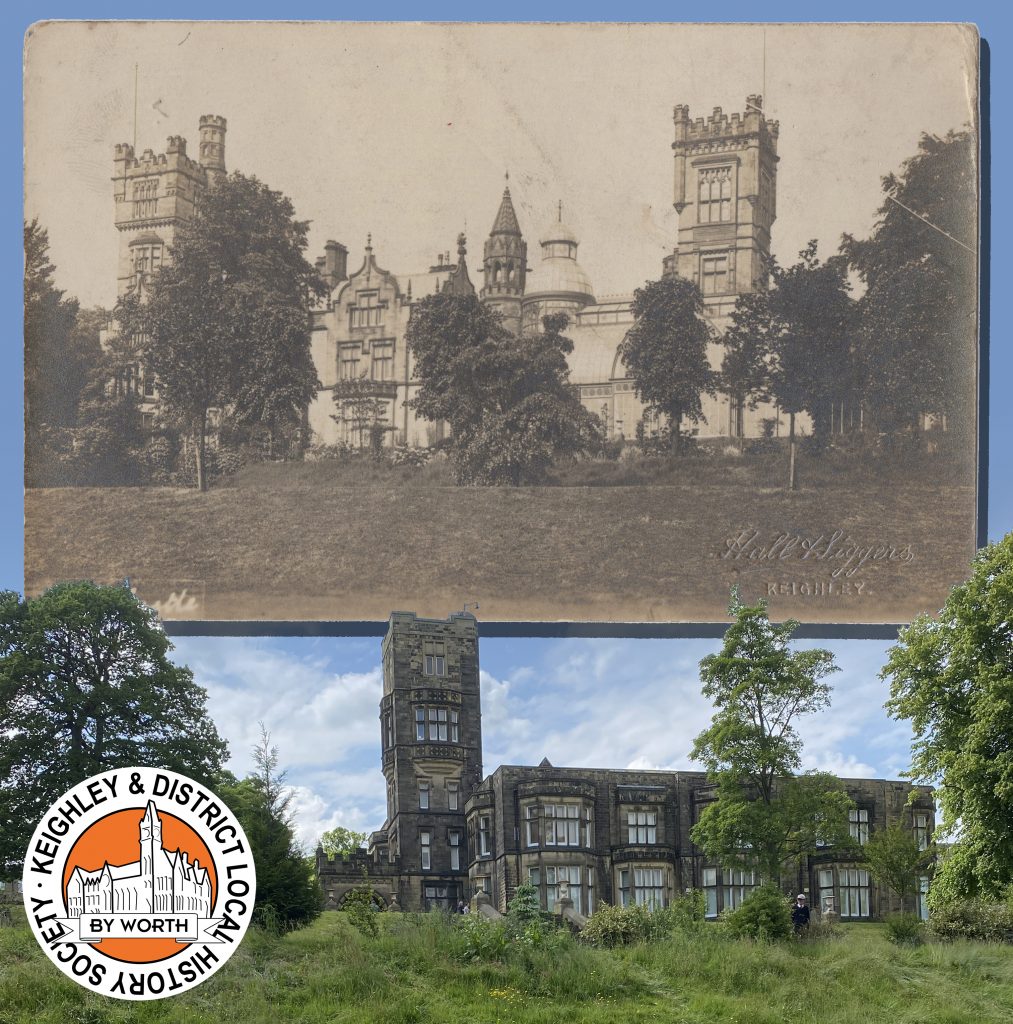
This postcard of Cliffe Castle was posted on the 29th of September 1912. The original photograph dates from around 1910 when the house was the private home of the Butterfield family.
Cliffe Castle is a Victorian mansion, built as Cliffe Hall at the height of Keighley’s industrial prowess by architect George Webster for local lawyer Christopher Netherwood. It was purchased by the Butterfield Brothers in 1848 to serve as the family home and was used as a summer home by Henry Isaac Butterfield (1819–1910) from 1878, who set about having it redesigned as a Gothic castle by architect George Smith. At this point it was renamed Cliffe Castle. It then passed to his son, Frederick Butterfield, until his death in 1948. It was purchased by Sir Bracewell Smith (Keighley-born hotel entrepreneur and Lord Mayor of London) on behalf of the people of Keighley in 1950 and opened as the town’s museum in 1959. Sadly for safety and maintenance reasons, several of the features added to the ‘castle’ had to be removed.
The postcard was published by Hall & Siggers of Keighley (embossed in the bottom right corner of the front). Hall & Siggers was a partnership between Harry Hall and Frank Siggers who had worked together in Chelmsford. Looking for fresh fields from which to operate, the pair moved with their families up to Keighley in 1909. Hall & Siggers bought up the studio of Keighley photographer Alexander Jennings at 105 Cavendish Street. In 1919 the ten-year agreement between the businessmen was coming to an end. Siggers went to Leicester, and Harry Hall and his son Gilbert became partners in the business. In 1926 Gilbert became sole proprietor of Hall & Siggers, although his father continued to lend a helping hand well into his 80s. The business flourished, including expanding to a second studio in Skipton from 1927 to 1934. Up to eight assistants were employed across both shops. In 1935 the business relocated to 4 Cavendish Street. As a firm they took individual and group portraits as well as building and landscape photography. Their work was included in various official Keighley Corporation publications. Gilbert continued the Hall & Siggers photography business up until July 1955 when he and his wife retired back to Essex.
Postcard from the personal collection of Tim Neal. Colour photograph taken by Tim in 2022.
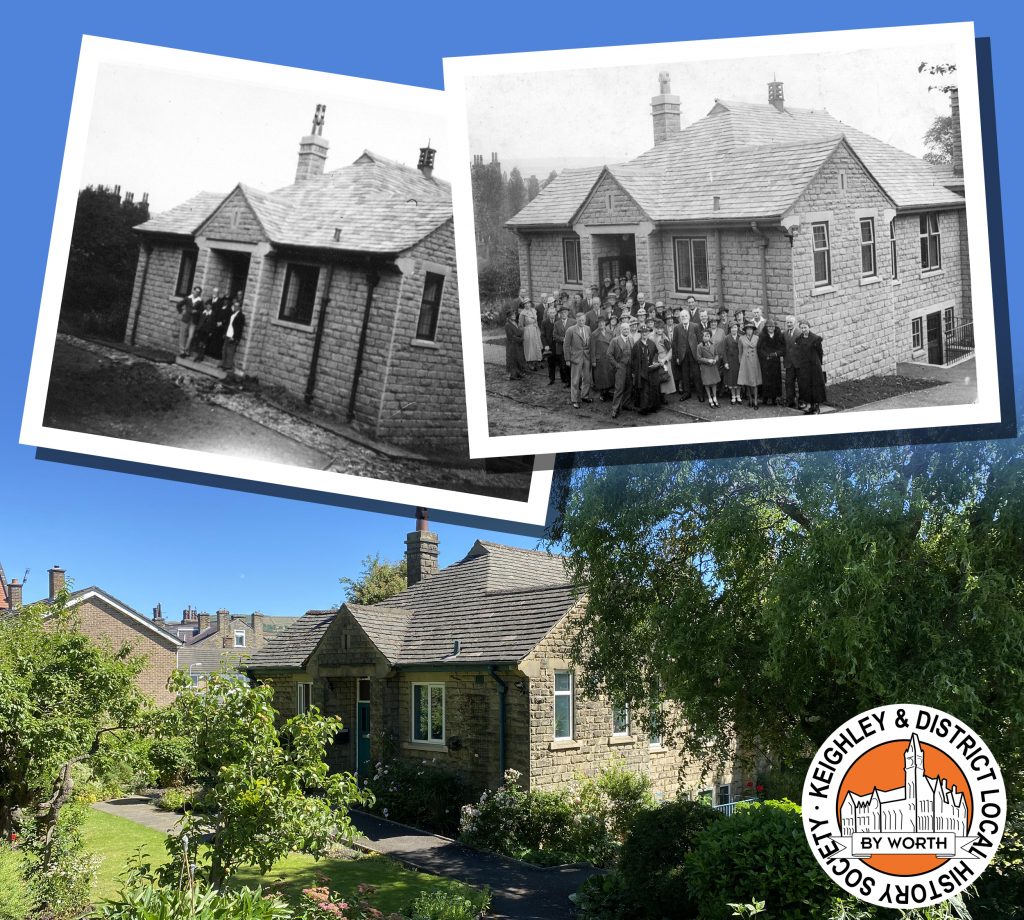
The first meeting for worship at the newly-built Quaker Meeting House at the junction of Strawberry Street and Skipton Road was held on Sunday 27th September 1936. It was attended by more than seventy people including several dignitaries. The black and white photographs were taken around this time. Worshippers include William Thomson and Nellie Sugden.
Quakerism arrived in Keighley in around 1653, preached by William Dewsbury and Thomas Stubbs. The Meetings had to be held in secret as the followers were regarded as radicals. The Toleration Act of 1689 allowed for freedom of worship. Leading members of early Meetings included William Clough, Joshua Dawson, Thomas Briggs, Robert Smith and Henry Ambler. A property on Mill Street in Westgate was bought in 1709 to serve as the Friends’ Meeting House. A property in the same area was used on and off up until the 1930s when much of Westgate was cleared due to the conditions of the buildings and homes.
A new property was purpose built in the grounds of a Victorian garden at the junction of Strawberry Street and Skipton Road. The new Meeting House was covered in the Keighley News of Saturday 15th August 1936, below a picture of the new building it stated: “After worshipping in the old meeting house in Mill Street, Keighley, since 1709, the Quaker congregation in Keighley are to have to have a new place of worship in Skipton Road. It is intended to open the building, now nearing completion, on 27th September.”
The black and white photographs were supplied by Simon Spedding along with some of the background information. The colour photograph was taken by Tim Neal in 2022.
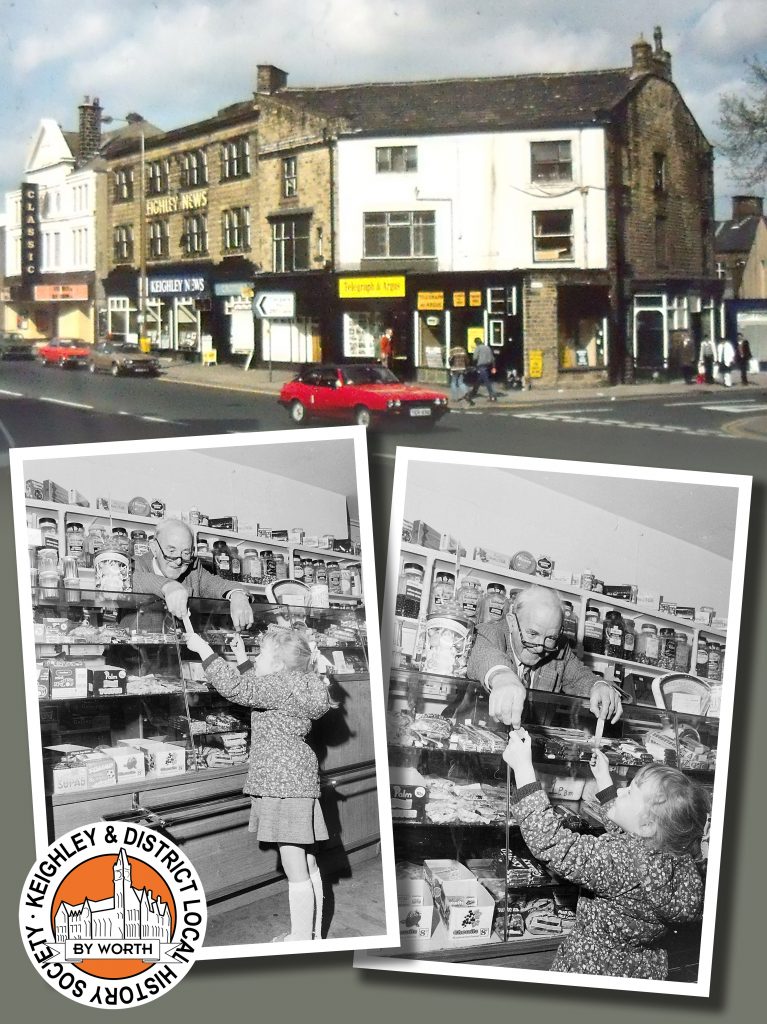
Press photographs of “grandad” John Harrison serving his last customer in his Crotona sweet shop on North Street (next door to the Keighley News offices), taken on 26th September 1981. Harrison was retiring and his final customer is Donna Leighton. The story was covered in the Keighley News of 2nd October 1981.
In 2021, Keighley and District Local History Society acquired an extensive collection of photograph negatives taken by the Keighley News. Groups of negatives were held in small wallets with the date and basic labelling written on the wallet. The main photograph was taken around 1980 and is from the personal collection of Allan Smith. Allan and his father Alex had the foresight to take photographs at various points through Keighley’s history.
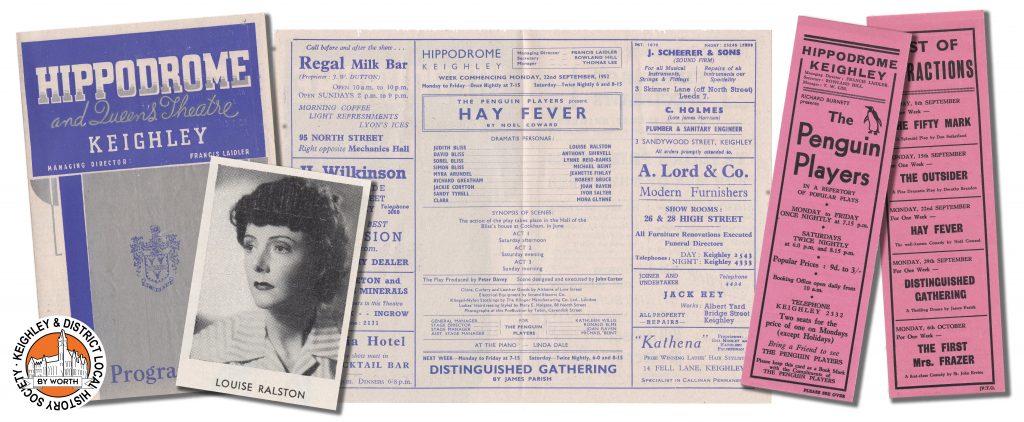
The Penguin Players’ production of ‘Hay Fever’, by Noel Coward, opened at the Hippodrome and Queen’s Theatre in Keighley for one week from Monday 22nd September 1952.
Players in the company included Michael Beint, Robert Bruce, Jeanette Finlay, Mona Glynne, Louise Ralston, Joan Raven, Lynne Reid-Banks, Ivor Salter, and Anthony Shirvell. The play was produced by Peter Davey and the manager of the players was Kathleen Willis. Linda Dale accompanied proceedings on the piano.
The programme also included adverts for the Regal Milk Bar (proprietor J. W. Dutton) on North Street; H. Wilkinson (television dealer) in The Arcade on North Street; Shackleton and Sagar’s Minerals from Spring Bank in Ingrow; the cocktail bar of the Victoria Hotel on Cavendish Street; J. Scheerer & Sons (sound firm) of Leeds; C. Holmes (plumber and sanitary engineer) of Sandywood Street; A. Lord & Co. (modern furnishers) with showrooms on High Street; Jack Hey (joiner and undertaker) of Albert Yard off Bridge Street; Katheena (prize-winning ladies’ hair stylist) on Fell Lane; John W. Laycock Ltd. (fireplace specialists) of North Street; Timothy Taylor’s Prize Ales (“for men of the North”); Rightway School of Motoring on Lawkholme Crescent; Harry Stowell (plumber and sanitary engineer) of Bradford Road, Riddlesden; Renee Coats, Gowns and Knitwear of Church Street; and Windser Pottery (H. Brearley and Sons) of North Street.
The 1950s was a turbulent decade in the history of the Hippodrome and Queen’s Theatre in Keighley. Long-time Managing Director Francis Laidler (who also owned the Alhambra Theatre in Bradford) died in 1955 and was succeeded by his widow Gwladys. Television was providing a significant challenge to theatre-going by the middle of the decade, and the Hippodrome had to try more extreme forms of entertainment to draw in the crowds. But to no avail, and the theatre finally closed its doors in 1956, before being demolished in 1961 to make way for the new town centre’s multi-storey car park.
The items were donated to Keighley and District Local History Society by Tim Neal in 2022.
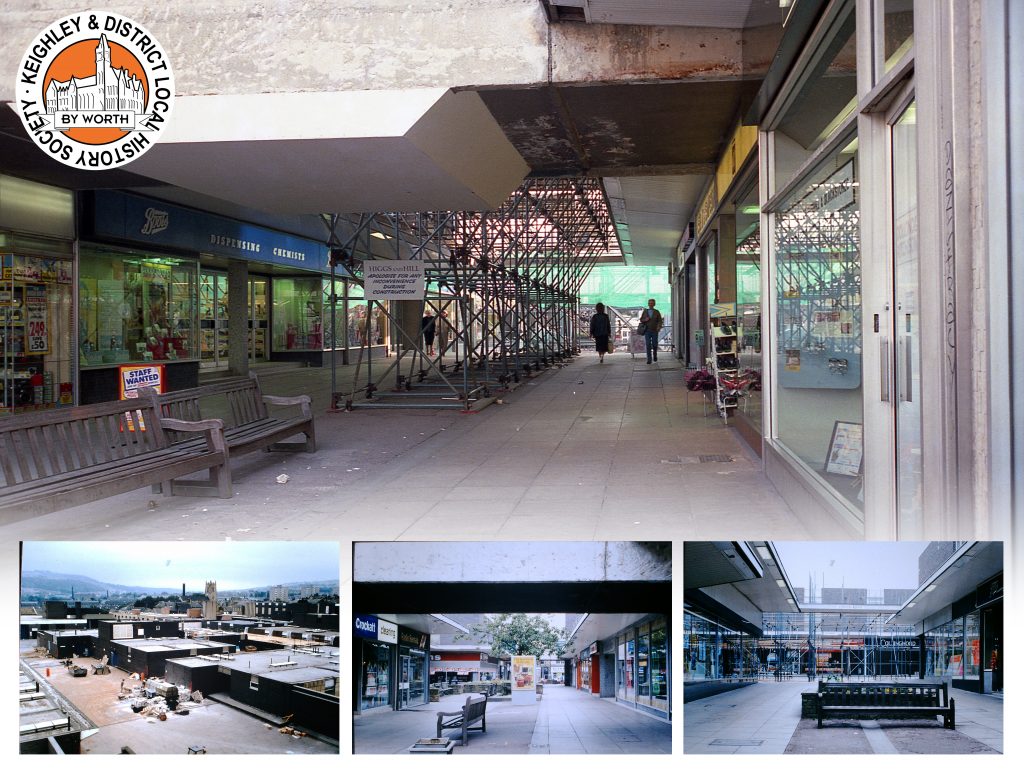
These photographs of the redevelopment of the Airedale Shopping Centre were all taken on 21st September 1986 by Roy Willoughby. Up until this point, the 1960s shopping precinct had been open to the elements, but at this time work was underway to build a roof over all the walkways.
Roy Dean Willoughby was born in Keighley on 1st February 1932, and lived most of his life in East Morton. He wanted to be a cabinet maker but his father was a fishmonger, with a shop in Bingley, and Roy followed in his footsteps. From the late 1960s, he owned and ran the fish and chip shop at 253 Bradford Road (now Stockbridge Fisheries) up until 1983. There are tales of him giving the leftovers at the end of the day to those who were struggling or homeless. After he retired and sold the business he went on to work with his son at Studio 127 on East Parade. They were signwriters and made posters, producing shop signs for businesses in Keighley. He was passionate about photography and he took thousands of photographs throughout his life. Some of his photographs are believed to have been used by Keighley News. Roy passed away on 7th May 2012. Many of Roy’s photographs can be seen on the History Society’s Flickr site courtesy of his grandson Billy Stride.
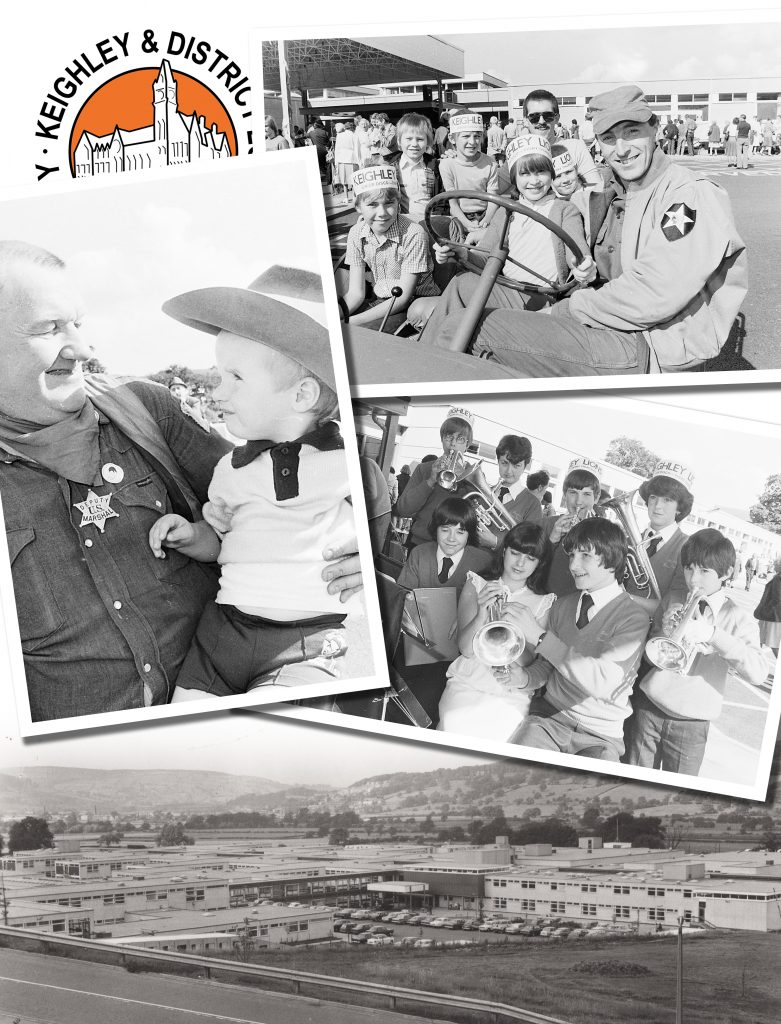
Three photographs taken by a Keighley News reporter at the Friends of Airedale Hospital September Fete held at the Hospital on Saturday 12th September 1981. The event was covered in the Keighley News of 18th September 1981.
Left: Regular fete attender Tex Slack lends his hat to two year old James Brown. Top right: Peter Whitaker of Glusburn, a member of the U.S. Army Vehicle Club, gives children a ride in one of his U.S. Army Jeeps. Bottom right: Junior members of Keighley Band offer tuition to ‘Miss Airedale’ Diane Khan. Some of the children sitting in the photographs are wearing hats advertising ‘Keighley Lions’ Junior Disco – Every Thursday’.
In 2021, Keighley and District Local History Society acquired an extensive collection of photograph negatives taken by the Keighley News. Groups of negatives were held in small wallets with the date and basic labelling written on the wallet. These images are from that collection.
This postcard was posted to Workington in Cumbria on 16th September 1941 (although to be fair the postmark is a little hard to read – it could be 18th September and it might 1940-something else).
But it’s still interesting on several levels – the postcard was produced by Lilywhite Ltd., based in Brighouse, who produced dozens of postcards of Keighley between the 1920s and 1960s. They occasionally get a few details wrong – and in this case it’s the street name (the photographer is standing pretty much where North Street and Skipton Road meet, but the view is definitely along North Street).
The sender of the postcard writes: “Having a nice time and lovely weather. Keighley is still the same – no change from last time at all.” And that’s pretty much true of this view 80 years on. St. Anne’s Primary School still dominates the right hand side of the road, and the dome of the Temperance Hall (now Wetherspoon’s) can still be seen in the distance. The clocktower of the Mechanics’ Institute on the left is long gone, but you can’t tell because of the ‘Get in lane’ road sign. The main additions are the various bits of signage, the road markings and the volume of traffic.
Postcard from the personal collection of Tim Neal, modern photograph taken by Tim in 2022.
A reminder that Cliffe Castle community curator Heather Millard will be giving her talk on ‘The Butterfield Women’ this Wednesday (14th September).
We hear a lot about the Butterfield men who lived in Cliffe Castle but this time Heather is telling us about the interesting lives of the women of the Butterfield Family and their influence on more than just the family.
This talk is planned for upstairs at the Library and is open to everyone. £3 on the door for non-members. Paid-up History Society members will have received their emails on how to join the Zoom meeting if they would prefer. Doors open at 7pm for a 7.30pm start.
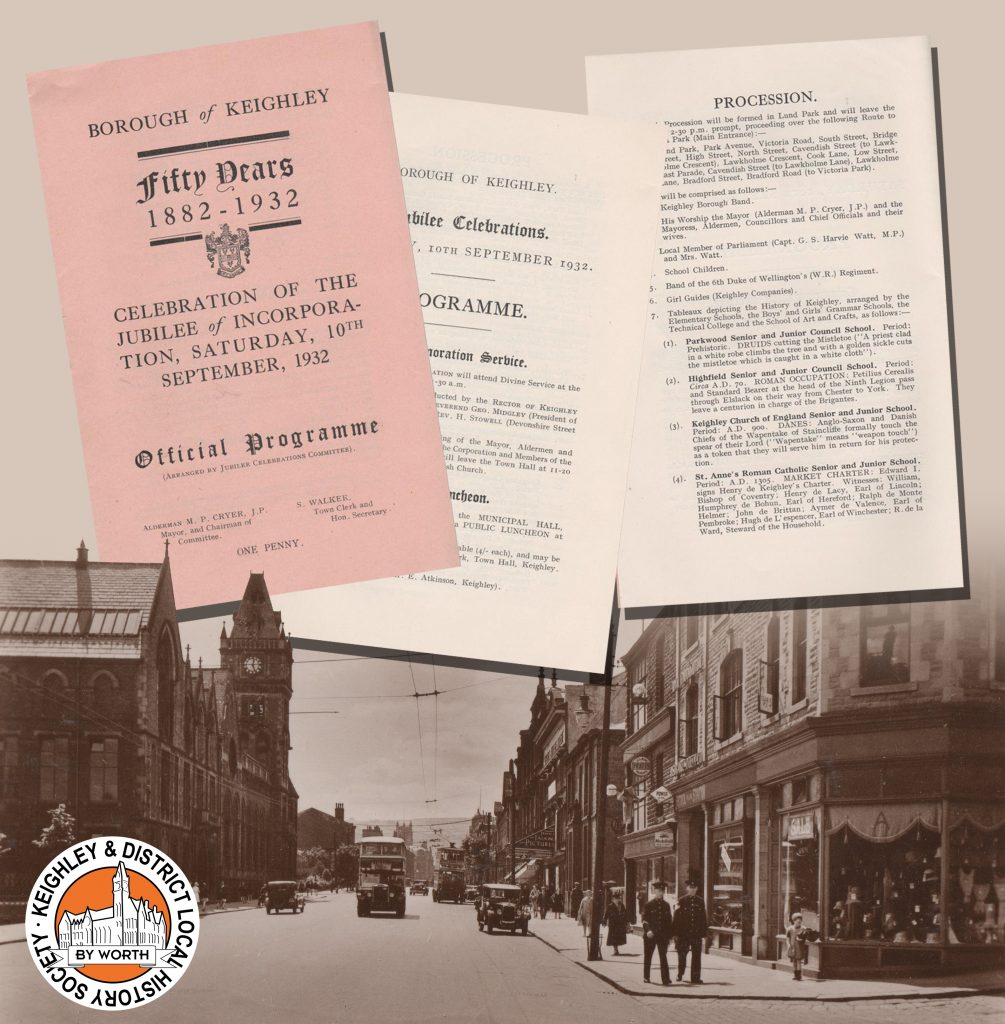
On Saturday 10th September 1932, the town celebrated fifty years since the Borough of Keighley was formed. The actual incorporation had taken place in July 1884. This meant a local town council and mayor taking on responsibility for running various services within the area.
The jubilee celebrations on that Saturday started with a civic procession led by the Mayor (Alderman Michael P. Cryer) from the Town Hall to Keighley Parish Church for a commemoration service. The service was led jointly by the Rector of Keighley (Reverend J. C. F. Hood), the President of the Free Church Council (Reverend George Midgley) and the vicar of Devonshire Street Congregational Church (Reverend H. Stowell). There followed a public luncheon in the Municipal Hall (Mechanics’ Institute), catered by Mr E. Atkinson. Tickets were four shillings each.
The main event was a procession that set off from Lund Park at 2.30pm and headed down to Victoria Park (in a rather loopy fashion!). The procession was made up of the Mayor, Mayoress, and members of the town council, the local MP (George S. Harvie Watt) and his wife, Keighley Borough Band and the Band of the Sixth Duke of Wellington’s West Riding Regiment, children from many of the local schools who formed historic tableaux on the back of lorries and carts, and students from the Technical College who also created tableaux.
A tea party in Victoria Park (catered by Keighley Industrial Co-operative Society Ltd.) was held for school children, at which they were presented with commemorative mugs. Various entertainments were provided for all from a stage erected in the park, there was an exhibition netball match between a team from Keighley Girls’ Grammar School and a team from various Keighley elementary schools, tree planting led by the Mayor, and a massed male voice choirs concert. To end the evening at 9pm there was a grand display of fireworks staged by Messrs Henry Shaw & Sons of Huddersfield.
A 12-page Official Programme for the day was available, printed by Wadsworth & Co. Ltd. of Russell Street. The full programme can be found on the History Society’s Flickr site. The main photograph is a detail from a Valentine’s postcard showing North Street in 1930.