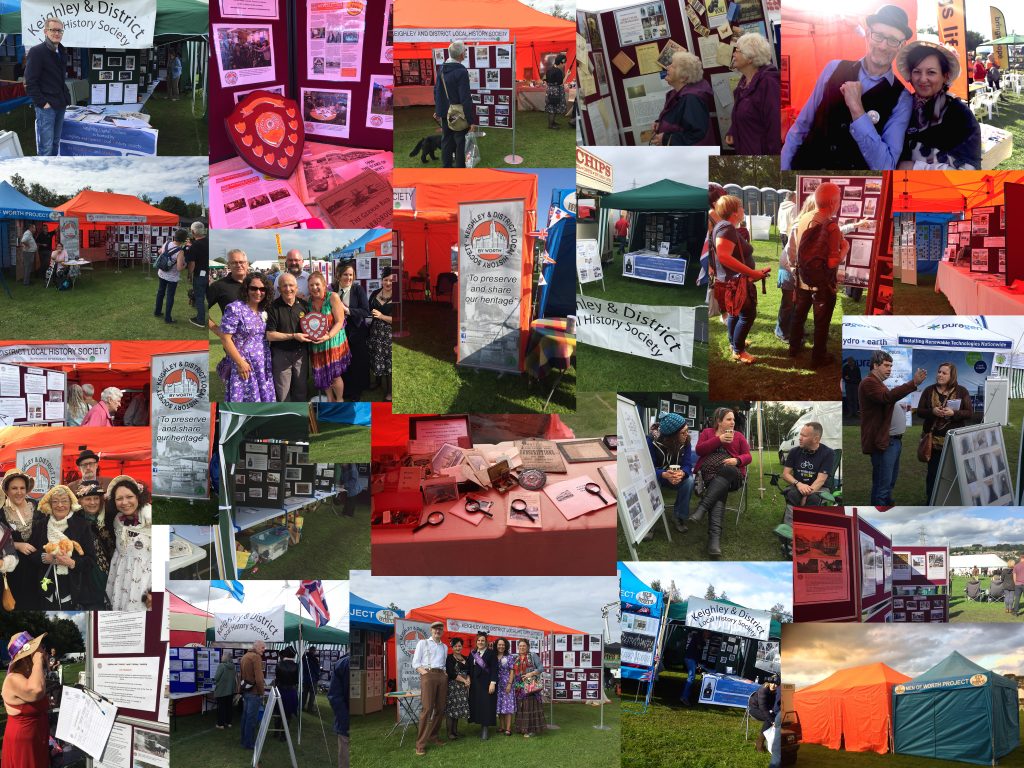
Keighley Show is back on this year after a three-year gap due to the coronavirus. Please support the event and come and see the History Society tent (it’s the big orange one!). It’s happening on Saturday 3rd September and tickets this year are just £5 (thanks to the support of Keighley Town Council) – with accompanied children getting in free! See the Show’s website for more details of what to expect.
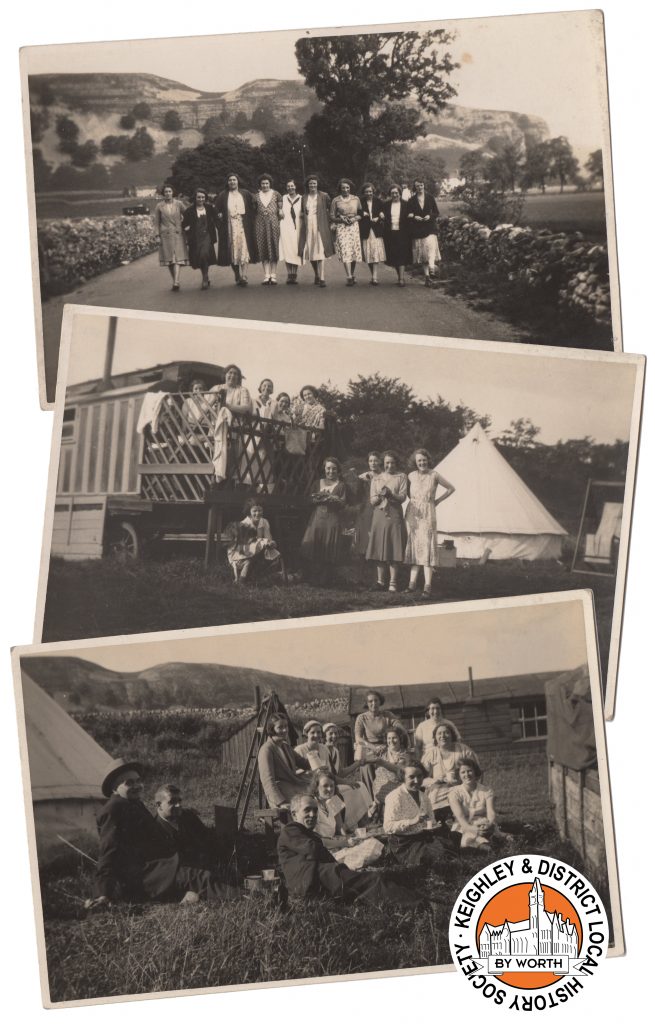
These three photographs show members of Wesley Place Girls League camping at Kilnsey in August 1932. The photographs were donated by Clarence Rushworth and are held in the physical archive of the History Society.
It’s possible to track the lineage of one electrical firm in Keighley from the 1920s through to the 1970s. The sepia inset shows engineer Hartley Wilkinson and is taken from a mid-1920s newspaper clipping with photograph taken by George Crowther.
The caption reads: “Good use of propaganda opportunities was made at the Keighley Hospital Gala by Mr H. Wilkinson, who has just taken over a wireless business in the Arcade, North Street, Keighley, Yorks. Mr Wilkinson entered in the class for decorated vehicles a sidecar used for the collection of accumulators in connection with his battery charging scheme, and on the top of the sidecar was an assortment of fittings and accessories, including a four valve set and a loud speaker. The set was connected with an aerial over the top, and, with a scheme of decoration carried out in blue and white. The cycle provided an interesting feature in the procession which passed through the crowded streets.”
Local historian Eddie Kelly (writing in July 2022) picks up the story: “The earliest reference I have of Hartley Wilkinson is a Keighley News advert dated 4th October 1924 when he was operating as a wireless engineer based at his parents home at 30 Malsis Road. By October 1927 he is listed in Kelly’s Directory at 37 North street, one of the smaller units inside the North Street arcade. He remained there until about 1948 when he moved to the larger double unit at 29 and 31 North Street, the corner unit adjacent to the former York Country Savings Bank facing into North Street.”
Wilkinson advertised his business in Keighley Hippodrome Theatre programmes in the early 1950s. In 1951 it was “for all your radio and electrical requirements” but in 1952 it became “where the best television comes from” (as shown here) as Wilkinson became an early adopter of this newly emerging broadcasting phenomena.
Eddie Kelly again: “On 17th April 1958 the business was acquired by Leonard Dyer & Co. who were Shipley based I think. Dyers continued to trade under Wilkinson’s name until June 1961 when they commenced using their own name. They moved to the new shopping precinct in August 1969 occupying (as original tenants) adjoining units at the corner of Bow Street and Queensway. The trading name was soon changed to Loyds Electrical during October 1970 and later Vallances in July 1976.”
There is a receipt from Leonard Dyers for a Bush Radio that was issued in July 1965 that shows that the proprietor is still H. Wilkinson and the address is still The Arcade on North Street. Plans for the occupancy of the units in the newly built town centre shopping arcade show Dyer’s occupying L-shaped unit 41, next door to Tesco on Bow Street and Direct Raincoat C. Ltd. on Queensway.
The main photograph shows Bow Street in 1970, with work being carried out to improve the bus station. You can see the Leonard Dyer store next door to Tesco. The photograph was supplied by Allan Smith. All items from the History Society’s digital archive on Flickr.
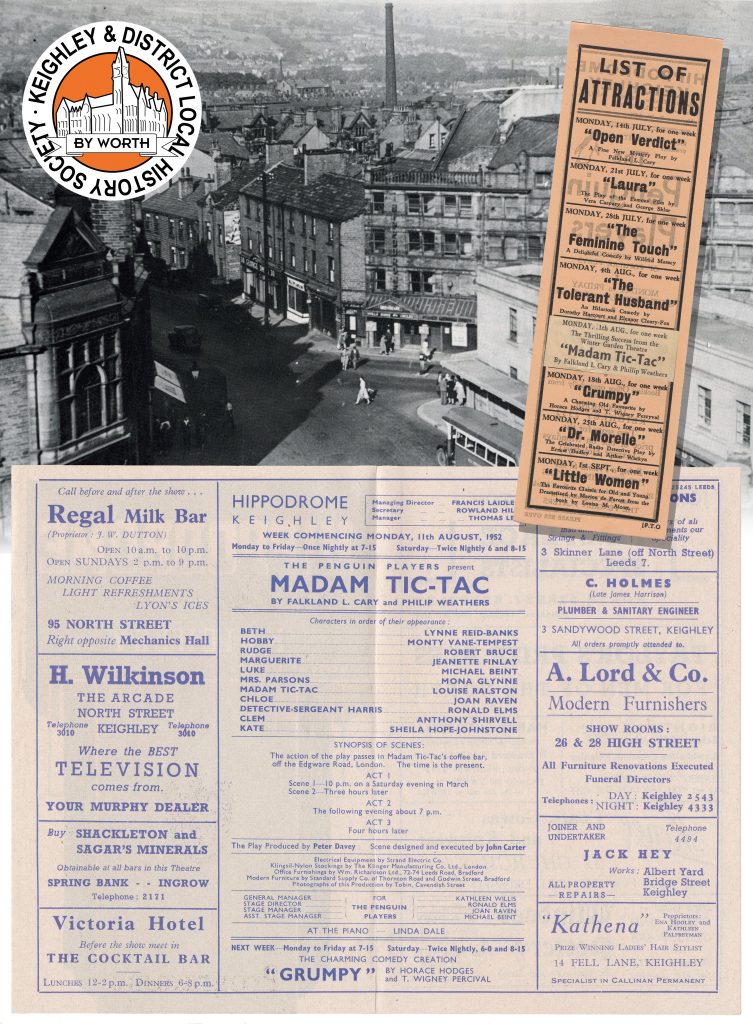
Repertory company The Penguin Players’ production of ‘Madam Tic-Tac’, by Falkland L. Cary and Philip Weathers, opened at the Hippodrome and Queen’s Theatre in Keighley on Monday 11th August 1952.
The play is set in the modern day in Madam Tic-Tac’s coffee bar off the Edgeware Road in London. Madam Tic-Tac (played by Louise Ralston) is blind and deaf, and operates a den of thieves from her premises. The play was not the original choice for the company in this slot (publicity material has ‘Madam Tic-Tac’ pasted over the original choice). Perhaps its status as a “thrilling success from the Winter Garden Theatre” (in London, where it played in 1950) made it seem a more bankable choice.
Players in the company included Michael Beint, Robert Bruce, Ronald Elms, Jeanette Finlay, Mona Glynne, Sheila Hope-Johnstone, Louise Ralston, Joan Raven, Lynne Reid-Banks, Anthony Shirvell, and Monty Vane-Tempest. The play was produced by Peter Davey and the manager of the players was Kathleen Willis. Linda Dale accompanied proceedings on the piano.
The programme also included adverts for the Regal Milk Bar (proprietor J. W. Dutton) on North Street; H. Wilkinson (television dealer) in The Arcade on North Street; Shackleton and Sagar’s Minerals from Spring Bank in Ingrow; the cocktail bar of the Victoria Hotel on Cavendish Street; J. Scheerer & Sons (sound firm) of Leeds; C. Holmes (plumber and sanitary engineer) of Sandywood Street; A. Lord & Co. (modern furnishers) with showrooms on High Street; Jack Hey (joiner and undertaker) of Albert Yard off Bridge Street; Katheena (prize-winning ladies’ hair stylist) on Fell Lane; John W. Laycock Ltd. (fireplace specialists) of North Street; Timothy Taylor’s Prize Ales (“for men of the North”); Rightway School of Motoring on Lawkholme Crescent; Harry Stowell (plumber and sanitary engineer) of Bradford Road, Riddlesden; Renee Coats, Gowns and Knitwear of Church Street; and Windser Pottery (H. Brearley and Sons) of North Street.
The 1950s was a turbulent decade in the history of the Hippodrome and Queen’s Theatre in Keighley. Long-time Managing Director Francis Laidler (who also owned the Alhambra Theatre in Bradford) died in 1955 and was succeeded by his widow Gwladys. Television was providing a significant challenge to theatre-going by the middle of the decade, and the Hippodrome had to try more extreme forms of entertainment to draw in the crowds. But to no avail, and the theatre finally closed its doors in 1956, before being demolished in 1961 to make way for the new town centre’s multi-storey car park.
The items were donated to Keighley and District Local History Society by Tim Neal in 2022. They are held in the History Society’s physical archive. The Local Studies Library in Keighley also has a rich archive of material relating to the Hippodrome.
St. John’s Hospital on Fell Lane closed on 9th August 1970, its remaining patients transferring to the newly opened Airedale General Hospital. These photographs were taken by Jack Cawood around that time.
The hospital on Fell Lane that became St. John’s Hospital was founded as the Keighley Union Workhouse Infirmary in 1868. It was built originally to serve the Keighley Poor Law Union. It became known as Fell Lane Infirmary and served as an Auxiliary War Hospital during the First World War, housing 185 servicemen’s beds and treating 1,052 military cases. It moved on to specialise in maternity and geriatric cases.
According to Ian Dewhirst, writing in the Keighley News of 31st May 2002: “Early twentieth-century additions included convalescent, infirm and female imbecile blocks, phthisis pavilions to accommodate consumptives, and steam cooking apparatus. Nevertheless, a report of 1930, after its acquisition by the County, thought its atmosphere was “rather that of a Poor Law Institution than that of a modern hospital,” its Nurses’ Home of 1927 being considered its most satisfactory feature.”
The hospital was the subject of an exchange in Parliament on 1st April 1963. Sir Marcus Worsley, MP for Keighley from 1959 to 1964, asked Lord Bernard Braine, Parliamentary Secretary to the Department of Health, if he knew how long the huts, then being used as geriatric wards at the hospital, were expected to last given they had been built as temporary provision during the Second World War. He was told they would have to suffice until the building of the new district general hospital (which arrived seven years later).
St. John’s Hospital closed down in August 1970, and it was demolished three years later and the area is now occupied by housing.
Jackie Earle (August 2022): “The photos were taken by my dad, Jack Cawood. He worked at the Victoria Hospital, and then he moved to Airedale when that opened. He loved taking photos. My parents both worked at Victoria Hospital. My dad was a van driver delivering to all the different hospitals (Victoria, St. John’s, Menston, Morton Banks etc.).”
The original photographs were donated to Keighley and District Local History Society in 2022 by Jackie Earle.
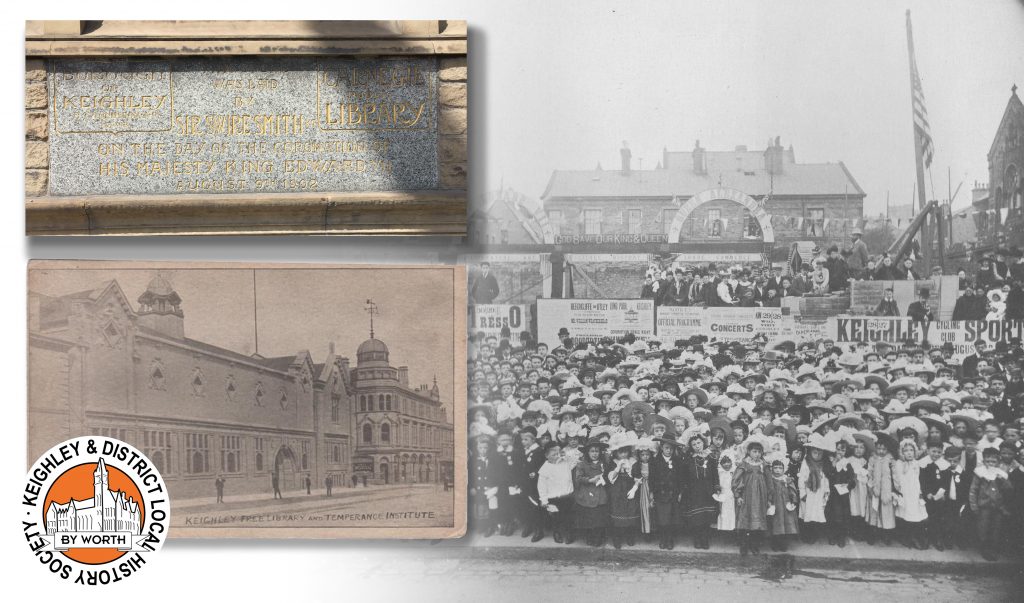
The foundation stone for Keighley’s new free public library on North Street was laid on 9th August 1902 “in a workmanlike manner” (according to the press) by mill owner Sir Swire Smith. It was Smith’s friendship with American industrialist Andrew Carnegie that had secured funds for the new premises to be built. Carnegie was unable to attend the ceremony but the American flag was flown in his honour.
The event was deliberately scheduled to coincide with the town’s celebrations of the coronation of King Edward VII, hence the large crowds.
The Library took two years to build and opened in 1904. It cost twice as much to build as Carnegie was originally planning on. 10,000 books were donated from across the road at the Mechanics Institute. It included a newspaper reading room upstairs (now the Local Studies Library) that seated 150. Within one year it had 3,000 borrowers including 10 policemen, 2 window cleaners and 520 “married women, spinsters and juveniles”.
The stone can be seen today to the right of the library’s entrance. Main photograph taken by Keighley photographer Alex Jennings and published in Ian Dewhirst’s book ‘More Old Keighley in Photographs’ (Hendon Publishing, 1973). Photograph of foundation stone taken by Tim Neal in 2019. Postcard from the History Society’s archive on Flickr.
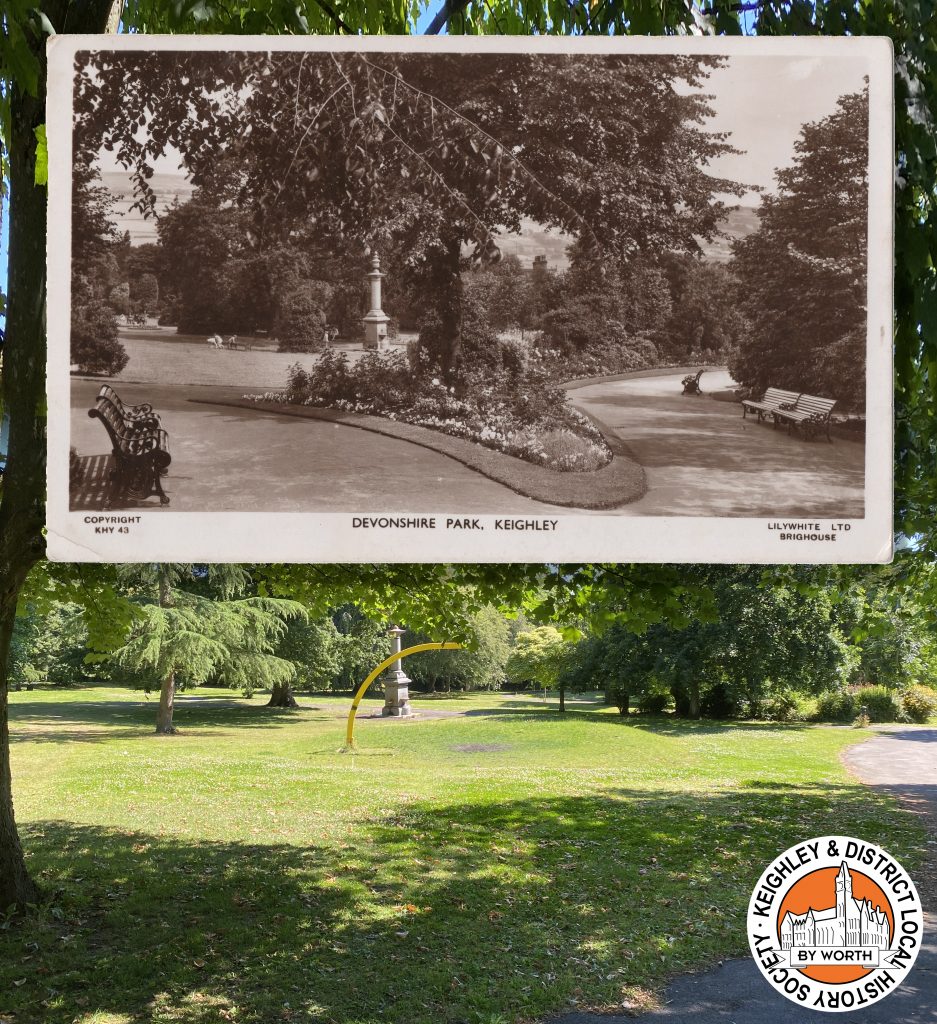
This Lilywhite Ltd. postcard of Devonshire Park in Keighley was posted on 8th August 1952.
The card is one of those featured in Tim Neal’s History Society talk ‘Lilywhite Postcards – Then and Now’, where modern photographs have been taken of the same view captured in postcards from the 1920s to the 1960s. The talk will be held upstairs in the Library on 10th August 2022, admission is £3 (free to paid up members) and doors open at 7 pm.
This Schofield & Co. Publishers postcard of The Cross area of Keighley was posted to Mansfield on 3rd August 1912. The Cross is the area of Keighley where High Street, Low Street, North Street and Church Street meet, and was the area where the original market cross was erected (would have been slightly to the right of this picture). What is fantastic is that the quality of the photograph means we can zoom in an see a lot of detail about the shops and businesses at the time.
Local historian Eddie Kelly has stepped in with a wealth of additional information (July 2022): “I would date the image as between 1905 to 1908. Bottomley’s Sugar Confectioners (on the right) are at 3 Church Street and adjacent at No. 1 is the Public Benefit Boot Co. This was not a Co-operative type enterprise but a normal trading company headquartered at Hull with numerous branches all over the North & Midlands.
“Both businesses were forced to move in 1911 as a result of the buildings new owners the London City & Midland Bank deciding to install their new banking hall on the ground floor. Bottomley’s moved to 3 North Street and the Public Benefit Boot Co. moved to 41 Low Street. The Boot Co. would later emerge as Lennards Footwear Co, an original tenant in the 1960s shopping centre.
“The upper floors of the building were occupied as offices & clubs, visible are the windows of accountant Francis Stirk Pearson on the first floor and the floor above was occupied by the Keighley Building Trades Club & Stone Exchange, a social club for the building trade employers and masters, and a trading exchange for stone used in their profession.
“Around the corner adjacent to the Boot Co. store is the Keighley branch of tea dealer Abraham Altham who also had to move in 1911. They moved to 22 Low Street and are still there albeit as travel agents nowadays.
“The three shops below Althams were occupied by Thomas Bannister tailor and outfitter, Whitham & Co. tobacconist and on the corner of the Market Place, Newboulds Ltd. (men’s outfitters and clothiers).
“On the corner of North Street and Low Street (or Changegate) are the premises of upmarket drapers and ladies’ outfitters Keighley & Wilkins who traded here from the building being new in 1894 continuing for sixty years until closure in 1954.
“Opposite on the corner of High Street and North Street is the wholesale and retail tobacconist business of Joseph & Thomas Whitworth. This was continued after 1911 by Slater & Co. tobacconist who remained until about 1928.
“The adjacent vacant store with the To Let poster in the window (near left) would later be occupied during 1910 by John Mills Watchmaker & Jeweller. The Mills store remained here until July 1982 when then owner Jack Greenwood retired. The shop far left with the blind down & only partially visible was about this time a branch of James Nelson & Sons Ltd, Glasgow based importers and purveyors of cheap American frozen meat.”
The Midland Bank building (as it became commonly known) was demolished in the 1980s. Postcard from the personal collection of Tim Neal. Modern photograph taken by Tim in 2021.